In brief
At a glance
Quick Facts
- Definition
- A hypothesized large-scale shift of the Amazon rainforest to a drier, savanna-like state due to deforestation, climate change, and fire.
- Key feedback
- Forest loss reduces evapotranspiration, leading to less rainfall, which causes more tree death and fire, further reducing forest cover.
- Carbon storage
- The Amazon stores an estimated 150–200 billion tons of carbon in vegetation and soils.
- Tipping point
- The exact threshold of forest loss or warming that would trigger dieback is unknown, but some models suggest 20–40% deforestation could be critical.
- Current status
- Parts of the southeastern Amazon are already emitting more carbon than they absorb, and the dry season has lengthened.
- Primary drivers
- Deforestation for agriculture, global climate change, and human-ignited fires.
- Biodiversity
- The Amazon is home to about 10% of all known species on Earth.
- Uncertainty
- Climate models disagree on future rainfall trends, and the CO2 fertilization effect could partially offset drought stress.
Key Takeaways
- Amazon dieback is a hypothesized large-scale shift from rainforest to savanna or degraded forest, driven by deforestation, climate change, and fire, which could become self-reinforcing through reduced rainfall.
- The Amazon rainforest generates much of its own rainfall through evapotranspiration; losing forest cover disrupts this cycle, potentially causing a tipping point beyond which the ecosystem cannot recover.
- Current evidence shows the Amazon is losing resilience, with some regions already emitting more carbon than they absorb, but the exact threshold and timing of a dieback remain highly uncertain.
- Dieback would have severe consequences for global climate, biodiversity, and millions of people, making it a critical area of research and policy action.
What Is Amazon Rainforest Dieback: Evidence, Risks and Uncertainty?
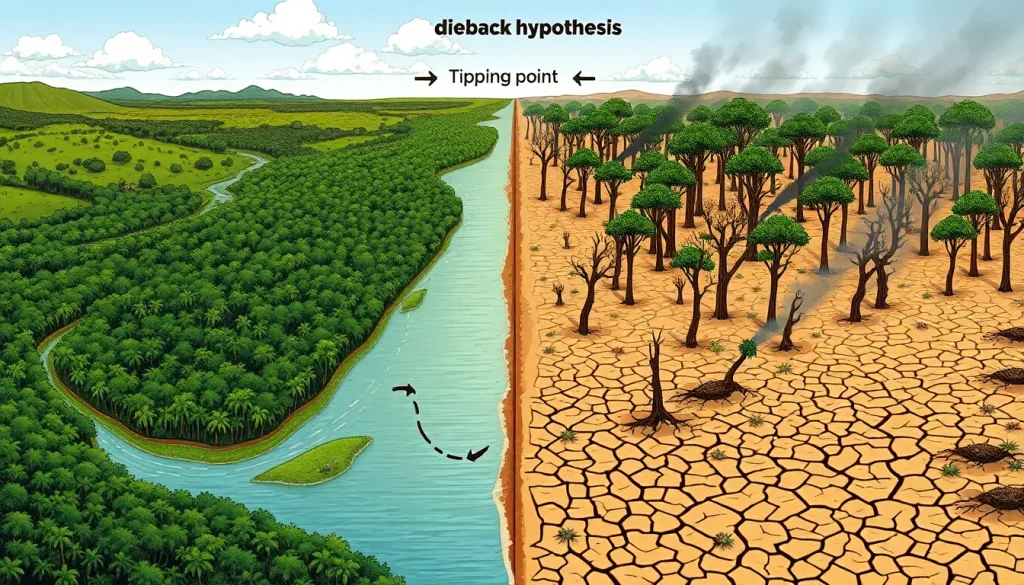
Amazon rainforest dieback is the scientific hypothesis that a large portion of the Amazon basin could transition from a lush, closed-canopy tropical forest to a drier, open savanna-like ecosystem or degraded forest state. This shift would not be a gradual change but rather a self-reinforcing collapse triggered by the interaction of deforestation, climate change, and fire. The term “dieback” emphasizes the widespread tree mortality and the potential for the ecosystem to cross a tipping point, beyond which it cannot return to its original state even if the initial pressures are removed.
The concept is rooted in the understanding that the Amazon rainforest plays a crucial role in generating its own rainfall. Trees release vast amounts of water vapor into the atmosphere through evapotranspiration, which then condenses and falls as rain downwind. If enough forest is lost, this moisture recycling weakens, leading to reduced rainfall, longer dry seasons, and increased vulnerability to fire. This creates a feedback loop: less forest leads to less rain, which leads to more tree death and fire, further reducing forest cover. The dieback hypothesis examines the evidence for this feedback, the risks it poses to the regional and global climate, and the deep uncertainties about when or if such a tipping point might be crossed.
How It Works
The dieback process is driven by a series of interconnected feedback loops involving the atmosphere, vegetation, and fire. The Amazon rainforest acts as a massive water pump: trees draw moisture from the soil and release it into the air through transpiration. This moisture contributes to cloud formation and precipitation, which in turn sustains the forest. When large areas of forest are cleared, this moisture recycling is disrupted, leading to reduced rainfall and a longer dry season. The remaining forest becomes drier and more susceptible to fire, which can spread from adjacent agricultural lands. Fires kill trees, further reducing evapotranspiration and rainfall, creating a vicious cycle.
Climate change amplifies these effects. Rising global temperatures increase the frequency and intensity of droughts, such as those associated with El Niño events or warming of the tropical North Atlantic. Drought-stressed trees are more likely to die from water deficit and are more flammable. Additionally, deforestation can alter regional atmospheric circulation, potentially reducing the transport of moisture from the Atlantic Ocean into the basin. If forest loss and climate change push the system past a critical threshold, the remaining forest may no longer be able to sustain the rainfall needed for its own survival, leading to a rapid, self-reinforcing transition to a savanna-like state.
Main Causes or Drivers
The primary drivers of Amazon dieback are deforestation, climate change, and fire, which often interact and reinforce one another. Deforestation, primarily for cattle ranching, soy cultivation, and other agricultural activities, directly removes forest cover and fragments the landscape. This fragmentation reduces the forest’s ability to recycle moisture and increases the exposure of forest edges to drying winds and fire. Climate change, driven by global greenhouse gas emissions, leads to rising temperatures and altered precipitation patterns, increasing the frequency and severity of droughts in the Amazon. These droughts weaken trees and make the forest more flammable.
Fire is both a driver and a consequence of dieback. In the Amazon, fires are almost always human-ignited, used for land clearing and pasture management. Under normal conditions, the humid forest understory resists fire spread, but during drought years and in degraded forests, fires can escape into standing forest, causing significant tree mortality. This creates a feedback loop where fire degrades the forest, making it drier and more flammable, leading to more fires. Additional pressures include logging, which removes large trees and opens the canopy, and the expansion of infrastructure, which increases access and fragmentation.
What the Evidence Shows
Observational evidence indicates that the Amazon is experiencing changes consistent with early stages of dieback. Satellite data show that the dry season has lengthened by several weeks in parts of the southern and eastern Amazon over recent decades. Studies using satellite-derived vegetation indices have found that the forest’s ability to recover from disturbances like drought has declined, a phenomenon known as “critical slowing down,” which is a hallmark of systems approaching a tipping point. Research also shows that deforested and degraded areas have higher temperatures and lower humidity than intact forest, altering local and regional climate.
Carbon flux measurements reveal that some parts of the Amazon have shifted from being a net carbon sink to a net carbon source, particularly in the southeastern region, due to deforestation and drought-induced tree mortality. Modeling studies consistently project that under high deforestation and high greenhouse gas emission scenarios, a large-scale dieback could occur by the end of the 21st century, with the forest transitioning to savanna or seasonal forest. However, the exact threshold of forest loss or warming that would trigger such a shift remains uncertain, and different models produce varying results regarding the timing and extent of dieback.
Environmental and Human Impacts
An Amazon dieback would have profound environmental consequences. The loss of forest would release billions of tons of carbon dioxide into the atmosphere, accelerating global climate change. The Amazon stores an estimated 150–200 billion tons of carbon in its vegetation and soils, equivalent to many years of global fossil fuel emissions. Dieback would also drastically reduce biodiversity, as the rainforest is home to roughly 10% of all known species on Earth. Regional rainfall patterns would be disrupted, potentially affecting agriculture and water supplies across South America, including in the productive La Plata basin.
For humans, the impacts would be severe. Indigenous peoples and traditional communities who depend on the forest for their livelihoods, culture, and sustenance would face displacement and loss of resources. The agricultural sector, which relies on predictable rainfall, could suffer from reduced precipitation and increased temperatures, threatening food security. Hydroelectric power generation, a major energy source in Brazil and other Amazonian countries, would be compromised by reduced river flows. The loss of the forest’s cooling effect could also exacerbate regional and global warming, with cascading effects on human health and economies.
Data Limitations and Uncertainties
Despite the strong theoretical basis for dieback, significant uncertainties remain. Climate models differ in their projections of future rainfall over the Amazon, with some even suggesting increased precipitation under certain scenarios. The response of the forest to elevated CO2 levels is also uncertain: while CO2 fertilization could enhance tree growth and water-use efficiency, potentially offsetting some drought stress, the magnitude and duration of this effect are debated. The exact location and nature of the tipping point are unknown, making it difficult to predict when or if dieback will occur.
Observational data also have limitations. Ground-based measurements of forest health and carbon fluxes are sparse relative to the vast size of the Amazon, and satellite data can be difficult to interpret due to cloud cover and the complexity of tropical ecosystems. The interactions between deforestation, fire, and climate are highly nonlinear and can produce surprises. Furthermore, the Amazon is not a single homogeneous system; different regions have distinct rainfall regimes, soil types, and species compositions, meaning that dieback risks vary across the basin. These uncertainties make it challenging to provide precise, actionable predictions for policymakers.
Solutions
Addressing the risk of Amazon dieback requires a combination of local, regional, and global actions. The most immediate and effective measure is to halt deforestation and forest degradation. This involves strengthening law enforcement, expanding protected areas and indigenous territories, and promoting sustainable land-use practices such as agroforestry and zero-deforestation agriculture. Reforestation and restoration of degraded lands can help rebuild forest cover and enhance regional moisture recycling.
At the global level, reducing greenhouse gas emissions is essential to limit climate change and the associated increase in drought frequency and intensity. International cooperation and financial mechanisms, such as REDD+ (Reducing Emissions from Deforestation and Forest Degradation), can support forest conservation efforts. Improved fire management, including early warning systems and controlled burns, can reduce the risk of catastrophic wildfires. Finally, continued scientific monitoring and research are needed to better understand the complex dynamics of the Amazon and to provide early warning of an approaching tipping point, enabling proactive rather than reactive responses.
FAQ
What is Amazon rainforest dieback?
Amazon rainforest dieback is the hypothesis that a large part of the Amazon could transition from rainforest to savanna or degraded forest due to deforestation, climate change, and fire, potentially crossing a tipping point where the change becomes self-reinforcing and irreversible.
How does the Amazon create its own rain?
Trees in the Amazon release water vapor through evapotranspiration. This moisture rises, condenses into clouds, and falls as rain downwind. The forest recycles moisture multiple times as air moves across the basin, so losing forest disrupts this cycle and reduces rainfall.
Why does Amazon dieback matter?
Dieback would release massive amounts of carbon dioxide, accelerating climate change, cause the loss of immense biodiversity, disrupt rainfall patterns across South America, and threaten the livelihoods of millions of people, including indigenous communities.
References
- Nobre, C. A., et al. (2016). Land-use and climate change risks in the Amazon and the need of a novel sustainable development paradigm. Proceedings of the National Academy of Sciences.
- Lovejoy, T. E., & Nobre, C. (2018). Amazon Tipping Point. Science Advances.
- Boulton, C. A., et al. (2022). Pronounced loss of Amazon rainforest resilience since the early 2000s. Nature Climate Change.