In brief
At a glance
Quick Facts
- Definition
- A large-scale Earth system component that can shift abruptly when a critical threshold is crossed.
- Key Examples
- Greenland ice sheet, West Antarctic ice sheet, AMOC, Amazon rainforest, permafrost.
- Threshold Concept
- Tipping point is the critical level of forcing beyond which a self-reinforcing change becomes inevitable.
- Irreversibility
- Many tipping changes are effectively irreversible on human timescales due to hysteresis.
- Main Driver
- Anthropogenic global warming, along with deforestation and pollution.
- Potential Sea-Level Rise
- Complete melting of Greenland and West Antarctic ice sheets could raise sea level by over 10 meters.
- Cascading Risk
- One tipping event can trigger others, leading to a domino effect across the Earth system.
- Policy Relevance
- Avoiding tipping points is a key argument for limiting warming to 1.5–2°C.
Key Takeaways
- A tipping element is a large-scale part of the Earth system that can be pushed past a critical threshold, leading to a self-perpetuating and often irreversible change.
- Examples include the collapse of ice sheets, dieback of the Amazon rainforest, and disruption of major ocean currents.
- Once a tipping point is crossed, the system may shift to a new state, with consequences that can cascade through the climate system and affect human societies worldwide.
- Understanding tipping elements is essential for assessing long-term climate risks and setting safe limits for global warming.
What Is a Tipping Element in the Earth System?
A tipping element is a large-scale component of the Earth system that can undergo a qualitative change in state when a critical threshold—often called a tipping point—is crossed. These elements include ice sheets, ocean circulation patterns, and major ecosystems, which typically respond gradually to external pressures but can suddenly shift to a new, often less desirable, state once a certain level of forcing is exceeded. The concept originates from the study of complex systems and has been applied to climate science to describe how human-induced changes, such as greenhouse gas emissions, might trigger abrupt and potentially irreversible transformations in the Earth system.
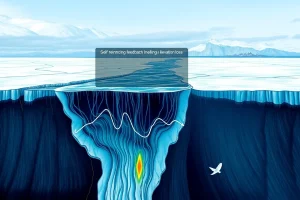
In climate science, tipping elements are distinguished by their potential for self-reinforcing feedbacks that, once initiated, can drive the system further away from its original state without additional external forcing. For example, the melting of the Greenland ice sheet reduces the surface reflectivity (albedo), causing more solar energy to be absorbed and accelerating further melting. This process can become self-sustaining, leading to the eventual complete loss of the ice sheet even if global temperatures were later stabilized. The concept highlights the non-linear nature of the Earth system and the risks of crossing thresholds that could lead to abrupt, large-scale, and often irreversible changes with significant consequences for ecosystems and human societies.
Overview
The Earth system is composed of interconnected physical, chemical, and biological components that interact across a range of spatial and temporal scales. Within this system, certain large-scale components—such as ice sheets, ocean currents, and major ecosystems—can exist in multiple stable states. A tipping element is one that can be pushed from one stable state to another by a relatively small perturbation once a critical threshold is crossed. The transition is often abrupt, self-reinforcing, and difficult or impossible to reverse on human timescales.
The concept gained prominence in climate science with the recognition that gradual global warming could trigger sudden shifts in key parts of the Earth system. In 2008, a seminal paper by Lenton et al. identified a set of policy-relevant tipping elements, including the Greenland and West Antarctic ice sheets, the Atlantic Meridional Overturning Circulation (AMOC), the Amazon rainforest, and the El Niño–Southern Oscillation (ENSO). These elements are considered “tipping” because they exhibit threshold behavior and have the potential to cause large-scale impacts. Since then, research has expanded the list and deepened understanding of the underlying mechanisms, feedbacks, and potential cascading effects.
How It Works
Tipping elements operate through positive feedback loops that amplify a small initial change. In a stable state, negative feedbacks tend to dampen perturbations and return the system to equilibrium. However, as a system approaches a tipping point, positive feedbacks can become dominant. Once the threshold is crossed, the system may reorganize into a new state, often with a different structure and function. This process is characterized by hysteresis, meaning that reversing the change requires the forcing to be reduced well below the level that triggered the shift.
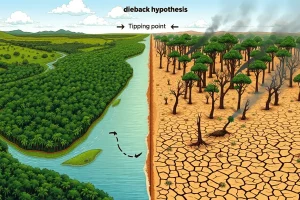
For example, the Greenland ice sheet is maintained by its own height: the higher the ice, the colder the surface, which preserves the ice. As the ice sheet melts, its surface lowers, exposing it to warmer air, which accelerates melting. This is known as the melt-elevation feedback. If warming exceeds a critical threshold, this feedback becomes self-sustaining, and the ice sheet will eventually collapse, contributing several meters to global sea level over centuries. Similarly, the Amazon rainforest generates much of its own rainfall through evapotranspiration. Deforestation and climate change can reduce this moisture recycling, pushing the forest past a tipping point where it transitions to a savanna-like state, with massive loss of biodiversity and carbon release.
Main Causes or Drivers
The primary driver pushing tipping elements toward their thresholds is anthropogenic climate change, particularly the rise in global average temperatures due to greenhouse gas emissions. However, other human activities such as deforestation, land-use change, and pollution also play significant roles. For instance, the Amazon rainforest is threatened not only by regional warming and drying but also by direct clearing for agriculture, which fragments the ecosystem and reduces its resilience. In the case of ocean circulation, freshwater input from melting ice sheets and increased precipitation can alter salinity and density, potentially slowing or shutting down the AMOC.
The rate of forcing is also critical. Rapid changes can outpace the ability of systems to adapt, making tipping more likely. Paleoclimate records show that past abrupt climate changes were often triggered by relatively fast perturbations. Today, the unprecedented speed of human-induced warming is a major concern, as it may push multiple tipping elements past their thresholds simultaneously, increasing the risk of cascading effects.
Examples
Scientists have identified several major tipping elements in the Earth system. While the exact thresholds and timing remain uncertain, the following are widely studied:
- Greenland Ice Sheet: Sustained warming above a certain level could commit the ice sheet to irreversible melting, eventually raising global sea level by about 7 meters over centuries to millennia.
- West Antarctic Ice Sheet: Much of this ice sheet rests on bedrock below sea level, making it vulnerable to marine ice-sheet instability. Its collapse could add 3–5 meters to sea level.
- Atlantic Meridional Overturning Circulation (AMOC): This ocean current system transports heat northward. A slowdown or shutdown could drastically alter climate patterns in Europe and beyond, and is linked to freshwater input from melting ice.
- Amazon Rainforest: Dieback could occur due to deforestation, warming, and drying, leading to a shift to savanna, with massive carbon release and biodiversity loss.
- Boreal Forest: Warming and increased fire frequency could push the southern boundary of the boreal forest northward, releasing carbon and altering albedo.
- Coral Reefs: Ocean warming and acidification can cause widespread bleaching and mortality, leading to ecosystem collapse and loss of coastal protection.
- Permafrost Thaw: Thawing permafrost releases methane and carbon dioxide, amplifying warming. Large-scale thaw could be irreversible and self-reinforcing.
- Monsoon Systems: The West African monsoon and Indian summer monsoon could undergo abrupt shifts in response to changes in sea surface temperatures and land cover, affecting water security for billions.
Importance and Impact
Tipping elements are critical to understanding the full risks of climate change because they represent thresholds beyond which impacts become far more severe and potentially irreversible. The collapse of ice sheets would commit the world to multi-meter sea-level rise over centuries, reshaping coastlines and displacing hundreds of millions of people. A shutdown of the AMOC could disrupt weather patterns, agriculture, and marine ecosystems across the North Atlantic region. The dieback of the Amazon would not only destroy one of the world’s most biodiverse ecosystems but also release vast amounts of carbon, accelerating global warming.
Moreover, tipping elements do not act in isolation. There is growing evidence that they can interact, with the crossing of one threshold increasing the likelihood of crossing others—a phenomenon known as cascading tipping. For example, melting of the Greenland ice sheet could freshen the North Atlantic and weaken the AMOC, which in turn could shift tropical rainfall patterns and affect the Amazon. Such cascades could lead to a global tipping point, fundamentally altering the Earth system. This makes the study of tipping elements essential for setting climate targets and for risk assessments that inform adaptation and mitigation strategies.
Data Limitations and Uncertainties
Despite advances in modeling and observations, significant uncertainties remain about the exact location of tipping thresholds, the timing of potential transitions, and the reversibility of changes. Climate models often struggle to represent the complex feedbacks and small-scale processes that govern tipping behavior. Observational records are too short to capture many long-term dynamics, and paleoclimate data, while valuable, have their own limitations. As a result, scientists often express tipping thresholds in terms of probability ranges rather than precise temperature levels.
There is also uncertainty about how different tipping elements might interact and whether cascading effects could occur at lower levels of warming than currently estimated. Research is ongoing to improve understanding through better models, satellite monitoring, and early warning systems that look for signs of critical slowing down—a statistical signal that a system is approaching a tipping point. Given the high stakes, many scientists advocate for a precautionary approach, aiming to keep global warming well below 2°C and as close to 1.5°C as possible to minimize the risk of triggering these dangerous changes.
FAQ
What is a tipping element?
A tipping element is a large-scale part of the Earth system, such as an ice sheet or ocean current, that can cross a critical threshold and shift into a new state, often abruptly and irreversibly.
How does a tipping element work?
It works through positive feedback loops that amplify a small change. Once a threshold is crossed, the feedback becomes self-sustaining, driving the system to a new state even if the original forcing is removed.
Why do tipping elements matter?
They matter because their activation could lead to catastrophic and irreversible changes in the climate system, with severe impacts on sea level, weather patterns, ecosystems, and human societies.
References
- Lenton, T. M., et al. (2008). "Tipping elements in the Earth's climate system." Proceedings of the National Academy of Sciences, 105(6), 1786–1793.
- IPCC (2021). "Climate Change 2021: The Physical Science Basis. Contribution of Working Group I to the Sixth Assessment Report." Cambridge University Press.
- Steffen, W., et al. (2018). "Trajectories of the Earth System in the Anthropocene." Proceedings of the National Academy of Sciences, 115(33), 8252–8259.