In brief
At a glance
Quick Facts
- Positive feedback amplifies initial change
- Positive feedback loops increase the magnitude of an initial climate perturbation, such as warming from greenhouse gases.
- Negative feedback dampens change
- Negative feedback loops reduce the impact of climate forcings, helping to stabilize the system.
- Water vapor is the strongest positive feedback
- Water vapor feedback roughly doubles the warming from CO2 alone.
- Ice-albedo feedback accelerates polar warming
- Melting ice reduces reflectivity, causing more solar absorption and further melting.
- Cloud feedback remains uncertain
- Clouds can both cool and warm the planet, making their net feedback effect a major source of uncertainty.
- Planck feedback is a fundamental negative feedback
- As Earth warms, it emits more infrared radiation, partially offsetting the warming.
- Tipping points can trigger irreversible feedbacks
- Some positive feedbacks, like permafrost thaw, may reach thresholds where they become self-sustaining.
- Climate sensitivity depends on feedbacks
- The total warming from doubled CO2 is determined by the sum of all feedbacks.
Key Takeaways
- Positive climate feedbacks amplify an initial warming or cooling, while negative feedbacks counteract it, stabilizing the climate system.
- Water vapor feedback is the strongest positive feedback, roughly doubling the warming effect of CO2 alone.
- Negative feedbacks, such as the Planck response, prevent runaway climate change but cannot fully offset human-caused warming.
- Uncertainties in cloud feedbacks and the risk of crossing tipping points make feedbacks a central focus of climate research.
What Is Positive vs Negative Climate Feedback Explained?
In climate science, a feedback is a process that either amplifies or dampens the response of the climate system to an initial forcing. A positive feedback increases the magnitude of the original change, while a negative feedback reduces it. These feedbacks do not imply value judgments; “positive” simply means the effect is in the same direction as the initial perturbation, and “negative” means it is in the opposite direction. For example, if rising CO2 warms the planet, a positive feedback would cause additional warming, whereas a negative feedback would cause cooling that partially offsets the initial warming.
Climate feedbacks are essential to understanding how sensitive Earth’s climate is to greenhouse gas emissions. Without feedbacks, a doubling of atmospheric CO2 would lead to a global temperature increase of about 1.2°C. However, the actual warming is projected to be between 2°C and 4.5°C, largely because of positive feedbacks. Negative feedbacks, on the other hand, prevent the climate from spiraling out of control. The interplay between these opposing forces determines the pace and severity of climate change, making feedback analysis a cornerstone of modern climate modeling.
How It Works
Climate feedbacks operate through interconnected physical, chemical, and biological processes. The basic mechanism can be described as a loop: an initial climate forcing (e.g., increased greenhouse gases) triggers a change in a climate variable (e.g., temperature), which then alters another component of the system (e.g., ice cover), and that alteration feeds back to either reinforce or counteract the original temperature change. The strength of a feedback is often expressed as a feedback factor or gain, which quantifies how much the initial response is multiplied.
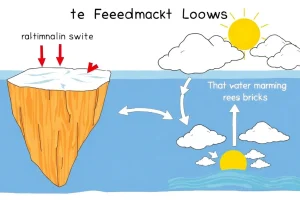
In a positive feedback loop, the cycle is self-reinforcing. For instance, warming melts sea ice, exposing darker ocean water that absorbs more sunlight, leading to further warming and more ice melt. In a negative feedback loop, the cycle is self-limiting. An example is the Planck feedback: as Earth’s surface warms, it emits more infrared radiation to space, which cools the planet and offsets some of the initial warming. The net effect of all feedbacks determines the equilibrium climate sensitivity—the long-term temperature change for a given forcing. Feedbacks can be fast (hours to years), like water vapor and clouds, or slow (decades to millennia), like ice sheet dynamics and carbon cycle changes.
Examples
Several key feedbacks dominate the climate system’s response to warming. The most significant positive feedbacks include:
- Water vapor feedback: Warmer air holds more moisture. Since water vapor is a potent greenhouse gas, increased atmospheric water vapor traps more heat, amplifying the initial warming. This feedback is well understood and is the primary reason climate sensitivity is higher than the no-feedback case.
- Ice-albedo feedback: Ice and snow have high albedo, reflecting most sunlight. As they melt, darker land or ocean surfaces absorb more solar radiation, causing further warming and melting. This feedback is especially strong in the Arctic.
- Permafrost carbon feedback: Thawing permafrost releases methane and CO2, which enhance the greenhouse effect and accelerate warming, leading to more thaw. This is a slow but potentially large feedback.
- Cloud feedback: Clouds can both cool (by reflecting sunlight) and warm (by trapping heat). The net effect depends on cloud type, altitude, and latitude. Most models suggest a net positive cloud feedback, but it remains the largest source of uncertainty.
Important negative feedbacks include:
- Planck feedback: The fundamental negative feedback; a warmer planet radiates more energy to space, following the Stefan-Boltzmann law. This is the primary brake on runaway warming.
- Lapse rate feedback: In the tropics, warming is greater in the upper troposphere than at the surface, which enhances heat loss to space and partially offsets water vapor feedback.
- CO2 fertilization: Higher CO2 levels can boost plant growth, increasing carbon uptake and slightly reducing atmospheric CO2. However, this effect is limited by nutrients and other factors.
- Silicate weathering: Over geological timescales, increased temperature and CO2 accelerate rock weathering, which removes CO2 from the atmosphere. This feedback operates too slowly to counteract modern emissions.
Importance and Impact
Climate feedbacks are the primary reason that relatively small changes in greenhouse gas concentrations can lead to significant global temperature shifts. They determine the magnitude of future warming and the risk of abrupt changes. Positive feedbacks, if strong enough, can push the climate system past tipping points—thresholds beyond which change becomes self-sustaining and potentially irreversible. For example, the loss of Arctic summer sea ice or the collapse of the West Antarctic Ice Sheet could be triggered by amplifying feedbacks.
Understanding feedbacks is also critical for climate policy. The range of climate sensitivity estimates—from about 2°C to 4.5°C for doubled CO2—is largely due to uncertainties in feedbacks, especially clouds. A higher sensitivity would mean more severe impacts for the same emissions, requiring more urgent mitigation. Conversely, if negative feedbacks were stronger than currently thought, the warming might be less severe, though evidence strongly points to net positive feedback dominating. Feedbacks also affect regional climate patterns, sea level rise, and the frequency of extreme weather events.
Common Misconceptions
One common misconception is that negative feedbacks will naturally cancel out human-caused warming, preventing dangerous climate change. While negative feedbacks do exist, they are not strong enough to offset the combined effect of greenhouse gas forcing and positive feedbacks. The Planck feedback, for instance, only partially offsets warming; it does not reverse it. Another misunderstanding is that all feedbacks are positive. In reality, the climate system includes both types, and the net effect is what matters.
Some people confuse the term “positive feedback” with something desirable. In climate science, it simply means amplification, not benefit. A positive feedback can be harmful, such as the permafrost carbon release. Additionally, there is a misconception that feedbacks act instantly. Many feedbacks, like ice sheet melt or deep ocean warming, operate over centuries to millennia, meaning the full consequences of today’s emissions may not be felt for generations. Finally, the idea that cloud feedback will save us is not supported by evidence; most research indicates a net positive or neutral cloud feedback.
Connections to Other Systems
Climate feedbacks are deeply intertwined with other Earth systems. The carbon cycle is both a source of feedbacks and a responder to them. For example, ocean warming reduces the solubility of CO2, leading to outgassing (a positive feedback), while increased terrestrial photosynthesis can act as a negative feedback. The water cycle is also closely linked: changes in evaporation and precipitation patterns affect cloud formation, water vapor distribution, and surface albedo.
Ecosystems play a dual role. Forests can dampen warming through carbon storage and evaporative cooling, but deforestation and wildfires release carbon and reduce this negative feedback. Ice sheets and glaciers connect to sea level and ocean circulation; meltwater can slow the Atlantic Meridional Overturning Circulation, which in turn affects regional climates and may trigger further feedbacks. Even human systems are part of the loop: climate impacts on agriculture, energy demand, and land use can create socio-economic feedbacks that either exacerbate or mitigate emissions.
Data Limitations and Uncertainties
Despite decades of research, significant uncertainties remain in quantifying climate feedbacks. The largest source of uncertainty is cloud feedback. Clouds have complex microphysical and dynamical properties that are difficult to represent in global climate models. Depending on how cloud cover, altitude, and phase (ice vs. liquid) change with warming, the net feedback could range from slightly negative to strongly positive. Satellite observations and high-resolution modeling are gradually reducing this uncertainty, but it remains a key challenge.
Other limitations include the representation of slow feedbacks, such as permafrost thaw and ice sheet dynamics, which are not fully included in many models. Paleoclimate data provide insights into how feedbacks operated in past warm periods, but these reconstructions have their own uncertainties. Additionally, the interaction between multiple feedbacks can produce non-linear responses that are hard to predict. Ongoing research aims to constrain feedback strengths through a combination of observations, process studies, and improved model physics, but the inherent complexity of the climate system means that some uncertainty will persist.
FAQ
What is a positive climate feedback?
A positive climate feedback is a process that amplifies an initial change in the climate system. For example, warming melts ice, which reduces the Earth's reflectivity and causes more warming.
How does negative feedback work in the climate system?
Negative feedback works by counteracting an initial change. For instance, as the Earth warms, it radiates more heat to space, which cools the planet and offsets some of the warming.
Why are climate feedbacks important for global warming?
Climate feedbacks determine how much warming occurs from greenhouse gas emissions. Without positive feedbacks, the warming from CO2 alone would be much smaller; negative feedbacks prevent runaway warming but cannot stop human-caused climate change.
References
- IPCC Sixth Assessment Report, Working Group I: The Physical Science Basis (2021)
- NASA Climate Science: Feedbacks and Climate Sensitivity
- National Academy of Sciences: Climate Change Evidence & Causes (2020)