In brief
Many of the world’s greatest sustainability challenges appear, at first glance, to be separate problems.
Climate change seems different from biodiversity loss.
Water scarcity appears unrelated to plastic pollution.
Food insecurity seems like an agricultural issue, while public health appears to belong to medicine.
In reality, these challenges are deeply interconnected.
A drought can reduce crop yields, increasing food prices, which affects livelihoods, migration, nutrition, and political stability. Deforestation alters regional rainfall, influences freshwater availability, reduces biodiversity, and releases carbon dioxide, which contributes to climate change. Plastic pollution affects marine ecosystems, fisheries, food security, and potentially human health.
None of these problems exists in isolation.
They are parts of larger systems.
This recognition lies at the heart of systems thinking.
Rather than focusing only on individual events or isolated causes, systems thinking seeks to understand how components interact through feedback loops, delays, networks, and dynamic relationships that produce complex behavior over time. It has become one of the foundational approaches for understanding sustainability because environmental, economic, and social systems are tightly interconnected. (ScienceDirect)
The Planetary Boundaries framework, Earth System Science, One Health, the Circular Economy, and Doughnut Economics all rely on systems thinking in different ways.
Instead of asking:
“What caused this problem?”
systems thinking asks:
“How do interactions within the whole system create this outcome?”
Understanding those interactions is essential for building resilient societies capable of thriving within Earth’s ecological limits.
Quick Answer
Systems thinking is an approach to understanding complex problems by examining how different parts of a system interact over time.
Instead of focusing on isolated events, systems thinking emphasizes:
- Interconnections
- Feedback loops
- Cause-and-effect relationships
- Delays
- Emergent behavior
- Adaptation
- Resilience
In sustainability, systems thinking helps explain why environmental, social, and economic challenges are interconnected and why solving one problem often requires understanding the larger system in which it occurs. (ScienceDirect)
What Is a System?
A system is a collection of interconnected components that interact to produce patterns of behavior.
Examples include:
Natural systems
- Forests
- Oceans
- Rivers
- Climate
- Ecosystems
Human systems
- Cities
- Economies
- Food systems
- Healthcare
- Transportation
Social-ecological systems
- Agriculture
- Fisheries
- Water management
- Energy systems
The important feature is not simply the parts.
It is the relationships between them.
Why Systems Thinking Matters
Traditional problem-solving often breaks problems into smaller pieces.
This approach works well for many engineering or technical problems.
However, sustainability challenges are often complex systems rather than simple machines.
Complex systems contain:
- Numerous interacting parts
- Feedback mechanisms
- Nonlinear relationships
- Adaptation
- Uncertainty
Studying only individual components may miss the behavior of the system as a whole.
Research reviewing sustainability management consistently identifies systems thinking as essential for understanding interactions among ecological, social, economic, and political systems across multiple scales. (ScienceDirect)
Systems Thinking Versus Linear Thinking
Linear Thinking
Linear thinking assumes:
A causes B.
B causes C.
Problems therefore have one primary cause and one primary solution.
Example:
Pollution → Clean it up.
Systems Thinking
Systems thinking recognizes that:
- Multiple causes interact.
- Effects become new causes.
- Feedback loops develop.
- Delays occur.
- Small changes sometimes produce large consequences.
Example:
Climate change affects forests.
Forest loss affects rainfall.
Reduced rainfall weakens agriculture.
Agricultural expansion increases deforestation.
The system reinforces itself.
Characteristics of Complex Systems
Most sustainability challenges involve complex adaptive systems.
Common characteristics include:
- Interdependence
- Feedback
- Adaptation
- Emergence
- Self-organization
- Nonlinearity
- Uncertainty
These characteristics make prediction more difficult but also reveal opportunities for meaningful intervention. (ScienceDirect)
Feedback Loops
Feedback loops are among the most important concepts in systems thinking.
They occur when outputs influence future inputs.
Two major types exist.
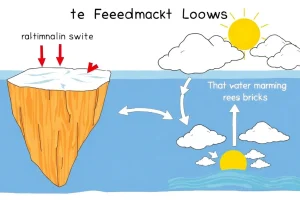
Reinforcing Feedback
Reinforcing loops amplify change.
Example:
Higher temperatures
↓
Permafrost thaw
↓
Methane release
↓
Additional warming
↓
More thaw
The process accelerates itself.
Balancing Feedback
Balancing loops stabilize systems.
Example:
Population increases
↓
Food demand rises
↓
Food prices increase
↓
Demand slows
↓
Population growth moderates
Balancing loops resist change.
Most real-world systems contain both types simultaneously.
Stocks and Flows
Systems contain stocks and flows.
Stocks
Stocks are accumulations.
Examples:
- Forest biomass
- Groundwater
- Carbon in the atmosphere
- Population
- Soil fertility
Flows
Flows change stocks.
Examples:
- Tree growth
- Logging
- Rainfall
- Carbon emissions
- Births
- Deaths
Many sustainability challenges arise because flows continually alter important stocks.
Delays
One reason sustainability problems are difficult is that causes and effects are often separated by time.
Examples include:
Carbon emissions today may influence climate for decades.
Groundwater depletion may remain unnoticed until wells begin failing.
Excess phosphorus may accumulate in soils for years before degrading lakes.
Because of these delays, societies often respond only after significant environmental change has already occurred.
Emergence
Emergence occurs when interactions among many components create new properties.
Examples include:
- Ecosystem resilience
- Market behavior
- Traffic congestion
- Climate patterns
No single component creates these outcomes.
They emerge from the interactions of the entire system.
Understanding emergence requires examining the whole rather than only individual parts.
Resilience
Resilience refers to the ability of a system to absorb disturbances while maintaining its essential functions.
Examples include:
- Forest recovery after fire
- Wetland recovery after flooding
- Economic recovery after shocks
- Community adaptation following disasters
Systems thinking emphasizes building resilience rather than simply maximizing short-term efficiency.
Highly optimized systems sometimes become less resilient because they possess fewer alternatives when disturbances occur.
Leverage Points
Not all interventions have equal influence.
Leverage points are places where relatively small changes can produce disproportionately large improvements.
Donella Meadows identified leverage points ranging from changing parameters (such as taxes or standards) to altering information flows, system rules, goals, and even the underlying paradigms that shape how a system operates. Changes in goals and mindsets are generally more transformative than adjusting individual parameters. (MacEwan Open Books)
Examples include:
- Carbon pricing
- Protected areas
- Circular product design
- Public education
- Governance reforms
- Changes in societal values
Finding effective leverage points is one of the primary goals of systems thinking.
Systems Thinking and Earth System Science
Earth itself functions as a system.
The atmosphere, oceans, land, ice, and biosphere interact continuously.
Examples include:
Climate influences forests.
Forests influence rainfall.
Rainfall influences rivers.
Rivers transport nutrients.
Nutrients influence marine ecosystems.
Marine ecosystems influence carbon cycling.
Earth System Science therefore depends fundamentally upon systems thinking.
The Planetary Boundaries framework similarly recognizes that changing one Earth-system process often influences many others.
Systems Thinking and Sustainability
Systems thinking has become central to sustainability research because it helps integrate environmental, economic, and social dimensions rather than studying them separately.
Major sustainability themes supported by systems thinking include:
- Behavioral change
- Leadership
- Innovation
- Industrial ecology
- Social-ecological systems
- Sustainability transitions
- Education
These themes reflect the growing recognition that sustainability challenges are systemic rather than isolated. (ScienceDirect)
Systems Thinking in Food Systems
Food illustrates systems thinking clearly.
Agriculture depends on:
- Climate
- Pollinators
- Soil
- Water
- Biodiversity
Food production also influences:
- Climate
- Nutrient cycles
- Land use
- Freshwater
- Health
Changing one part of the food system often affects many others.
Solutions therefore require considering the entire system rather than agriculture alone.
Systems Thinking and the Circular Economy
The circular economy is fundamentally systemic.
Instead of treating products individually, it redesigns relationships among:
- Manufacturing
- Consumers
- Waste
- Materials
- Ecosystems
Waste becomes a design problem rather than an unavoidable outcome.
This systems perspective helps explain why circular economy strategies extend beyond recycling to include redesign, repair, reuse, and regeneration.
Systems Thinking and Climate Change
Climate change cannot be understood solely through atmospheric physics.
It also involves:
- Energy systems
- Food systems
- Transportation
- Economics
- Governance
- Human behavior
- Technology
- International cooperation
Systems thinking therefore reveals climate change as a societal challenge rather than simply an environmental one.
Common Systems Thinking Tools
Researchers and practitioners use several analytical tools.
Examples include:
- Causal loop diagrams
- Stock-and-flow models
- System dynamics models
- Network analysis
- Scenario planning
- Resilience assessment
These tools help visualize interactions and identify leverage points.
Benefits of Systems Thinking
Systems thinking can improve sustainability by helping decision-makers:
- Understand complexity
- Identify root causes
- Anticipate unintended consequences
- Improve long-term planning
- Coordinate across sectors
- Recognize cross-scale interactions
- Design more resilient policies
Rather than solving isolated symptoms, it encourages addressing underlying system structures.
Challenges and Limitations
Systems thinking is powerful but not perfect.
Important limitations include:
Complexity
Large systems are difficult to model completely.
Uncertainty
Future behavior cannot always be predicted accurately.
Data limitations
Many interactions remain poorly understood.
Communication
Complex models may be difficult for policymakers or the public to interpret.
Trade-offs
Improving one part of a system may create unintended consequences elsewhere.
Systems thinking therefore complements—not replaces—other scientific and policy approaches.
Common Misunderstandings
“Systems thinking means everything is connected equally.”
No.
Some relationships are much stronger than others.
A key task is identifying the most influential interactions.
“Systems thinking predicts the future.”
No.
It improves understanding of system behavior but cannot eliminate uncertainty.
“Complex systems cannot be managed.”
They can often be influenced through carefully chosen leverage points, even if they cannot be fully controlled.
“Systems thinking replaces specialized expertise.”
No.
It integrates knowledge from multiple disciplines rather than replacing them.
Frequently Asked Questions
What is systems thinking?
Systems thinking is an approach that studies how interacting parts of a system create patterns of behavior over time rather than focusing on isolated events. (Nature)
Why is systems thinking important for sustainability?
Because sustainability challenges involve interconnected environmental, economic, and social systems whose interactions often determine outcomes more than any single factor. (ScienceDirect)
What is a feedback loop?
A feedback loop occurs when a system’s outputs influence its future behavior. Reinforcing loops amplify change, while balancing loops stabilize systems.
What are leverage points?
Leverage points are places within a system where relatively small interventions can produce significant changes. Donella Meadows showed that changing system goals or underlying paradigms is often more influential than adjusting individual parameters. (MacEwan Open Books)
How does systems thinking relate to planetary boundaries?
Planetary boundaries describe interconnected Earth-system processes. Systems thinking helps explain how changes in one boundary influence others through feedbacks and cascading effects.
Can systems thinking solve sustainability challenges?
Systems thinking is not a solution by itself. It is a way of understanding complexity that supports better decision-making, policy design, and collaboration across disciplines.
Conclusion
Sustainability challenges cannot be fully understood through isolated problems or single-cause explanations.
Climate change, biodiversity loss, freshwater depletion, food insecurity, pollution, and human health are all connected through networks of interactions that span ecosystems, economies, technologies, and societies. Systems thinking provides a framework for understanding these relationships, emphasizing feedback loops, delays, resilience, emergence, and the structures that generate long-term patterns rather than focusing only on short-term events. (ScienceDirect)
This perspective underpins many of today’s most influential sustainability frameworks, including Earth System Science, Planetary Boundaries, the Circular Economy, One Health, and Doughnut Economics. Rather than treating environmental, social, and economic challenges separately, systems thinking encourages integrated solutions that recognize how actions in one part of a system influence many others. (Heriot-Watt Research Portal)
Ultimately, systems thinking does not eliminate complexity—it helps us navigate it. By learning to see relationships instead of isolated events, patterns instead of symptoms, and leverage points instead of simple fixes, individuals, organizations, and governments can make more informed decisions that strengthen resilience and support a sustainable future within the limits of our interconnected planet.