In brief
At a glance
Quick Facts
- Definition
- A process where a change in the climate system triggers a response that either amplifies (positive) or dampens (negative) the initial change.
- Strongest Positive Feedback
- Water vapor feedback: warmer air holds more moisture, which traps more heat, amplifying warming.
- Key Negative Feedback
- Planck feedback: a warmer Earth radiates more infrared energy to space, partially offsetting warming.
- Climate Sensitivity
- Without feedbacks, a doubling of CO₂ would cause ~1°C warming; with feedbacks, likely 2°C–4.5°C.
- Tipping Point Risk
- Positive feedbacks can push the climate past irreversible thresholds, such as the loss of ice sheets.
Key Takeaways
- A climate feedback loop is a process that can either amplify (positive feedback) or dampen (negative feedback) an initial change in the climate system.
- Positive feedbacks, such as the ice-albedo and water vapor feedbacks, are major contributors to the acceleration of global warming.
- Negative feedbacks, like the Planck feedback (increased infrared radiation from a warmer Earth), help stabilize the climate but may be insufficient to offset positive feedbacks.
- Understanding and accurately modeling feedback loops is crucial for projecting future climate change and assessing the risk of irreversible tipping points.
What Is a Climate Feedback Loop?
A climate feedback loop is a process in which a change in one part of the climate system triggers a response that either amplifies or dampens the original change. In climate science, these loops are categorized as positive (reinforcing) or negative (balancing). They are not “good” or “bad” in a value sense; rather, positive means the response goes in the same direction as the initial change, while negative means it opposes it. Feedback loops are a fundamental concept for understanding how the Earth’s climate can be sensitive to relatively small initial forcings, such as the increase in greenhouse gases from human activities.
The climate system is a complex web of interacting components—atmosphere, oceans, land surface, ice, and biosphere. A change in one component, such as a rise in global temperature, can set off a chain of effects that circle back to influence the original component. For example, warming melts ice, which reduces the Earth’s reflectivity (albedo), causing more solar energy to be absorbed, which leads to further warming. This is a positive feedback loop. In contrast, a warmer Earth radiates more heat into space, which cools the planet—a negative feedback. The balance of these feedbacks determines the overall climate sensitivity and the trajectory of future climate change.
How It Works
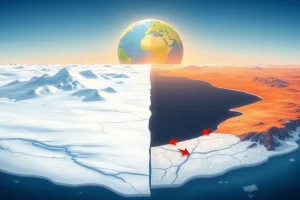
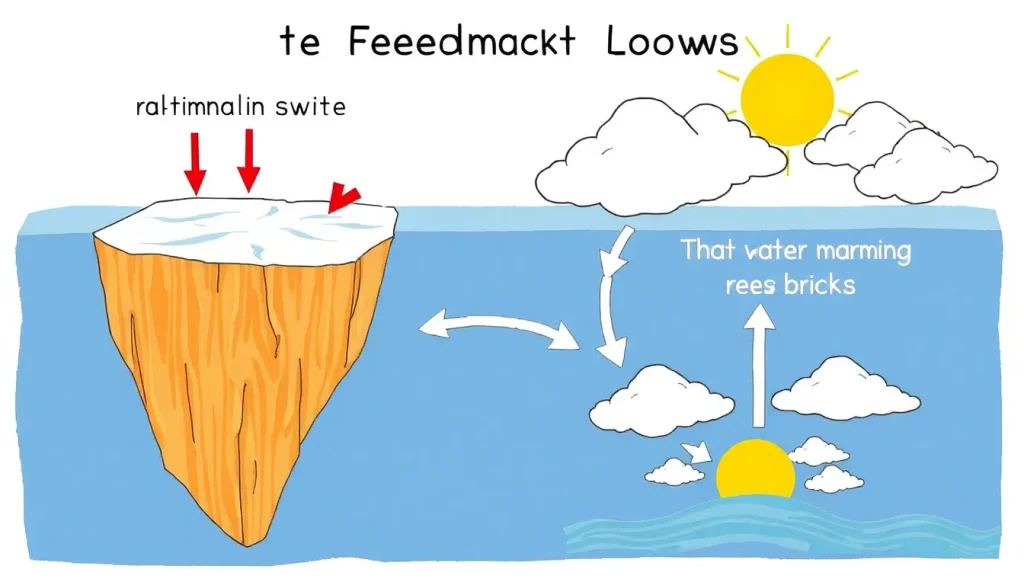
Feedback loops in the climate system operate through a series of interconnected steps. A typical positive feedback loop begins with an initial perturbation, such as an increase in atmospheric carbon dioxide (CO₂) that traps more heat. This warming triggers a secondary process—for instance, melting Arctic sea ice. Ice has a high albedo, reflecting most sunlight; open water is darker and absorbs more solar radiation. The additional absorbed energy further warms the region, melting more ice, which in turn reduces albedo further. This self-reinforcing cycle can accelerate the original warming.
Negative feedback loops work in the opposite direction. The most fundamental negative feedback is the Planck feedback: as the Earth’s surface warms, it emits more infrared radiation to space, following the Stefan-Boltzmann law. This increased heat loss partially offsets the initial warming. Other negative feedbacks include the weathering of rocks, which removes CO₂ from the atmosphere over geological timescales, and the response of clouds, which can either cool or warm the planet depending on their type and altitude. The net effect of all feedbacks is what determines the climate’s response to a given forcing.
Examples
Several well-documented feedback loops play critical roles in the climate system:
- Ice-albedo feedback: As global temperatures rise, ice and snow melt, exposing darker land or ocean surfaces that absorb more sunlight, causing further warming and more melting. This is a powerful positive feedback, particularly in the Arctic.
- Water vapor feedback: Warmer air can hold more moisture. Since water vapor is a potent greenhouse gas, increased evaporation leads to more atmospheric water vapor, which traps more heat and amplifies the initial warming. This is the strongest positive feedback in the climate system.
- Cloud feedback: Clouds can both cool (by reflecting sunlight) and warm (by trapping heat). The net effect depends on cloud type, altitude, and location. Overall, cloud feedback is thought to be positive, but it remains a major source of uncertainty in climate models.
- Permafrost carbon feedback: Thawing permafrost releases methane and CO₂, which are greenhouse gases, leading to more warming and further thaw. This feedback could release vast amounts of carbon currently stored in frozen soils.
- Ocean circulation feedback: Changes in temperature and salinity can alter ocean currents, which redistribute heat. A slowdown of the Atlantic Meridional Overturning Circulation (AMOC) could have complex regional climate effects, including cooling in some areas while global warming continues.
Importance and Impact
Climate feedback loops are crucial because they determine how much the Earth will warm in response to greenhouse gas emissions. Without feedbacks, a doubling of CO₂ would cause about 1°C of warming. However, when feedbacks are included, the expected warming is much higher—likely between 2°C and 4.5°C, according to the Intergovernmental Panel on Climate Change (IPCC). Positive feedbacks amplify the initial forcing, making climate change more severe and rapid than it would be otherwise.
The presence of strong positive feedbacks also raises the risk of crossing tipping points—thresholds beyond which changes become self-sustaining and potentially irreversible. For example, the loss of the Greenland ice sheet could become unstoppable once a certain warming level is reached, due to the ice-albedo feedback and other processes. Understanding feedbacks is therefore essential for setting emissions targets and for assessing the urgency of climate action.
Main Causes or Drivers
The primary driver that activates many climate feedback loops is the increase in greenhouse gas concentrations from human activities, such as burning fossil fuels, deforestation, and industrial processes. These gases—carbon dioxide, methane, nitrous oxide, and others—enhance the natural greenhouse effect, causing the planet to warm. This initial warming then triggers a cascade of feedbacks. For instance, the water vapor feedback is directly caused by the initial warming; without the initial temperature rise, there would be no increase in atmospheric moisture. Similarly, ice melt and permafrost thaw are responses to the warming driven by greenhouse gases.
Natural factors, such as changes in solar radiation or volcanic eruptions, can also initiate feedback loops, but the current rapid warming is overwhelmingly attributed to human-induced emissions. The strength of the feedbacks depends on the magnitude of the initial forcing and the sensitivity of the various components of the climate system.
Connections to Other Systems
Climate feedback loops are deeply interconnected with other Earth systems. The carbon cycle is a prime example: the ocean and land biosphere currently absorb about half of human CO₂ emissions, acting as a negative feedback. However, as the planet warms, the ability of these sinks to absorb carbon may decrease, turning them into sources and creating a positive feedback. Ocean acidification, caused by increased CO₂, can harm marine ecosystems and reduce the ocean’s capacity to take up carbon.
The water cycle is also tightly linked. Changes in evaporation and precipitation patterns affect cloud formation, soil moisture, and vegetation, which in turn influence the surface albedo and the carbon cycle. For example, droughts can lead to forest dieback, releasing stored carbon and reducing the land’s cooling effect. These interactions mean that feedback loops can propagate across different systems, sometimes in unexpected ways, complicating climate projections.
Common Misconceptions
One common misconception is that “positive feedback” means something beneficial. In climate science, positive simply means the feedback amplifies the initial change, which in the context of global warming is generally detrimental. Another misunderstanding is that feedback loops inevitably lead to runaway warming, like on Venus. On Earth, negative feedbacks such as the Planck feedback place a limit on how much warming can occur, but the risk of crossing dangerous thresholds remains.
Some also believe that feedbacks are too uncertain to be a concern. While uncertainties exist—particularly regarding cloud feedbacks—the overall understanding is robust, and the net feedback is very likely positive. Ignoring feedbacks would lead to a significant underestimation of future warming. Finally, it is sometimes assumed that feedbacks operate instantly; in reality, many feedbacks have time lags, meaning the full effects of today’s emissions may not be felt for decades or centuries.
FAQ
What is a climate feedback loop?
A climate feedback loop is a chain of cause-and-effect interactions where a change in the climate system triggers a response that either amplifies (positive feedback) or dampens (negative feedback) the original change.
How does a positive feedback loop differ from a negative one?
A positive feedback loop reinforces the initial change, leading to more warming or cooling, while a negative feedback loop counteracts the change, stabilizing the system. For example, melting ice reduces reflectivity and causes more warming (positive), whereas a warmer Earth radiates more heat to space (negative).
Why are climate feedback loops important for global warming?
They determine the climate's sensitivity to greenhouse gas emissions. Positive feedbacks amplify the warming from CO₂, making climate change more severe, while negative feedbacks moderate it. The net effect of feedbacks is a major factor in projections of future temperature rise.
References
- IPCC, 2021: Climate Change 2021: The Physical Science Basis. Contribution of Working Group I to the Sixth Assessment Report of the Intergovernmental Panel on Climate Change.
- NASA Global Climate Change: Vital Signs of the Planet – 'Feedback Loops' (climate.nasa.gov).
- National Geographic Encyclopedia: 'Climate Feedback' (nationalgeographic.org).