In brief
At a glance
Quick Facts
- Definition of renewable groundwater
- Groundwater that is replenished by precipitation or surface water on a timescale of years to decades.
- Definition of non-renewable groundwater
- Groundwater recharged thousands to millions of years ago with negligible modern replenishment; also called fossil groundwater.
- Global groundwater use
- Provides about 50% of drinking water and 43% of irrigation water worldwide.
- Primary driver of depletion
- Agricultural irrigation accounts for roughly 70% of groundwater withdrawals.
- Key environmental impact
- Over-extraction can cause land subsidence, saltwater intrusion, and loss of streamflow.
- Example of non-renewable aquifer
- The Nubian Sandstone Aquifer in North Africa contains water up to one million years old.
- Example of mined renewable aquifer
- The Ogallala Aquifer in the U.S. is being depleted much faster than its natural recharge rate.
- Measurement challenge
- Recharge rates are difficult to quantify and often rely on models with limited data.
Key Takeaways
- Renewable groundwater is replenished by precipitation and surface water within a human timescale, while non-renewable (fossil) groundwater was recharged thousands to millions of years ago and receives negligible modern recharge.
- The distinction is critical for sustainable management: extracting more than the renewable rate leads to aquifer depletion, land subsidence, and loss of water security.
- Many of the world’s largest aquifers, including those under major agricultural regions, are being mined at rates far exceeding natural recharge, effectively turning renewable resources into non-renewable ones.
- Accurate assessment of groundwater renewability is hampered by data scarcity, complex geology, and the long timeframes involved, making it difficult to set safe extraction limits.
What Is Renewable vs Non-Renewable Groundwater?
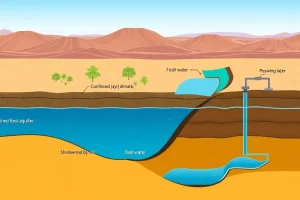
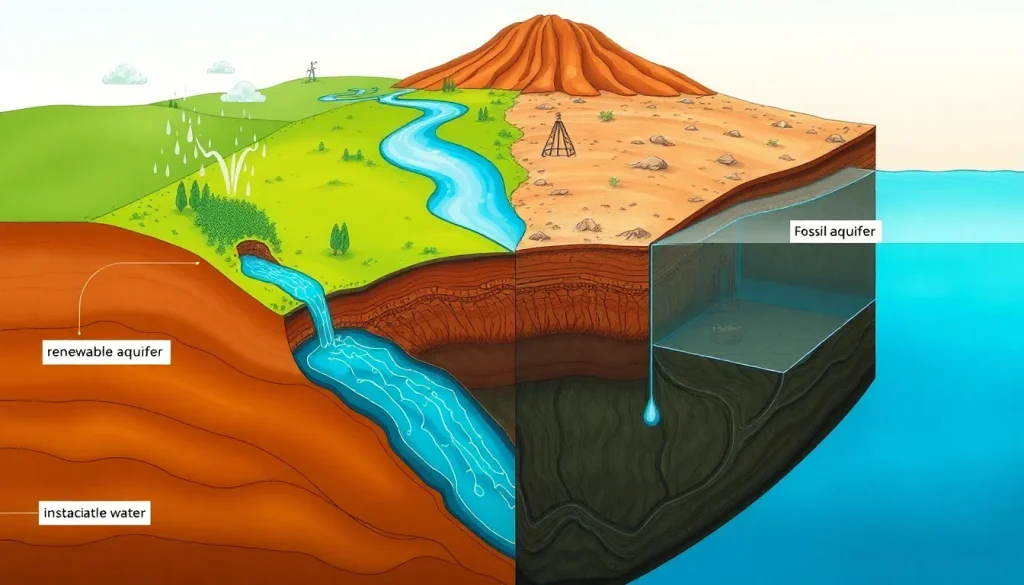
Groundwater is water stored beneath the Earth’s surface in porous rock formations called aquifers. The distinction between renewable and non-renewable groundwater hinges on the timescale of replenishment relative to human use. Renewable groundwater is that which is actively recharged by precipitation, rivers, or lakes on a timescale of years to decades. It is part of the contemporary hydrological cycle and can be used sustainably if extraction does not exceed the rate of recharge. In contrast, non-renewable groundwater (often called fossil groundwater) was recharged under past climatic conditions, typically thousands to millions of years ago, and receives negligible modern recharge. Once extracted, it is effectively lost from the aquifer on any human timescale.
This distinction is not always absolute; many aquifers contain a mix of renewable and non-renewable water. For example, a shallow aquifer may receive regular recharge, while deeper confined layers contain ancient water. The concept of “renewability” is therefore tied to the rate of extraction relative to recharge. Even a renewable aquifer can be mined like a non-renewable resource if withdrawals exceed the sustainable yield. Understanding this classification is essential for water resource planning, agriculture, and ecosystem protection.
How It Works
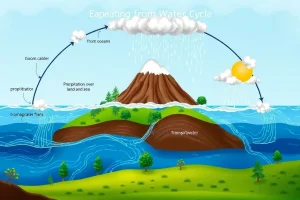
Groundwater recharge occurs when water from precipitation, rivers, lakes, or irrigation percolates through the soil and unsaturated zone to reach the water table. In renewable aquifers, this process is ongoing and can balance withdrawals if managed properly. The recharge rate depends on climate, soil type, vegetation, and land use. In humid regions, recharge may be a significant fraction of annual rainfall; in arid areas, it can be near zero. Once water reaches the saturated zone, it flows slowly through the aquifer, eventually discharging into springs, streams, or the ocean. This natural discharge maintains baseflow in rivers and supports ecosystems.
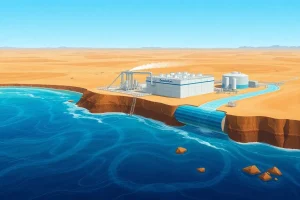
Non-renewable groundwater, by contrast, is stored in aquifers that are effectively isolated from modern recharge. These aquifers were filled during wetter paleoclimatic periods, such as the end of the last ice age, when rainfall was more abundant. Today, they receive little to no replenishment. When a well taps into a non-renewable aquifer, the water level declines continuously because there is no inflow to balance the extraction. This is analogous to mining a mineral resource. In some cases, what is classified as non-renewable may still receive a small amount of modern recharge, but the rate is so low that the resource is considered finite for practical purposes.
Main Causes or Drivers
The primary driver of non-renewable groundwater extraction is the growing demand for water in regions where surface water is scarce or seasonal. Agriculture accounts for approximately 70% of global groundwater withdrawals, with irrigation heavily reliant on aquifers in major food-producing areas. Population growth and urbanization further increase demand for drinking water and sanitation. In many arid and semi-arid regions, such as the Middle East, North Africa, and parts of South Asia, renewable water resources are insufficient to meet needs, forcing reliance on fossil aquifers.
Economic and policy factors also play a role. Subsidized energy for pumping, lack of regulation, and the “tragedy of the commons” encourage over-extraction. Climate change exacerbates the problem by altering precipitation patterns, reducing surface water availability, and increasing evaporation, which in turn heightens dependence on groundwater. Additionally, the hidden nature of groundwater makes it difficult to monitor and manage, often leading to unintentional mining of non-renewable reserves.
Environmental and Human Impacts
Over-extraction of groundwater, whether from renewable or non-renewable sources, has severe consequences. When pumping exceeds recharge, water tables decline, increasing energy costs for lifting water and eventually making wells unproductive. This can lead to economic losses for farmers and communities. In coastal areas, excessive pumping can cause saltwater intrusion, where seawater contaminates freshwater aquifers, rendering them unusable for drinking or irrigation.
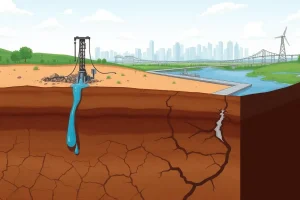
One of the most dramatic impacts is land subsidence—the gradual sinking of the ground surface as aquifer sediments compact. This can damage infrastructure, reduce aquifer storage capacity permanently, and increase flood risk. For example, parts of California’s Central Valley have subsided by several meters due to groundwater extraction. Ecosystems also suffer: reduced groundwater levels can dry up springs, wetlands, and rivers, harming aquatic life and riparian habitats. In the case of non-renewable aquifers, depletion is irreversible on any practical timescale, meaning that once the water is gone, the communities and agriculture that depended on it must find alternative sources or face collapse.
Regional Differences
The balance between renewable and non-renewable groundwater varies dramatically across the globe. In humid regions like the Amazon Basin or Southeast Asia, abundant rainfall ensures high recharge rates, and most groundwater use is renewable. However, even here, local over-extraction can cause problems such as reduced streamflow. In contrast, arid and semi-arid regions—including the Middle East, North Africa, parts of India, Australia, and the western United States—often rely on aquifers with very slow or negligible recharge. The Nubian Sandstone Aquifer beneath Egypt, Libya, Chad, and Sudan is a classic example of a non-renewable resource, containing water that fell as rain tens of thousands of years ago.
Some regions face a paradox: they have large renewable groundwater resources but are depleting them faster than they can be replenished. The High Plains (Ogallala) Aquifer in the central United States is a prime example. While it receives some recharge, the rate is far below current extraction for irrigation, effectively making it a non-renewable resource in many areas. Similarly, the North China Plain and the Indo-Gangetic Basin are experiencing severe groundwater depletion due to intensive agriculture. Understanding these regional differences is crucial for tailoring management strategies.
Importance and Impact
Groundwater supplies nearly half of all drinking water worldwide and about 43% of the water used for irrigation. The distinction between renewable and non-renewable groundwater is therefore central to global food security and public health. In many developing countries, groundwater is the primary source of safe drinking water, and its depletion directly threatens human well-being. Economically, groundwater-dependent agriculture supports the livelihoods of hundreds of millions of people. When aquifers are mined unsustainably, the long-term viability of these agricultural systems is at risk.
Beyond direct human use, groundwater plays a critical role in sustaining ecosystems. Baseflow from groundwater keeps rivers flowing during dry periods, maintaining aquatic habitats and water quality. The loss of this baseflow due to over-extraction can lead to the collapse of fisheries and the degradation of wetlands. Moreover, the energy required to pump water from ever-deeper wells contributes to greenhouse gas emissions, creating a feedback loop with climate change. Thus, the management of renewable and non-renewable groundwater has far-reaching implications for the environment, economy, and society.
Data Limitations and Uncertainties
Despite its importance, accurately quantifying groundwater renewability is fraught with challenges. Recharge rates are difficult to measure directly and are often estimated using models that rely on sparse data. Groundwater age dating, using isotopes such as carbon-14 or tritium, can help distinguish modern from fossil water, but such studies are expensive and not widely available. Aquifer boundaries and storage volumes are also uncertain, especially in deep or transboundary systems. This lack of data makes it hard to determine sustainable extraction limits.
Furthermore, the time lag between extraction and observable impacts—such as declining water tables or land subsidence—can be decades, leading to a false sense of security. Monitoring networks are inadequate in many parts of the world, and groundwater use is often unregulated or unreported. As a result, many aquifers are being depleted without a clear understanding of how much water remains or how long it will last. Improving data collection and sharing is essential for moving toward sustainable groundwater management.
FAQ
What is the difference between renewable and non-renewable groundwater?
Renewable groundwater is replenished by modern precipitation and surface water within a human timescale, while non-renewable groundwater was recharged in the distant past and receives little to no current recharge.
How can you tell if groundwater is renewable or non-renewable?
Scientists use isotopic dating (e.g., carbon-14, tritium) to determine the age of the water. Water that is decades to centuries old is typically renewable; water thousands of years old is non-renewable. Recharge rates and aquifer modeling also help classify the resource.
Why does the distinction between renewable and non-renewable groundwater matter?
It matters for sustainable management. Using non-renewable groundwater is like mining a finite resource—it will eventually run out, leading to water scarcity, economic disruption, and environmental damage. Even renewable groundwater can become non-renewable if extraction exceeds recharge.
References
- United States Geological Survey (USGS) – Groundwater Information Pages
- UNESCO World Water Assessment Programme – Groundwater Resources
- Food and Agriculture Organization of the United Nations (FAO) – AQUASTAT Database
- Gleeson, T., et al. (2012). Water balance of global aquifers revealed by groundwater footprint. Nature.