In brief
At a glance
Quick Facts
- Definition
- A fossil aquifer is a groundwater reservoir that was recharged thousands to millions of years ago and receives negligible recharge today.
- Age of Water
- Water in fossil aquifers can be over 10,000 years old, with some dating back to the Pleistocene or earlier.
- Non-Renewable
- Once depleted, fossil aquifers are effectively non-renewable on human timescales.
- Major Examples
- Nubian Sandstone Aquifer (Africa), Ogallala Aquifer (parts), Great Artesian Basin (Australia).
- Extraction Methods
- Often accessed via deep wells, sometimes artesian, requiring pumping as water tables decline.
- Water Quality
- Typically high quality, low in modern contaminants, but may contain ancient dissolved minerals.
Key Takeaways
- Fossil aquifers contain ancient water that was recharged thousands to millions of years ago under different climatic conditions.
- They are essentially non-renewable resources; extraction rates far exceed any modern recharge.
- Many arid and semi-arid regions depend on fossil aquifers for drinking water, agriculture, and industry.
- Depletion of fossil aquifers can lead to permanent loss of water supply, land subsidence, and geopolitical tensions.
What Is a Fossil Aquifer?
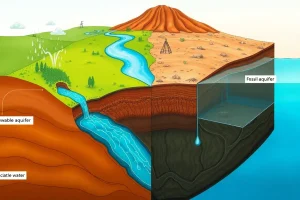
A fossil aquifer is an underground layer of permeable rock, sand, or gravel that holds water which entered the aquifer in the distant past, typically during a wetter climatic period. Unlike renewable aquifers that are replenished by current precipitation and surface water, fossil aquifers receive little to no recharge under present-day conditions. The water they contain is often referred to as “fossil water” or “paleowater” because it has been trapped underground for thousands to millions of years. These aquifers are essentially non-renewable resources; once the stored water is extracted, it cannot be replaced on a human timescale.
Fossil aquifers are found worldwide, but they are especially critical in arid and semi-arid regions where they represent the only significant source of freshwater. Their existence is a legacy of past climates, such as the last ice age, when wetter conditions allowed for substantial groundwater recharge. Today, they are often deep, confined aquifers protected by impermeable layers, which have preserved the water from contamination but also prevent natural replenishment. Understanding their nature is essential for sustainable water management, as their use involves a trade-off between present needs and future availability.
Overview
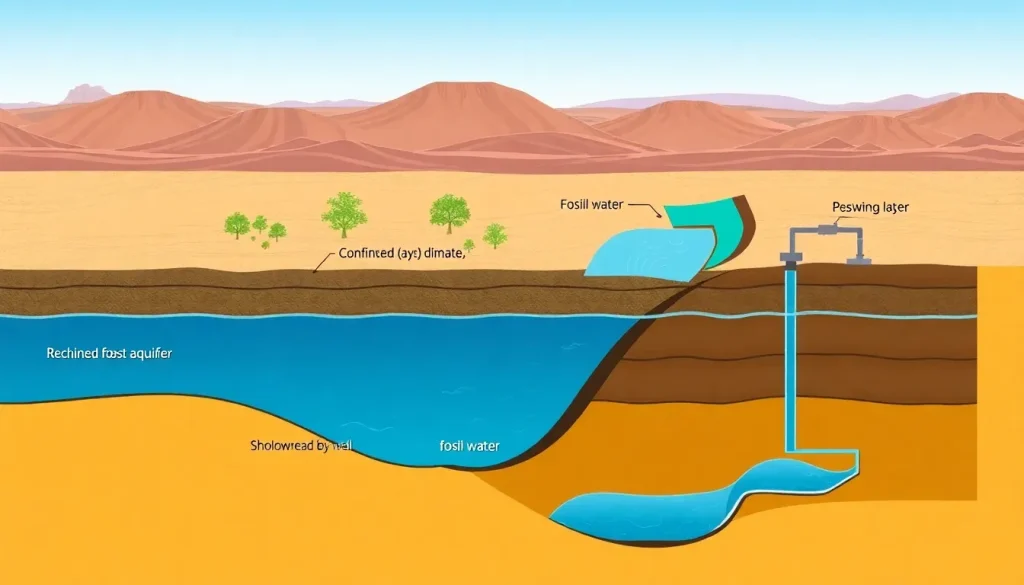
Fossil aquifers are a subset of confined aquifers, meaning they are sandwiched between layers of low-permeability rock or clay that restrict water movement. The water within them is often under pressure, leading to artesian conditions where water can flow to the surface without pumping if tapped. These aquifers vary greatly in size, depth, and water quality. Some, like the Nubian Sandstone Aquifer System in North Africa, cover vast areas and hold immense volumes of water, while others are smaller, localized pockets.
The age of the water can be determined through isotope dating, revealing recharge periods that align with past glacial or pluvial epochs. Because they are isolated from modern hydrological cycles, fossil aquifers are often free of contemporary pollutants, making them attractive for drinking water. However, their isolation also means that once depleted, they will not refill, turning them into a “water mine” rather than a sustainable resource. The water quality may vary, sometimes containing naturally occurring dissolved minerals or gases from long contact with the rock matrix.
How It Works
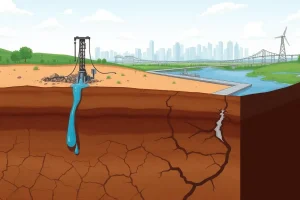
Fossil aquifers function as natural underground reservoirs. The water was originally recharged through infiltration from rainfall, rivers, or lakes during a time when the climate was much wetter. Over millennia, geological changes—such as the formation of impermeable cap layers or the shift to arid conditions—sealed off the aquifer, preventing further significant recharge. Today, water is accessed by drilling deep wells through the confining layers. In some cases, the aquifer is under pressure, creating artesian wells that flow without pumping.
As water is extracted, the pressure drops, and the water table declines. The rate of extraction far exceeds any modern recharge, so the aquifer is being “mined.” The water quality may change as the aquifer is drawn down, sometimes becoming more saline or drawing in poorer-quality water from adjacent formations. Understanding the aquifer’s geometry, storage, and past recharge rates is essential for estimating its lifespan under various extraction scenarios. Once the pressure falls below a certain point, pumping becomes necessary, increasing energy costs and the economic burden of water supply.
Examples
Several major fossil aquifers around the world illustrate the diversity and importance of these resources:
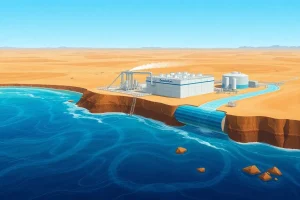
- Nubian Sandstone Aquifer System: One of the world’s largest fossil aquifers, underlying Egypt, Libya, Chad, and Sudan. It contains water recharged during the last glacial period and earlier wet phases. Libya’s Great Man-Made River project taps this aquifer to supply coastal cities.
- Ogallala Aquifer (High Plains, USA): While parts of the Ogallala receive some recharge, large portions—especially in the southern High Plains—contain fossil water from the Pleistocene. It supports extensive irrigation but is being rapidly depleted.
- Great Artesian Basin (Australia): This deep aquifer contains water up to 2 million years old. It is a vital resource for livestock and communities in arid inland Australia, though extraction has reduced artesian pressure.
- North China Plain Aquifers: Deep confined aquifers beneath the plain contain fossil water that is being heavily pumped for agriculture, leading to significant water-level declines.
Importance and Impact
Fossil aquifers are lifelines for many arid and semi-arid regions, supporting agriculture, industry, and domestic water supply. They enable human settlement and economic activity in areas that would otherwise be uninhabitable. For example, the Nubian Sandstone Aquifer allows oasis agriculture in the Sahara. However, their depletion has severe consequences. Falling water tables increase pumping costs and energy use, making water less affordable. In coastal areas, over-extraction can lead to saltwater intrusion.
Land subsidence is another risk, as the removal of water causes the aquifer matrix to compact, permanently reducing storage capacity and damaging infrastructure. The loss of a fossil aquifer can also trigger social and political instability, especially in transboundary contexts where multiple nations share the resource. The environmental impact extends to ecosystems that may have depended on natural discharge from these aquifers, such as springs and wetlands, which can dry up as water tables fall.
Benefits, Limitations and Trade-offs
Benefits: Fossil aquifers provide a reliable, high-quality water source in regions with no other viable options. They are often protected from surface contamination, requiring minimal treatment. Their use can spur economic development and food security.
Limitations: They are finite and non-renewable. Extraction is energy-intensive as water tables drop. Over-pumping can cause irreversible damage, such as subsidence and aquifer compaction. The exact volume and lifespan are often uncertain, complicating management.
Trade-offs: Using fossil water today supports current populations and economies but deprives future generations of the resource. There is a tension between immediate development needs and long-term sustainability. Some argue that fossil aquifers should be reserved for emergency use or high-value applications, while others see them as a necessary resource for present-day survival.
Common Misconceptions
FAQ
What is a fossil aquifer?
A fossil aquifer is an underground layer of water-bearing rock that contains ancient water, recharged thousands to millions of years ago, with little to no modern replenishment.
How does a fossil aquifer differ from a renewable aquifer?
Renewable aquifers are regularly recharged by precipitation and surface water, while fossil aquifers receive negligible recharge under current climatic conditions, making them non-renewable on human timescales.
Why does fossil aquifer depletion matter?
Depletion can lead to permanent loss of a critical water source, increased pumping costs, land subsidence, and potential conflicts over shared resources, especially in arid regions that depend on them.
References
- United States Geological Survey (USGS) – Groundwater Information
- UNESCO – International Hydrological Programme, Non-Renewable Groundwater Resources
- Foster, S. & Loucks, D.P. (2006). Non-Renewable Groundwater Resources: A Guidebook on Socially-Sustainable Management for Water-Policy Makers. UNESCO.