In brief
At a glance
Quick Facts
- Global desalination capacity
- Over 95 million cubic meters per day, with more than 20,000 plants worldwide.
- Primary technology
- Reverse osmosis accounts for about 70% of global desalination capacity.
- Energy consumption
- Seawater reverse osmosis typically uses 3–4 kWh per cubic meter of water produced.
- Cost range
- Desalinated water costs between $0.50 and $2.00 per cubic meter, depending on location and energy prices.
- Brine production
- Global desalination plants produce an estimated 142 million cubic meters of brine daily.
- Regional concentration
- The Middle East and North Africa account for nearly 50% of worldwide desalination capacity.
Key Takeaways
- Desalination can provide a reliable, climate-independent source of freshwater, but it is not a universal solution to water scarcity due to high costs, energy demands, and environmental concerns.
- Reverse osmosis is the most widely used desalination technology, accounting for the majority of new plants worldwide.
- Brine disposal and greenhouse gas emissions are the primary environmental challenges that limit the sustainability of large-scale desalination.
- Desalination is most effective when integrated with water conservation, recycling, and demand management strategies.
What Is Desalination?
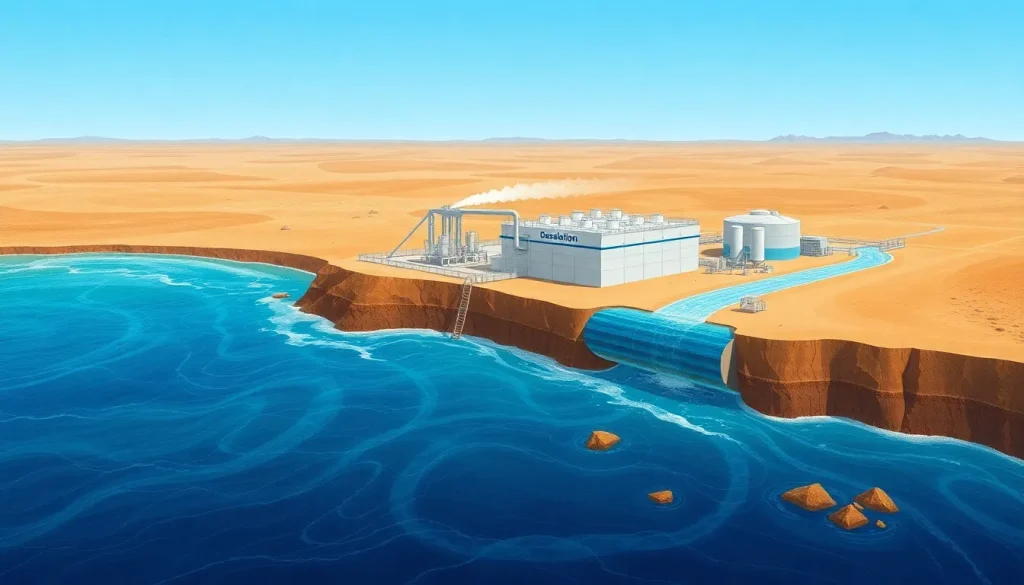
Desalination is the process of removing dissolved salts and minerals from seawater or brackish water to produce fresh water suitable for human consumption, irrigation, or industrial use. It is a technological intervention that expands the available water supply by tapping into the vast oceans, which hold over 97% of the Earth’s water but are too saline for direct use. Desalination is categorized as a non-conventional water resource, alongside treated wastewater reuse and rainwater harvesting, and is employed in regions where natural freshwater sources are insufficient or overexploited.
While desalination has been practiced for centuries in rudimentary forms, modern industrial-scale plants emerged in the mid-20th century. Today, desalination is a critical component of water security strategies in arid and semi-arid regions, particularly in the Middle East, North Africa, and parts of the Mediterranean. However, its role in solving global water scarcity is debated: it offers a drought-proof supply but faces significant economic, energy, and environmental hurdles that prevent it from being a standalone solution.
How It Works
Modern desalination relies primarily on two methods: thermal distillation and membrane separation. Thermal distillation mimics the natural water cycle by heating saline water to produce steam, which is then condensed into fresh water, leaving salts behind. The most common thermal methods are multi-stage flash distillation (MSF) and multi-effect distillation (MED). These are energy-intensive and often coupled with power plants in cogeneration schemes.
Membrane-based desalination, particularly reverse osmosis (RO), has become the dominant technology due to its lower energy consumption. In RO, seawater is pressurized against a semipermeable membrane that allows water molecules to pass through while blocking salts and other impurities. The pressure required is typically 55–70 bar for seawater, and energy recovery devices have significantly improved efficiency. Other membrane processes include electrodialysis, used mainly for brackish water. Pre-treatment to remove particles and biological matter is essential to prevent membrane fouling. The output is two streams: fresh water (permeate) and concentrated brine (reject).
Benefits, Limitations and Trade-offs
Desalination offers a climate-resilient water source that is not dependent on rainfall, snowmelt, or river flows, making it especially valuable in drought-prone regions. It can provide a reliable, high-quality supply for municipal, industrial, and agricultural uses, reducing pressure on overexploited groundwater and surface water bodies. In coastal cities, desalination can serve as a strategic buffer against water shortages, ensuring continuity of supply during dry periods. Technological advances have steadily reduced the energy consumption and cost of desalinated water, making it more accessible.
However, desalination is capital-intensive, with high upfront construction costs and significant ongoing operational expenses, primarily due to energy consumption. The cost of desalinated water, while declining, remains higher than most conventional freshwater sources, limiting its affordability for low-income communities and agricultural use. Energy requirements are substantial: even efficient reverse osmosis plants consume 3–4 kWh per cubic meter, and energy can account for up to half of operational costs. This energy intensity ties water costs to energy prices and raises concerns about greenhouse gas emissions if fossil fuels are used. Furthermore, desalination is only feasible for coastal areas or regions with access to brackish groundwater; transporting desalinated water inland is prohibitively expensive due to pumping costs and infrastructure needs.
Environmental and Human Impacts
The primary environmental concern is brine discharge, a concentrated salt solution that is typically released back into the ocean. If not properly dispersed, brine can increase salinity and temperature locally, harming marine ecosystems such as seagrasses, coral reefs, and benthic organisms. Intake systems can also cause impingement and entrainment of marine life, though modern designs use subsurface intakes or fine screens to mitigate this. Desalination plants also consume significant amounts of energy, contributing to air pollution and carbon emissions unless powered by renewables.
On the human side, desalination can improve water security and public health by providing a safe drinking water supply, but high water costs may disproportionately affect poorer households if not subsidized. In some regions, reliance on desalination has enabled economic growth and urban development in otherwise water-scarce areas, but it also creates a dependency on energy-intensive infrastructure that may be vulnerable to energy price shocks or supply disruptions.
Regional Differences
The role of desalination varies dramatically by region. The Middle East and North Africa account for nearly half of global desalination capacity, driven by extreme water scarcity, wealth from energy exports, and coastal population centers. Countries like Saudi Arabia, the United Arab Emirates, and Kuwait rely heavily on desalination for municipal water. In contrast, regions with more abundant freshwater resources, such as North America and Europe, use desalination sparingly, often as a supplemental source during droughts (e.g., California, Spain). Australia invested in large-scale seawater desalination plants during the Millennium Drought, but many now operate at low capacity or are on standby. In sub-Saharan Africa, despite severe water scarcity, desalination remains limited due to high costs and energy constraints, though small-scale solar-powered units are emerging.
Examples
Several notable examples illustrate the potential and challenges of desalination. Saudi Arabia’s Ras Al-Khair plant is one of the world’s largest, combining thermal and membrane technologies to produce over 1 million cubic meters per day, supplying Riyadh and other cities. Israel’s Sorek plant, one of the largest seawater reverse osmosis facilities, provides about 20% of the country’s municipal water at a relatively low cost, demonstrating how technology and scale can improve efficiency. In Australia, the Victorian Desalination Plant was built in response to severe drought but has been used intermittently, highlighting the challenge of maintaining expensive infrastructure for emergency use. California’s Carlsbad Desalination Plant supplies about 10% of San Diego County’s water, but its high cost and energy use have sparked debate about whether conservation and recycling would be more cost-effective.
Solutions and Integration
Desalination alone cannot solve water scarcity; it must be part of an integrated water resource management strategy. This includes demand management through water conservation, leak reduction, and efficient irrigation; water recycling and reuse; and protection of existing freshwater sources. Coupling desalination with renewable energy, such as solar or wind, can reduce its carbon footprint and long-term costs. Advances in membrane technology, brine mining (extracting valuable minerals from brine), and zero-liquid discharge systems aim to mitigate environmental impacts. Policy measures, such as appropriate water pricing and regulations on brine disposal, are essential to ensure desalination contributes to sustainable water security without causing undue harm.
FAQ
What is desalination?
Desalination is the process of removing salt and other minerals from seawater or brackish water to produce fresh water suitable for drinking, irrigation, or industrial use.
How does desalination work?
Most modern desalination uses reverse osmosis, where high pressure forces seawater through a membrane that blocks salt and impurities, allowing only water molecules to pass through. Thermal distillation methods boil water and condense the steam.
Why does desalination matter for water scarcity?
Desalination provides a climate-independent water source that can supplement traditional supplies in water-scarce regions, but its high cost, energy use, and environmental impacts mean it is not a standalone solution and must be part of a broader water management strategy.
References
- United Nations World Water Development Report, UNESCO
- International Desalination Association (IDA) Desalination Yearbook
- National Research Council. (2008). Desalination: A National Perspective. The National Academies Press.