In brief
At a glance
Quick Facts
- Definition
- The global carbon budget is the cumulative amount of net global CO₂ emissions that can be released while limiting warming to a given temperature target with a specified probability.
- Key Relationship
- Global warming is approximately linearly related to total cumulative CO₂ emissions, a metric known as the Transient Climate Response to Cumulative Carbon Emissions (TCRE).
- Total Budget for 2°C
- For a 66% chance of staying below 2°C, the total carbon budget from the pre-industrial era is about 2,900 GtCO₂, according to the IPCC Fifth Assessment Report.
- Historical Emissions
- By the early 2020s, cumulative human-caused CO₂ emissions since 1870 had reached roughly 2,400 GtCO₂, consuming most of the budget for 1.5°C and a large share of the 2°C budget.
- Remaining Budget for 1.5°C
- The IPCC Sixth Assessment Report estimated the remaining carbon budget from 2020 for a 50% chance of limiting warming to 1.5°C at about 500 GtCO₂.
- Annual Depletion Rate
- Global CO₂ emissions from fossil fuels and industry are around 40 GtCO₂ per year, meaning the remaining budget is being depleted at a rapid pace.
- Non-CO₂ Gases
- The carbon budget applies specifically to CO₂, but emissions of other greenhouse gases like methane can reduce the available budget by contributing to warming.
Key Takeaways
- The global carbon budget is the maximum amount of cumulative net global carbon dioxide (CO₂) emissions that can be released while still limiting global warming to a specific temperature target, such as 1.5°C or 2°C above pre-industrial levels.
- It is based on the well-established near-linear relationship between total cumulative CO₂ emissions and the resulting increase in global mean surface temperature.
- The budget is finite; once it is exhausted, net CO₂ emissions must reach zero to halt further warming, making it a critical benchmark for climate policy and action.
- Understanding the remaining carbon budget helps governments and industries set emission reduction pathways and underscores the urgency of transitioning to a low-carbon economy.
What Is the Global Carbon Budget?
The global carbon budget is a scientific estimate of the total amount of carbon dioxide (CO₂) that can be emitted into the atmosphere from human activities while still keeping global warming below a specified temperature limit, such as 1.5°C or 2°C above pre-industrial levels. It is a cumulative budget, meaning it accounts for all CO₂ emissions from the start of the industrial era (around 1870) onward, and it defines a finite cap on total emissions to avoid the most dangerous impacts of climate change. The concept emerged from climate research showing that the peak warming is approximately proportional to the total amount of CO₂ emitted over time, rather than the rate of emissions in any given year.
This budget is often expressed in gigatonnes of CO₂ (GtCO₂), where one gigatonne equals one billion metric tonnes. The total carbon budget for a given temperature target is divided into two parts: the historical emissions already released, and the remaining carbon budget that can still be emitted. Because a large portion of the total budget has already been used, the remaining budget is relatively small, highlighting the need for rapid and deep emissions cuts. The global carbon budget is a cornerstone of climate science and policy, informing international agreements like the Paris Agreement and guiding national commitments to reduce greenhouse gas emissions.
Overview
The global carbon budget concept was formalized by the Intergovernmental Panel on Climate Change (IPCC) in its Fifth Assessment Report (2013–2014) and has since become a central framework for understanding the link between cumulative emissions and global warming. It is not an annual emissions limit but a total cumulative allowance, analogous to a financial budget that cannot be exceeded without incurring debt—in this case, additional warming. The budget is typically defined for different temperature targets (most commonly 1.5°C and 2°C) and for different probabilities of staying below those targets (e.g., a 50% or 66% chance). The remaining budget is updated periodically by the Global Carbon Project and the IPCC as scientific understanding improves and as emissions continue.
The budget applies specifically to CO₂ because of its long atmospheric lifetime and dominant role in human-caused warming. However, other greenhouse gases and aerosols also influence the climate, and their emissions can effectively reduce the available carbon budget. The concept has profound implications: it demonstrates that the total amount of CO₂ that can ever be emitted is limited, and that most of the budget for the most ambitious temperature goals has already been consumed. This makes the remaining budget a critical metric for tracking progress toward the Paris Agreement goals.
How It Works
The scientific foundation of the global carbon budget is the near-linear relationship between cumulative CO₂ emissions and global mean surface temperature rise. This relationship is captured by a metric called the Transient Climate Response to Cumulative Carbon Emissions (TCRE), which quantifies the warming per trillion tonnes of carbon emitted. TCRE is estimated to range from about 0.8°C to 2.5°C per 1,000 GtCO₂, with a best estimate around 1.65°C per 1,000 GtCO₂. Because this ratio is roughly constant, the total warming can be directly linked to the total amount of CO₂ released, regardless of the emission pathway.
To calculate the budget, scientists use Earth system models and observational data to determine the total allowable cumulative emissions for a given temperature target. They then subtract the cumulative emissions already released since the pre-industrial period. The result is the remaining carbon budget. Several factors influence the calculation:
- Non-CO₂ climate forcings: The warming from other greenhouse gases (e.g., methane, nitrous oxide) and the cooling from aerosols affect how much CO₂ can be emitted while still meeting a temperature goal.
- Earth system feedbacks: Processes like permafrost thaw or changes in carbon uptake by oceans and land can amplify or dampen warming, altering the budget.
- Probability choice: A higher probability of staying below a target (e.g., 66% vs. 50%) requires a smaller budget, as it leaves less room for uncertainty.
- Historical emissions uncertainty: Estimates of past emissions, especially from land-use change, carry some uncertainty that affects the remaining budget calculation.
What the Evidence Shows
Multiple lines of evidence from climate models, paleoclimate records, and observations support the carbon budget framework. According to the IPCC Sixth Assessment Report (2021), the total carbon budget from the pre-industrial period (1850–1900) for a 50% likelihood of limiting warming to 1.5°C is about 2,900 GtCO₂, and for a 66% likelihood it is about 2,500 GtCO₂. For a 2°C target, the total budget is larger: roughly 3,700 GtCO₂ for a 50% chance and 3,200 GtCO₂ for a 66% chance.
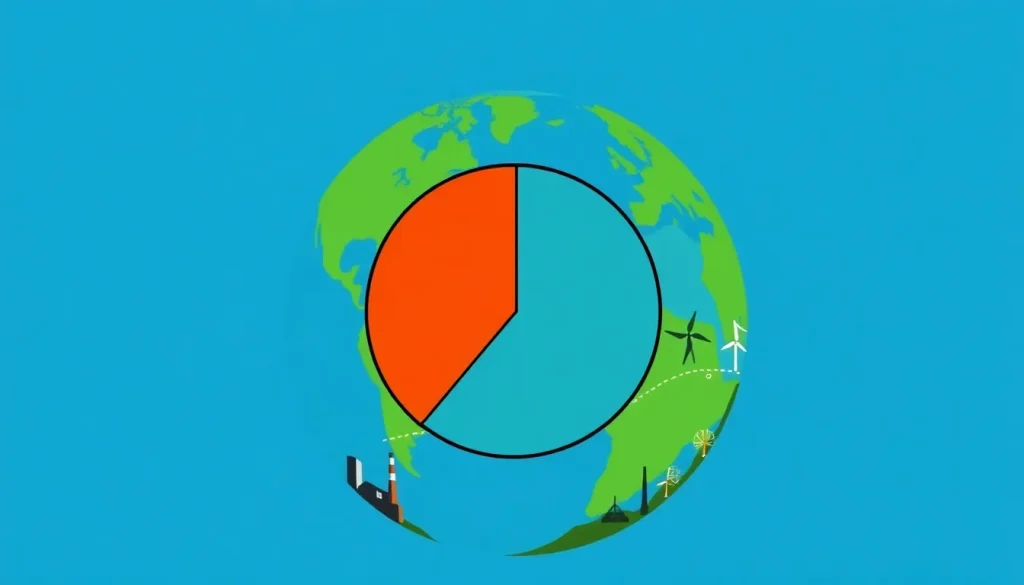
By the beginning of 2020, cumulative human-caused CO₂ emissions had already reached approximately 2,400 GtCO₂. This means the remaining carbon budget from 2020 for a 50% chance of 1.5°C was about 500 GtCO₂, and for a 66% chance it was around 300 GtCO₂. For 2°C, the remaining budgets were larger—about 1,350 GtCO₂ and 900 GtCO₂, respectively. With global CO₂ emissions from fossil fuels and industry averaging around 40 GtCO₂ per year, the 1.5°C budget would be exhausted in roughly a decade or two if emissions do not decline rapidly. These numbers illustrate the urgency of deep and immediate emission reductions.
Importance and Impact
The global carbon budget has transformed climate policy by providing a clear, quantitative limit on total emissions. It underpins the scientific rationale for net-zero emissions targets, which require that any remaining CO₂ emissions be balanced by removals once the budget is exhausted. The Paris Agreement’s goal of holding warming well below 2°C and pursuing efforts to limit it to 1.5°C is directly informed by carbon budget analysis. Countries and corporations use the budget to set emission reduction pathways and to assess the adequacy of their commitments.
Beyond policy, the budget concept has significant economic and social implications. It highlights the need for a rapid transition away from fossil fuels, the potential role of carbon dioxide removal technologies, and the risks of exceeding the budget (overshoot), which could necessitate large-scale negative emissions later. The finite nature of the budget also raises questions of equity, as different nations have contributed unequally to historical emissions and have varying capacities to reduce future emissions. Thus, the global carbon budget is not only a scientific tool but also a framework for international climate negotiations and justice.
Data Limitations and Uncertainties
While the carbon budget is a robust concept, its precise numerical value is subject to several uncertainties. The TCRE relationship, though linear, has a range that translates into a spread of possible budgets. Additionally, the climate response to non-CO₂ forcings, such as methane and aerosols, is not perfectly known, and future changes in these forcings can expand or contract the CO₂ budget. Earth system feedbacks, like the release of carbon from thawing permafrost or changes in ocean circulation, are difficult to quantify and could reduce the remaining budget.
Historical emission estimates, particularly from land-use change and deforestation, carry uncertainties that affect the calculation of the remaining budget. The choice of pre-industrial reference period and the definition of the temperature target (e.g., using global mean surface air temperature versus blended ocean temperatures) also introduce small variations. Despite these uncertainties, the overall message remains unchanged: the remaining budget for ambitious temperature limits is small relative to current emission rates, and rapid reductions are essential. The uncertainties do not undermine the need for urgent action but rather emphasize the importance of precautionary approaches.
FAQ
What is the global carbon budget?
The global carbon budget is the maximum amount of cumulative net global CO₂ emissions that can be released while still limiting global warming to a specific temperature target, such as 1.5°C or 2°C above pre-industrial levels, with a given probability.
How is the global carbon budget calculated?
It is calculated using climate models and observations that establish the near-linear relationship between cumulative CO₂ emissions and global temperature rise. Scientists estimate the total allowable emissions for a temperature target and subtract historical emissions to determine the remaining budget.
Why does the global carbon budget matter?
It provides a clear scientific limit for total CO₂ emissions, guiding international climate policy, national emission reduction targets, and the timeline for achieving net-zero emissions. It underscores the urgency of reducing emissions to avoid the worst impacts of climate change.
References
- IPCC, 2013: Climate Change 2013: The Physical Science Basis. Contribution of Working Group I to the Fifth Assessment Report of the Intergovernmental Panel on Climate Change.
- IPCC, 2021: Climate Change 2021: The Physical Science Basis. Contribution of Working Group I to the Sixth Assessment Report of the Intergovernmental Panel on Climate Change.
- Global Carbon Project. (Annual updates and data on global carbon budgets).
- Matthews, H.D., Gillett, N.P., Stott, P.A. and Zickfeld, K. (2009). 'The proportionality of global warming to cumulative carbon emissions.' Nature, 459, 829–832.