In brief
At a glance
Quick Facts
- First coined by
- Ecologist Robert Paine in 1980
- Classic marine example
- Sea otter → sea urchin → kelp forest cascade
- Classic terrestrial example
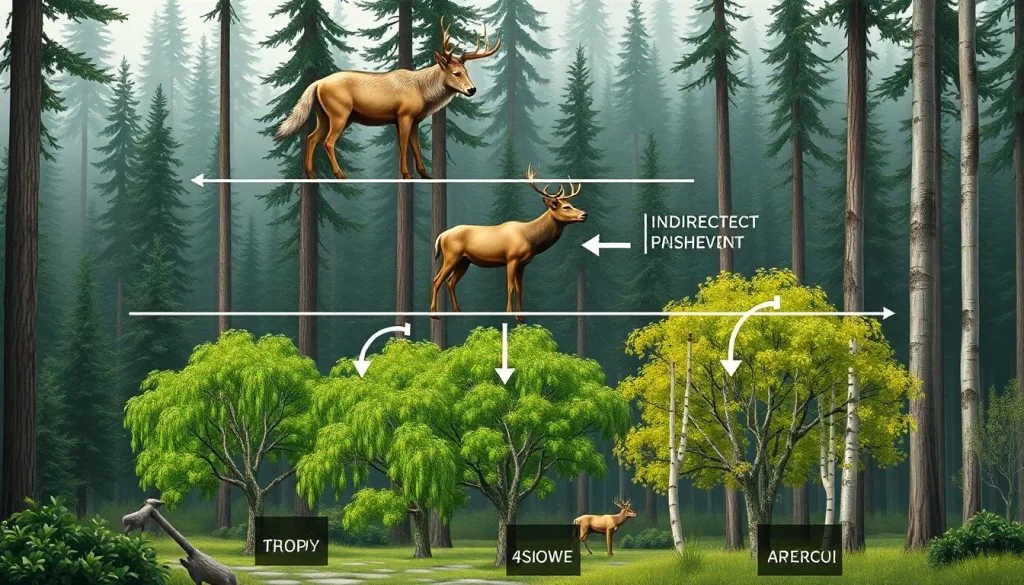
- Wolf → elk → willow/aspen cascade in Yellowstone
- Key mechanism
- Predators control herbivore numbers and behavior, indirectly benefiting plants
- Ecosystem effects
- Can alter biodiversity, nutrient cycling, river courses, and carbon storage
- Human disruption
- Overhunting, habitat loss, and climate change can trigger or break cascades
- Not always top-down
- Bottom-up cascades start with changes in primary productivity
- Behavioral cascades
- Fear of predators can change prey foraging patterns, benefiting vegetation even without large prey declines
Key Takeaways
- A trophic cascade is an indirect ecological effect where changes at one trophic level cause reciprocal changes in the abundance or behavior of species at other levels, often altering the entire ecosystem.
- Trophic cascades can be top‑down (driven by predators) or bottom‑up (driven by primary producers), but the term most commonly refers to top‑down cascades.
- Classic examples include the reintroduction of wolves to Yellowstone, which reduced elk browsing and allowed willow and aspen recovery, and the decline of sea otters, which led to sea urchin outbreaks and kelp forest collapse.
- Trophic cascades demonstrate the profound importance of apex predators in maintaining biodiversity, ecosystem structure, and resilience.
- Human activities such as overhunting, habitat fragmentation, and climate change can disrupt or trigger trophic cascades, often with unintended consequences.
What Is Trophic Cascades Explained With Examples?
A trophic cascade is an ecological process that starts at the top of the food chain and tumbles all the way down to the bottom, or vice versa. The term describes the powerful indirect interactions that occur when predators in a food web suppress the abundance or alter the behavior of their prey, thereby releasing the next lower trophic level from predation or grazing pressure. These cascading effects can propagate through multiple trophic levels, fundamentally reshaping the ecosystem’s composition, physical structure, and nutrient dynamics.
In a classic top‑down cascade, the removal of an apex predator leads to an increase in the population of its prey (mesopredators or herbivores). The overabundant herbivores then overgraze or overbrowse the primary producers (plants or algae), causing a decline in vegetation and a loss of habitat for other species. Conversely, the reintroduction or recovery of a top predator can reverse the cascade, restoring balance. Trophic cascades are not limited to predator–prey relationships; they can also be triggered by changes in primary productivity (bottom‑up cascades) or by behavioral shifts, such as prey altering their foraging patterns to avoid predation, which can have landscape‑level effects on plant communities.
How It Works
Trophic cascades operate through a series of linked interactions across at least three trophic levels. In a simplified three‑level system, the mechanism is straightforward:
- Top predators (e.g., wolves, sharks, sea otters) control the population size and behavior of their prey.
- Herbivores or mesopredators (e.g., elk, sea urchins, small carnivores) are the prey of the top predators. When top predators are abundant, herbivore numbers are kept in check, and their foraging is often restricted to safer, less productive areas.
- Primary producers (e.g., trees, kelp, grasses) benefit from reduced herbivory, allowing them to thrive and support a diverse community of other organisms.
When a top predator is removed, the system can flip: herbivore populations explode, overconsuming vegetation and degrading the habitat. This is a top‑down cascade. A bottom‑up cascade occurs when changes in primary productivity (e.g., nutrient enrichment) ripple upward, increasing herbivore numbers and then predator numbers. Behavioral cascades, a subset of top‑down effects, occur when the mere presence of a predator alters prey behavior (e.g., elk avoid risky areas), indirectly benefiting plants even without a large reduction in herbivore numbers.
Examples
Several well‑documented case studies illustrate the power of trophic cascades across different ecosystems:
- Yellowstone National Park (wolves, elk, and willows/aspen): After wolves were extirpated in the 1920s, elk populations grew and overbrowsed riparian vegetation, causing declines in willow and aspen stands, which in turn affected beavers and songbirds. Following wolf reintroduction in 1995, elk numbers decreased and their behavior changed—they avoided open areas where they were more vulnerable. This allowed willows and aspens to recover, stabilizing streambanks and creating habitat for beavers, whose dams further enhanced riparian ecosystems.
- North Pacific kelp forests (sea otters, sea urchins, and kelp): Sea otters are a keystone predator that controls sea urchin populations. When sea otters were hunted to near‑extinction during the maritime fur trade, sea urchin numbers exploded, overgrazing kelp forests and creating “urchin barrens.” The loss of kelp eliminated habitat for fish, invertebrates, and marine mammals. Where sea otters have recovered, urchin densities drop, kelp forests regenerate, and biodiversity rebounds.
- Aleutian Islands and coastal Alaska (killer whales, sea otters, and kelp): A decline in killer whales’ traditional prey (seals and sea lions) led some pods to switch to hunting sea otters. The resulting otter decline triggered a trophic cascade: urchin populations increased, kelp forests collapsed, and coastal ecosystems lost productivity and resilience.
- Venezuelan rainforest (top predators and seed dispersal): The loss of jaguars and other large predators from fragmented forests led to an explosion of herbivore populations (e.g., agoutis, peccaries), which overconsumed seeds and seedlings, altering tree species composition and reducing carbon storage.
Importance and Impact
Trophic cascades reveal the disproportionate influence that certain species—especially apex predators—have on ecosystem structure and function. Their presence or absence can determine the physical landscape, biodiversity, and even biogeochemical cycles. For example, the return of wolves to Yellowstone not only changed elk behavior but also triggered a chain of effects that increased beaver populations, altered river courses, and boosted riparian plant diversity. In marine systems, healthy kelp forests supported by sea otters sequester carbon, buffer coastlines from storm surges, and sustain commercial fisheries.
Understanding trophic cascades is critical for conservation and ecosystem management. It underscores that protecting a single keystone species can have far‑reaching benefits, while removing it can lead to ecosystem collapse. The concept also informs rewilding efforts, fisheries management, and the design of protected areas. Moreover, trophic cascades highlight the interconnectedness of life, demonstrating that no species exists in isolation and that human actions can have unintended, cascading consequences across entire ecosystems.
History
The idea that predators regulate prey populations and thereby influence plant communities has roots in early ecological thought, but the term “trophic cascade” was first explicitly used by ecologist Robert Paine in 1980. Paine’s earlier work on keystone species—particularly his experiments with sea stars in intertidal zones—laid the groundwork by showing that removing a single predator could drastically reduce species diversity. The concept gained widespread attention through the study of kelp forest ecosystems and the sea otter–urchin–kelp cascade, notably advanced by James Estes and colleagues in the 1990s.
The reintroduction of gray wolves to Yellowstone National Park in 1995 provided a landmark terrestrial example that captured public and scientific imagination. Research by William Ripple, Robert Beschta, and others documented the cascading effects on elk, vegetation, and even physical geography, solidifying the trophic cascade as a central concept in ecology. Since then, cascades have been identified in diverse systems—from lakes and rivers to tropical forests and agricultural landscapes—demonstrating their ubiquity and importance.
What the Evidence Shows
A large body of empirical research supports the existence and ecological significance of trophic cascades. Long‑term field studies, predator‑exclusion experiments, and comparative analyses of ecosystems with and without apex predators consistently show that the loss of top predators leads to increased herbivore densities, reduced plant biomass, and simplified community structure. In Yellowstone, decades of data on elk populations, browsing intensity, and vegetation recovery before and after wolf reintroduction provide compelling evidence for a behaviorally mediated trophic cascade.
However, the strength and occurrence of trophic cascades can vary depending on ecosystem complexity, productivity, and the presence of alternative prey or predators. Some ecosystems exhibit strong, linear cascades, while others show more diffuse or attenuated effects. Meta‑analyses of experimental studies confirm that removing top predators generally reduces plant biomass and alters community composition, but the magnitude of the effect depends on context. Overall, the evidence supports trophic cascades as a widespread and powerful ecological force, though not a universal one.
Common Misconceptions
FAQ
What is a trophic cascade?
A trophic cascade is an ecological phenomenon where changes at one trophic level (usually the top predator) cause a series of indirect effects that ripple through lower levels, often altering the entire ecosystem’s structure and function.
How does a trophic cascade work?
In a top‑down cascade, the presence of a top predator controls the population or behavior of herbivores. When the predator is removed, herbivores increase and overconsume plants, leading to habitat degradation. Reintroducing the predator can reverse the process.
Why do trophic cascades matter?
They demonstrate the critical role of apex predators in maintaining biodiversity, ecosystem resilience, and even physical landscape features. Understanding cascades helps guide conservation, rewilding, and ecosystem management decisions.
References
- Paine, R. T. (1980). Food webs: linkage, interaction strength and community infrastructure. Journal of Animal Ecology, 49(3), 667–685.
- Estes, J. A., Tinker, M. T., Williams, T. M., & Doak, D. F. (1998). Killer whale predation on sea otters linking oceanic and nearshore ecosystems. Science, 282(5388), 473–476.
- Ripple, W. J., & Beschta, R. L. (2012). Trophic cascades in Yellowstone: The first 15 years after wolf reintroduction. Biological Conservation, 145(1), 205–213.