In brief
At a glance
Quick Facts
- Definition
- Climate overshoot occurs when global average temperature temporarily exceeds a target (e.g., 1.5°C) before returning below it through carbon dioxide removal.
- Key requirement
- Overshoot scenarios depend on achieving net-negative emissions later in the century to draw down atmospheric CO₂.
- Paris Agreement context
- Most pathways that limit warming to 1.5°C involve some overshoot, according to the IPCC.
- Irreversible impacts
- Even temporary overshoot can cause permanent loss of coral reefs, ice sheets, and species.
- Carbon removal methods
- Afforestation, BECCS, direct air capture, and enhanced weathering are proposed to reverse overshoot.
- Temperature decline lag
- After CO₂ removal, temperatures may remain elevated for decades due to ocean heat uptake.
- Moral hazard
- Relying on future overshoot and removal may reduce the urgency of near-term emissions cuts.
Key Takeaways
- Climate overshoot describes a temporary exceedance of a global temperature limit, such as 1.5°C or 2°C, followed by a decline back below that threshold through carbon dioxide removal.
- Most emissions scenarios consistent with the Paris Agreement involve some degree of overshoot, relying on negative emissions technologies that are not yet proven at scale.
- Even a temporary overshoot can cause irreversible damage, including species extinction, ice sheet loss, and long-lasting sea-level rise.
- Minimizing the magnitude and duration of any overshoot is essential to reduce risks, requiring both rapid emissions cuts and responsible deployment of carbon removal.
What Is Climate Overshoot Explained?
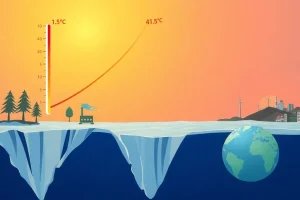
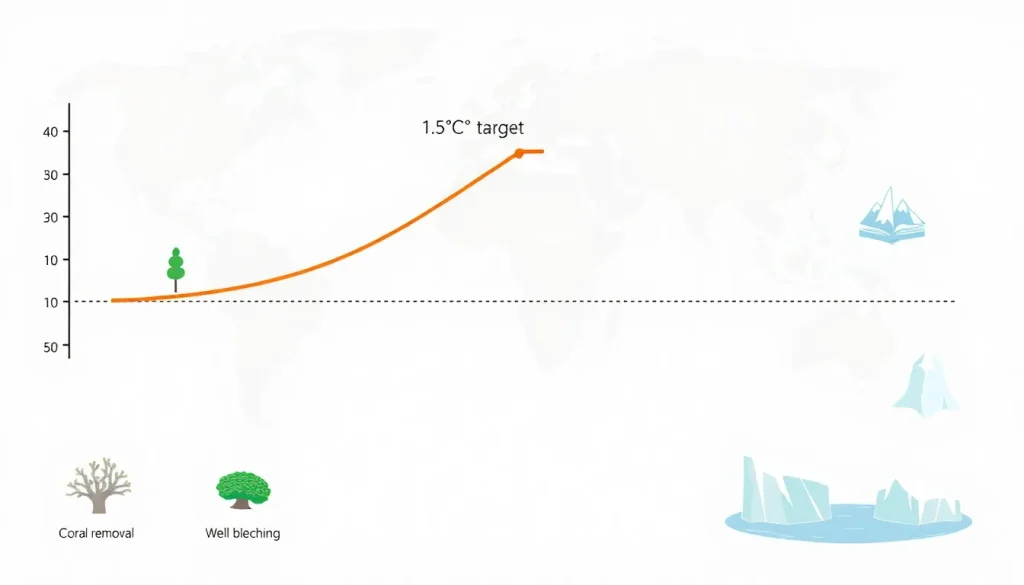
Climate overshoot is a scenario in which global average temperatures temporarily exceed a specified target, such as the 1.5°C or 2°C limits set by the Paris Agreement, before being brought back down through deliberate removal of carbon dioxide from the atmosphere. The concept is rooted in the physics of the climate system: because carbon dioxide accumulates and persists in the atmosphere for centuries, even if emissions were to cease immediately, temperatures would remain elevated. Overshoot pathways therefore assume that emissions will first push temperatures above the target and that subsequent negative emissions—achieved through technologies like direct air capture or afforestation—will draw down atmospheric CO₂, allowing temperatures to decline.
Overshoot is not a prediction but a feature of many modeled scenarios that limit long-term warming to 1.5°C or 2°C. These scenarios, assessed by the Intergovernmental Panel on Climate Change (IPCC), show that without immediate and drastic emissions reductions, the world is likely to exceed the 1.5°C threshold at least temporarily. The concept is thus central to climate policy discussions, as it frames the trade-offs between near-term action, reliance on future carbon removal, and the risks of crossing critical tipping points.
Overview
Climate overshoot is embedded in the broader framework of carbon budgets and temperature targets. A carbon budget is the total amount of CO₂ that can be emitted while still limiting warming to a given level. Because humanity has already used a large portion of the budget for 1.5°C, many pathways that stay within this budget require overshoot: emissions exceed the budget temporarily, then net-negative emissions later bring cumulative emissions back within the limit. The IPCC’s Special Report on 1.5°C found that in pathways with no or limited overshoot, global net anthropogenic CO₂ emissions decline by about 45% from 2010 levels by 2030, reaching net zero around 2050. In contrast, pathways with higher overshoot allow for later peaking and greater reliance on carbon removal.
Overshoot is not a single pathway but a spectrum. “Low overshoot” scenarios exceed the target by a small margin (less than 0.1°C) and for a short period, while “high overshoot” scenarios may exceed by 0.3°C or more and for several decades. The duration and magnitude of overshoot determine the severity of associated impacts, as some climate changes—such as sea-level rise from ice sheet melt—are irreversible on human timescales even if temperatures later decline.
How It Works
Climate overshoot operates through the interplay of cumulative CO₂ emissions, the transient climate response, and carbon removal. The global average temperature is roughly proportional to cumulative CO₂ emissions. If cumulative emissions exceed the budget for a given temperature limit, warming will surpass that limit. To later return below the limit, net-negative emissions must be achieved—meaning that more CO₂ is removed from the atmosphere than is emitted. This can be accomplished through carbon dioxide removal (CDR) methods such as afforestation, bioenergy with carbon capture and storage (BECCS), direct air capture (DAC), or enhanced weathering.
The timing and scale of CDR deployment are critical. In overshoot scenarios, emissions typically peak in the near term, decline rapidly, and reach net-zero around mid-century, after which net-negative emissions draw down atmospheric CO₂ concentrations. The rate of temperature decline depends on how quickly and how much CO₂ is removed, as well as the climate system’s inertia. Some processes, like ocean heat uptake, can delay cooling even after CO₂ concentrations fall. Moreover, the effectiveness of CDR methods is uncertain; many are still in early stages of development and face technical, economic, and environmental constraints.
Importance and Impact
Understanding overshoot is crucial because it directly affects the feasibility and risks of meeting climate goals. The Paris Agreement’s aim to limit warming to well below 2°C, and ideally 1.5°C, has made overshoot scenarios a focal point of climate policy. However, overshoot is not a benign delay tactic. Temporary exceedance of temperature thresholds can cause permanent damage to ecosystems and human systems. For example, coral reefs are highly sensitive to peak temperatures; even a brief overshoot above 1.5°C could trigger widespread bleaching and mortality from which reefs may not recover even if temperatures later decline.
Other impacts include accelerated melting of ice sheets and glaciers, which contributes to irreversible sea-level rise. Overshoot also increases the likelihood of crossing tipping points—critical thresholds beyond which changes become self-sustaining, such as the collapse of the West Antarctic Ice Sheet or the dieback of the Amazon rainforest. These risks escalate with the magnitude and duration of overshoot, making it imperative to minimize any temperature exceedance. Furthermore, reliance on future carbon removal to reverse overshoot introduces moral hazard: it may reduce the urgency of near-term emissions cuts, shifting the burden to future generations who must deploy unproven technologies at scale.
What the Evidence Shows
Scientific assessments, particularly from the IPCC, indicate that limiting warming to 1.5°C with no or limited overshoot requires rapid and far-reaching transitions in energy, land, urban infrastructure, and industrial systems. In pathways with no or limited overshoot, global net anthropogenic CO₂ emissions decline by about 45% from 2010 levels by 2030, reaching net zero around 2050. For pathways that allow higher overshoot, emissions reductions can be slower, but they rely heavily on CDR deployment later in the century. However, the IPCC also notes that CDR technologies face significant feasibility and sustainability constraints, and their large-scale deployment could compete with food production and biodiversity.
Evidence from climate models shows that even if temperatures are brought back down after an overshoot, some changes are irreversible on human timescales. For instance, sea-level rise from thermal expansion and ice sheet melt will continue for centuries, and species extinctions cannot be undone. The IPCC’s Sixth Assessment Report emphasizes that every increment of warming matters, and the risks of overshoot are substantially higher for 1.5°C than for 2°C. Thus, while overshoot scenarios are technically possible in models, they carry significant risks and uncertainties that make stringent near-term mitigation the safest path.
Common Misconceptions
A common misconception is that overshoot is a safe or desirable strategy because temperatures can be brought back down later. In reality, overshoot involves a gamble on future technologies and ignores the irreversibility of many climate impacts. Another misunderstanding is that overshoot is inevitable; while current emissions trajectories make some overshoot likely, the extent and duration can still be minimized through aggressive mitigation. Some also assume that carbon removal can quickly reverse temperature increases, but the climate system’s inertia means that even after CO₂ concentrations decline, temperatures may remain elevated for decades due to ocean heat uptake.
Additionally, there is confusion between “overshoot” and “exceedance.” Exceedance refers to any period where temperatures are above a target, while overshoot specifically implies a subsequent decline back below the target. Without large-scale net-negative emissions, an exceedance becomes a permanent failure to meet the target. Finally, overshoot is sometimes portrayed as a purely technical issue, but it involves profound ethical questions about intergenerational equity and the distribution of risks between those who benefit from delayed action and those who suffer the consequences.
Solutions
Addressing climate overshoot requires a two-pronged approach: aggressive near-term emissions reductions to limit the magnitude and duration of any overshoot, and responsible development of carbon dioxide removal (CDR) to draw down atmospheric CO₂. The primary solution is to decarbonize the global economy as rapidly as possible through renewable energy, electrification, energy efficiency, and sustainable land use. This reduces the cumulative emissions that cause overshoot in the first place.
For the removal side, a portfolio of CDR methods is needed, including nature-based solutions like reforestation and soil carbon sequestration, as well as technological approaches like direct air capture and carbon mineralization. However, these methods must be scaled up sustainably, with careful attention to land, water, and energy constraints. Governance frameworks are essential to ensure that CDR is not used as a substitute for emissions cuts but as a complement to address residual emissions and legacy CO₂. International cooperation, robust monitoring, and equitable burden-sharing are critical to managing overshoot risks.
FAQ
What is climate overshoot?
Climate overshoot is a scenario where global temperatures temporarily exceed a target, such as 1.5°C, before being brought back down through carbon dioxide removal from the atmosphere.
How does climate overshoot work?
It works by first allowing cumulative CO₂ emissions to surpass the carbon budget for a temperature limit, causing warming above that limit. Later, net-negative emissions—removing more CO₂ than is emitted—reduce atmospheric concentrations, and temperatures gradually decline.
Why does climate overshoot matter?
It matters because even a temporary overshoot can cause irreversible damage like species extinctions and sea-level rise, and it relies on carbon removal technologies that are not yet proven at scale, creating risks for future generations.
References
- IPCC, 2018: Global Warming of 1.5°C. An IPCC Special Report on the impacts of global warming of 1.5°C above pre-industrial levels and related global greenhouse gas emission pathways.
- IPCC, 2021: Climate Change 2021: The Physical Science Basis. Contribution of Working Group I to the Sixth Assessment Report of the Intergovernmental Panel on Climate Change.
- IPCC, 2022: Climate Change 2022: Mitigation of Climate Change. Contribution of Working Group III to the Sixth Assessment Report of the Intergovernmental Panel on Climate Change.