In brief
At a glance
Quick Facts
- Definition of Deforestation
- Permanent conversion of forest to non-forest land use, such as agriculture or urban development.
- Definition of Forest Degradation
- Reduction in a forest's capacity to provide ecosystem services without a change in land use.
- Primary Driver of Deforestation
- Agricultural expansion, including commercial crops and subsistence farming.
- Primary Driver of Degradation
- Unsustainable logging, fuelwood collection, overgrazing, and fire.
- Carbon Impact
- Deforestation releases stored carbon; degradation reduces carbon sequestration capacity.
- Biodiversity
- Both lead to habitat loss, but deforestation causes immediate and complete loss, while degradation causes gradual decline.
- Global Forest Cover
- Forests cover approximately 31% of Earth's land area.
- Monitoring
- Deforestation is easily detected by satellite; degradation is harder to monitor due to subtle changes.
- Reversibility
- Degraded forests can often recover if pressures are removed; deforestation is typically irreversible without reforestation.
- Policy Framework
- REDD+ program addresses both deforestation and degradation through financial incentives.
Key Takeaways
- Deforestation is the permanent conversion of forest to non-forest land uses, while forest degradation is the reduction of a forest’s quality and capacity to provide ecosystem services without a change in land use.
- Both processes are major contributors to global biodiversity loss, climate change, and the disruption of water cycles, but they require distinct monitoring and policy approaches.
- Agricultural expansion is the primary driver of deforestation, whereas unsustainable logging, fuelwood collection, and overgrazing are leading causes of degradation.
- Addressing both issues demands integrated solutions that combine sustainable land management, conservation, restoration, and supportive governance frameworks.
What Is Deforestation vs Forest Degradation?
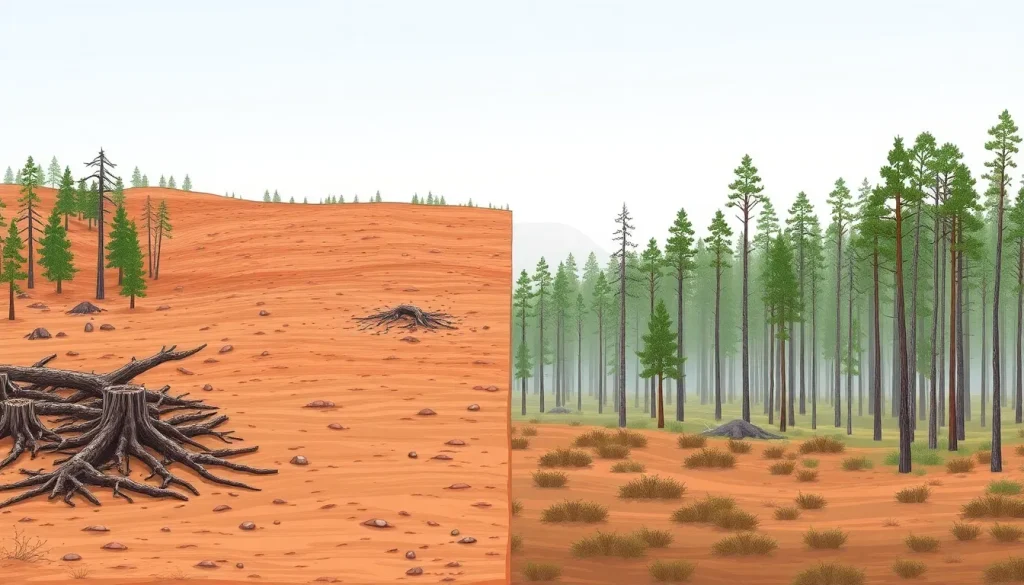
Deforestation is the complete and permanent removal of forest cover, resulting in the conversion of forest land to non-forest uses such as agriculture, urban development, or mining. It represents a categorical change in land use, where the forest ecosystem is replaced by something else, and the land is no longer classified as forest. This process is often driven by the demand for agricultural commodities, timber, and land for infrastructure. Once deforestation occurs, the forest’s ability to provide ecosystem services—such as carbon sequestration, biodiversity habitat, and water regulation—is lost, and recovery through natural regeneration can take centuries or may never occur without active restoration.
Forest degradation, on the other hand, is a more subtle but equally concerning process. It refers to the reduction in the capacity of a forest to provide goods and services without a change in land use. A degraded forest remains a forest, but its structure, function, and species composition are altered, often resulting in lower biomass, reduced biodiversity, and diminished ecological integrity. Degradation can be caused by selective logging, overgrazing, fuelwood collection, invasive species, or the impacts of climate change such as increased fire frequency and drought. Unlike deforestation, degradation does not involve a clear boundary change, making it harder to detect and monitor. However, it can be a precursor to deforestation, as degraded forests become more susceptible to clearing, fire, and disease.
Overview
Forests cover approximately 31% of the Earth’s land surface and play a vital role in maintaining global ecological balance. They are home to the majority of terrestrial biodiversity, regulate the climate by absorbing carbon dioxide, and support the livelihoods of billions of people. Despite their importance, forests are under constant threat from human activities. Deforestation and forest degradation are the two primary processes driving forest loss and decline, but they operate in different ways and have distinct implications for conservation and sustainable development.
Deforestation is most acute in tropical regions, where vast areas of rainforest are cleared for agriculture, particularly for commodities like palm oil, soy, and beef. Forest degradation, while also prevalent in the tropics, is a significant issue in temperate and boreal forests as well, often resulting from unsustainable logging practices, fire, and pest outbreaks. The distinction between the two is not merely academic; it has profound consequences for how we measure forest change, account for carbon emissions, and design interventions. International frameworks such as the United Nations’ Reducing Emissions from Deforestation and Forest Degradation (REDD+) explicitly recognize both processes, aiming to create financial incentives for developing countries to protect and restore their forests.
How It Works
Deforestation typically begins with the complete removal of tree cover, often through clear-cutting or slash-and-burn methods. In clear-cutting, all trees in a given area are harvested, leaving the land bare. Slash-and-burn involves cutting and then burning the vegetation to clear land for agriculture, a practice common in tropical regions. Once the forest is removed, the land is converted to other uses, and the forest ecosystem is effectively destroyed. The process is often driven by economic incentives, where the value of the land for agriculture or development outweighs the value of the standing forest.
Forest degradation, in contrast, is a gradual process that reduces the quality of the forest without eliminating it entirely. It can occur through:
- Selective logging: The removal of high-value tree species, which can damage surrounding trees, compact soil, and open the canopy, altering the forest microclimate and making it more susceptible to fire and invasive species.
- Overgrazing: Livestock browsing on young trees and understory vegetation, preventing regeneration and compacting soil.
- Fuelwood collection: The unsustainable harvesting of wood for cooking and heating, which can deplete tree populations and degrade forest structure.
- Fire: Both natural and human-induced fires can kill trees, reduce biodiversity, and release carbon, with degraded forests often burning more intensely.
- Invasive species: Non-native plants, pests, and pathogens can outcompete native species and alter ecosystem dynamics.
- Climate change: Rising temperatures, altered precipitation patterns, and increased frequency of extreme events can stress forests, making them more vulnerable to degradation.
Over time, these pressures can accumulate, leading to a forest that is structurally simplified, species-poor, and less resilient. In many cases, degradation sets the stage for eventual deforestation, as the land becomes less valuable as forest and more likely to be converted.
Main Causes or Drivers
The drivers of deforestation and forest degradation are often interconnected but can be distinguished by their direct and underlying causes. Direct causes are the immediate human activities that result in forest loss or decline, while underlying causes are the broader social, economic, and political factors that enable these activities.
Direct drivers of deforestation:
- Agricultural expansion: This is the single largest driver, accounting for the majority of deforestation globally. Commercial agriculture for commodities like soy, palm oil, and beef, as well as subsistence farming, leads to large-scale forest clearing.
- Logging: Both legal and illegal timber extraction can lead to deforestation when it is followed by land conversion or when logging roads open up previously inaccessible areas to settlement and agriculture.
- Infrastructure development: The construction of roads, dams, mines, and urban areas directly removes forest cover and fragments remaining forests.
- Mining: Surface mining for minerals and fossil fuels can result in complete deforestation and severe environmental degradation.
Direct drivers of forest degradation:
- Unsustainable logging: Selective logging that exceeds the forest’s regenerative capacity, often conducted illegally or without proper management plans.
- Fuelwood collection and charcoal production: In many developing regions, reliance on wood for energy leads to the gradual depletion of forest resources.
- Overgrazing: Livestock grazing in forests can prevent tree regeneration and degrade understory vegetation.
- Fire: Uncontrolled fires, often set intentionally for land clearing or accidentally spread, can severely degrade forests.
- Pests and diseases: Outbreaks of insects or pathogens, sometimes exacerbated by climate change, can kill large numbers of trees and reduce forest health.
Underlying causes include poverty, weak governance, insecure land tenure, population growth, and global market demand for forest-risk commodities. These factors create conditions where deforestation and degradation become economically rational or difficult to control.
Environmental and Human Impacts
Both deforestation and forest degradation have far-reaching environmental and human consequences, though the nature and scale of impacts can differ.
Environmental impacts:
- Biodiversity loss: Deforestation results in the immediate destruction of habitat, leading to species extinction and population declines. Degradation reduces habitat quality and can cause more gradual biodiversity loss, but it also fragments populations and disrupts ecological interactions.
- Climate change: Forests are major carbon sinks. Deforestation releases stored carbon into the atmosphere, contributing significantly to greenhouse gas emissions. Degradation reduces the forest’s capacity to sequester carbon, and ongoing degradation can turn a forest from a carbon sink into a carbon source.
- Water cycle disruption: Forests regulate water flow, prevent soil erosion, and maintain local and regional rainfall patterns. Deforestation can lead to reduced rainfall, increased flooding, and soil degradation. Degradation impairs these functions, though often less dramatically.
- Soil degradation: The removal of tree cover exposes soil to erosion, nutrient loss, and compaction. Degradation can also lead to soil impoverishment over time.
Human impacts:
- Livelihoods: Millions of people depend on forests for food, medicine, fuel, and income. Deforestation can displace communities and destroy their resource base. Degradation reduces the availability and quality of forest products, forcing people to travel farther or seek alternatives.
- Health: Deforestation has been linked to the emergence of zoonotic diseases as humans come into closer contact with wildlife. Forest degradation can increase the risk of fire and smoke-related health issues.
- Cultural and spiritual values: Many indigenous and local communities have deep cultural ties to forests. Both deforestation and degradation can erode these connections and traditional knowledge.
- Economic costs: The loss of ecosystem services such as pollination, water purification, and climate regulation can have significant economic repercussions at local to global scales.
Solutions
Addressing deforestation and forest degradation requires a combination of policy, market-based, and community-driven approaches tailored to the specific drivers and contexts.
For deforestation:
- Protected areas and land-use planning: Establishing national parks, reserves, and indigenous territories can safeguard forests from conversion. Integrated land-use planning can balance conservation with development needs.
- Sustainable agriculture: Promoting agroforestry, improved crop yields on existing farmland, and deforestation-free supply chains can reduce pressure on forests. Certification schemes like the Roundtable on Sustainable Palm Oil (RSPO) and Forest Stewardship Council (FSC) encourage responsible production.
- Payment for ecosystem services (PES): Programs that compensate landowners for maintaining forest cover, such as REDD+, provide economic incentives for conservation.
- Law enforcement and governance: Strengthening forest governance, combating illegal logging, and clarifying land tenure can reduce deforestation.
For forest degradation:
- Sustainable forest management: Implementing reduced-impact logging, selective cutting with long rotation cycles, and silvicultural treatments can maintain forest health and productivity.
- Community forestry: Empowering local communities to manage forests sustainably can be effective, as they have a direct stake in long-term forest health.
- Restoration: Active restoration through planting native species and assisted natural regeneration can help degraded forests recover their structure and function.
- Alternative energy sources: Providing access to clean cooking fuels and efficient stoves can reduce pressure from fuelwood collection.
- Fire management: Integrated fire management strategies, including controlled burns and early warning systems, can prevent degradation from wildfires.
Ultimately, a holistic approach that addresses both deforestation and degradation simultaneously is essential, as they are often linked. International cooperation, consumer awareness, and corporate responsibility are also critical in reducing global demand for forest-risk commodities.
Common Misconceptions
Several misconceptions surround the concepts of deforestation and forest degradation, which can hinder effective action.
- Misconception: Forest degradation is less harmful than deforestation. While degradation does not result in immediate land-use change, it can cause significant carbon emissions, biodiversity loss, and ecosystem decline. Over time, severe degradation can be just as damaging as deforestation, and it often precedes it.
- Misconception: All tree cutting is deforestation. Sustainable forestry practices involve harvesting trees in a way that allows the forest to regenerate. Deforestation specifically refers to the permanent removal of forest and conversion to another land use, not to responsible timber harvesting.
- Misconception: Planted forests are equivalent to natural forests. Tree plantations can provide some ecosystem services, but they typically support far less biodiversity and store less carbon than natural forests. Replacing a natural forest with a plantation is still deforestation, not a solution.
- Misconception: Deforestation only happens in developing countries. While tropical deforestation is most severe, developed countries have also experienced significant deforestation historically and continue to lose forest to urbanization and agriculture. Forest degradation is also widespread in boreal and temperate regions.
- Misconception: Forest degradation is always visible. Some forms of degradation, such as the loss of certain species or changes in soil quality, are not easily detected by satellite imagery or casual observation. This invisibility makes monitoring and addressing degradation particularly challenging.
FAQ
What is deforestation?
Deforestation is the permanent removal of forest cover and conversion of the land to non-forest uses, such as agriculture, urban areas, or mining. It results in the loss of all forest ecosystem services.
What is forest degradation?
Forest degradation is the decline in the quality of a forest ecosystem, including its structure, function, and species composition, without a change in land use. The forest remains but is diminished in its ability to provide services.
Why do both deforestation and forest degradation matter?
Both contribute to climate change, biodiversity loss, and disruption of water cycles. They also threaten the livelihoods of forest-dependent communities. Addressing them is essential for sustainable development and environmental stability.
References
- Food and Agriculture Organization of the United Nations (FAO). Global Forest Resources Assessment.
- Intergovernmental Panel on Climate Change (IPCC). Special Report on Climate Change and Land.
- United Nations Programme on Reducing Emissions from Deforestation and Forest Degradation (UN-REDD).