In brief
At a glance
Quick Facts
- Definition
- No-till farming is a method of growing crops without plowing or turning the soil, leaving crop residue on the surface.
- Surface carbon gain
- No-till often increases soil organic carbon in the top 10 cm by 0.1–0.5 tonnes per hectare per year.
- Deep soil effect
- When deeper layers (below 30 cm) are included, the net carbon gain from no-till is often negligible or negative.
- Fuel savings
- No-till reduces fuel use by 50–80% compared to conventional plowing, cutting CO2 emissions from machinery.
- Nitrous oxide risk
- In some conditions, no-till can increase nitrous oxide emissions, a potent greenhouse gas, offsetting carbon gains.
- Erosion control
- No-till reduces soil erosion by up to 90% compared to conventional tillage, preserving topsoil and its carbon.
- Adoption
- No-till is practiced on over 100 million hectares worldwide, with high adoption in the Americas and Australia.
Key Takeaways
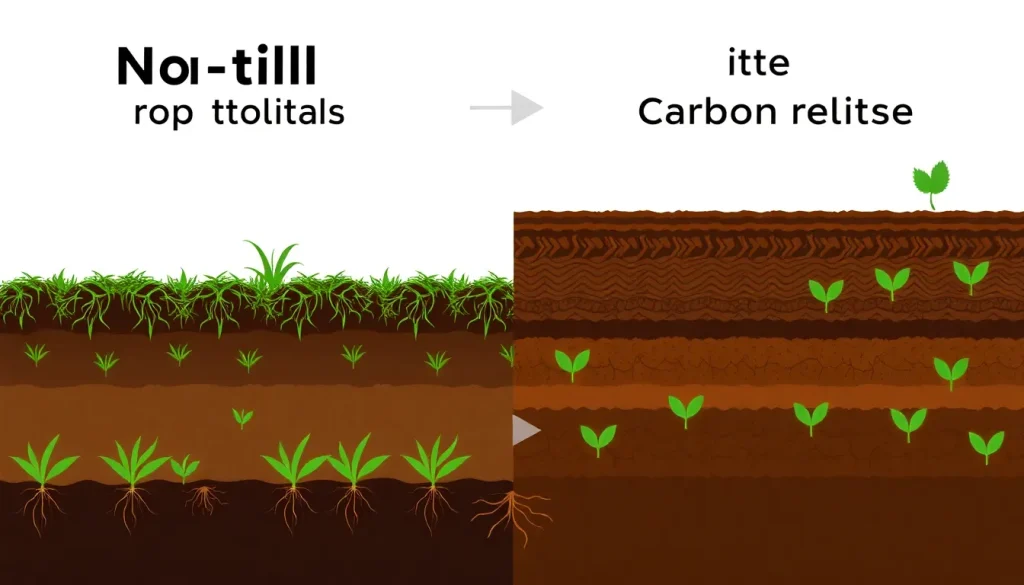
- No-till farming reduces soil disturbance, which can increase soil organic carbon in the upper soil layers compared to conventional tillage.
- The net effect on total carbon storage is debated; deeper soil layers may not gain carbon, and some studies find no overall increase when the full profile is measured.
- No-till’s climate benefit depends on other factors like crop rotation, cover crops, and management of nitrous oxide emissions from fertilizers.
- Adopting no-till alone is not a guaranteed carbon solution; it must be part of a broader system of conservation agriculture to maximize benefits.
What Is No-Till Farming: Does It Store More Carbon?
No-till farming is an agricultural practice where crops are planted directly into the soil without prior plowing, harrowing, or other forms of mechanical tillage. Instead of turning the soil to prepare a seedbed, farmers use specialized equipment to place seeds into narrow slots or holes cut into the residue of previous crops. The question of whether no-till stores more carbon arises because conventional tillage releases carbon dioxide (CO2) from soil organic matter into the atmosphere, while no-till is thought to reduce these emissions and potentially build up soil carbon over time.
However, the answer is not a simple yes or no. No-till farming can increase soil organic carbon in the upper layers of the soil profile, but the net effect on total carbon storage—including deeper layers—is complex and depends on climate, soil type, crop management, and the time scale considered. While no-till is often promoted as a carbon sequestration strategy, scientific evidence shows that its benefits are context-dependent and may be offset by other greenhouse gas emissions or by carbon losses at depth.
How It Works
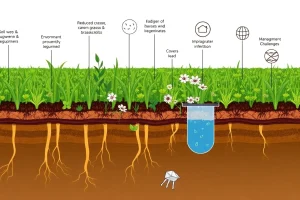
In conventional tillage, plowing and disking break up soil aggregates, exposing organic matter to microbial decomposition and releasing carbon dioxide into the atmosphere. Tillage also accelerates erosion, which can remove carbon-rich topsoil. No-till farming avoids these disturbances. Crop residues are left on the field surface, protecting the soil from erosion and reducing the rate of organic matter breakdown. Over time, the accumulation of residue and root biomass can increase the concentration of soil organic carbon (SOC) in the topsoil.
The process is not simply about adding carbon; it also involves reducing losses. No-till promotes the formation of stable soil aggregates that physically protect organic matter from decomposition. Additionally, reduced soil disturbance can enhance fungal networks and microbial communities that contribute to long-term carbon storage. However, the effect is often limited to the upper 10–20 cm of soil. Deeper layers may not experience the same gains, and in some cases, carbon can be redistributed rather than increased overall.
What the Evidence Shows
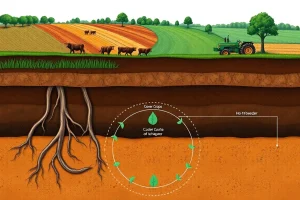
Numerous field studies and meta-analyses have examined the impact of no-till on soil carbon. A common finding is that no-till increases soil organic carbon in the surface layer (0–10 cm) compared to conventional tillage, with reported sequestration rates typically ranging from 0.1 to 0.5 tonnes of carbon per hectare per year. However, when measurements include deeper soil layers (e.g., 0–60 cm or more), the net gain often diminishes or disappears. Some long-term experiments show no significant difference in total carbon stocks between no-till and conventional tillage when the entire root zone is considered.
For example, a widely cited meta-analysis by Luo et al. (2010) found that no-till increased SOC in the top 10 cm but had no effect on SOC in the 10–40 cm layer, resulting in no net increase for the full profile. Other studies have reported that no-till can even lead to carbon losses in deeper layers due to changes in root distribution or increased decomposition of older carbon. The net climate impact also depends on changes in nitrous oxide (N2O) emissions, which can be higher under no-till in some conditions, and on reduced fuel use from fewer tractor passes.
Benefits, Limitations and Trade-offs
No-till farming offers several well-documented benefits beyond carbon storage. It significantly reduces soil erosion, improves water infiltration and retention, and lowers fuel and labor costs. By maintaining surface residue, it can also enhance biodiversity in the soil and reduce sediment runoff into waterways. These advantages make no-till a cornerstone of conservation agriculture.
However, there are limitations and trade-offs. No-till often relies on herbicides for weed control, which can have environmental and health impacts. In some soils, particularly those with poor drainage, no-till can lead to compaction and reduced yields. The carbon sequestration benefit may be temporary; if the land is tilled again, much of the stored carbon can be rapidly lost. Furthermore, the net greenhouse gas balance must account for potential increases in N2O emissions from denitrification in wetter, untilled soils, which can partially or fully offset the carbon gains.
Common Misconceptions
Regional Differences
The carbon storage potential of no-till varies widely by region. In tropical and subtropical climates, high temperatures and rainfall can accelerate decomposition, so the benefits of no-till may be smaller unless combined with continuous crop cover and biomass inputs. In temperate regions, no-till often shows clearer carbon gains in surface soils, but cold and wet conditions can limit residue breakdown and lead to N2O emissions that offset carbon sequestration. Dryland areas may see improved water conservation under no-till, which can indirectly support carbon storage by increasing plant productivity. Soil texture also matters: clay soils tend to protect organic matter better than sandy soils, influencing the net outcome.
Data Limitations and Uncertainties
Measuring soil carbon change is inherently difficult. Carbon stocks vary greatly over short distances, and changes occur slowly, often requiring decades to detect statistically significant differences. Many studies sample only the top 30 cm, missing dynamics in deeper layers. The lack of standardized measurement protocols and long-term experiments across diverse agroecosystems limits the ability to draw universal conclusions. Additionally, life-cycle analyses that account for all greenhouse gas fluxes—including fuel use, fertilizer production, and N2O emissions—are still relatively rare, making it hard to assess the full climate impact of no-till adoption.
FAQ
What is no-till farming?
No-till farming is a method of growing crops without disturbing the soil through plowing or tillage. Seeds are planted directly into the residue of previous crops using specialized equipment.
How does no-till farming affect carbon storage?
No-till can increase soil organic carbon in the surface soil by reducing decomposition and erosion, but the net effect on total carbon storage, including deeper layers, is still debated and depends on local conditions.
Why does no-till farming matter for climate change?
Agriculture is a significant source of greenhouse gases. No-till can help mitigate climate change by potentially sequestering carbon in soil and reducing fuel use, though it is not a standalone solution.
References
- IPCC Special Report on Climate Change and Land (2019), Chapter 2: Land–Climate interactions
- Luo, Z., Wang, E., & Sun, O. J. (2010). Can no-tillage stimulate carbon sequestration in agricultural soils? A meta-analysis of paired experiments. Agriculture, Ecosystems & Environment, 137(3-4), 224-231.
- Baker, J. M., Ochsner, T. E., Venterea, R. T., & Griffis, T. J. (2007). Tillage and soil carbon sequestration—What do we really know? Agriculture, Ecosystems & Environment, 118(1-4), 1-5.
- USDA Natural Resources Conservation Service, Conservation Practice Standard: No-Till (Code 329)