In brief
At a glance
Quick Facts
- Definition
- Monoculture: cultivation of a single crop species; Polyculture: simultaneous cultivation of multiple crop species in the same area.
- Primary Goal
- Monoculture aims for maximum yield of a specific crop; polyculture aims for overall system productivity and stability.
- Common Examples
- Monoculture: corn, wheat, soy, rice, palm oil; Polyculture: intercropping, agroforestry, traditional mixed gardens.
- Pest and Disease Risk
- Monoculture is highly susceptible to pest outbreaks and disease epidemics; polyculture reduces risk through diversity and natural enemies.
- Soil Health
- Monoculture often depletes soil nutrients and organic matter; polyculture can improve soil structure, fertility, and microbial diversity.
- Labor and Mechanization
- Monoculture is well-suited to mechanization and low labor; polyculture often requires more manual labor and complex management.
- Environmental Impact
- Monoculture contributes to erosion, water pollution, and biodiversity loss; polyculture can mitigate these impacts and support ecosystem services.
Key Takeaways
- Monoculture involves growing a single crop species over a large area, while polyculture cultivates multiple crops together in the same space.
- Monoculture maximizes short-term efficiency and yield for specific crops but increases vulnerability to pests, diseases, and soil degradation.
- Polyculture enhances biodiversity, improves soil health, and reduces reliance on chemical inputs, though it often requires more labor and complex management.
- The choice between monoculture and polyculture has profound implications for food security, environmental sustainability, and economic resilience.
What Is Monoculture vs Polyculture?
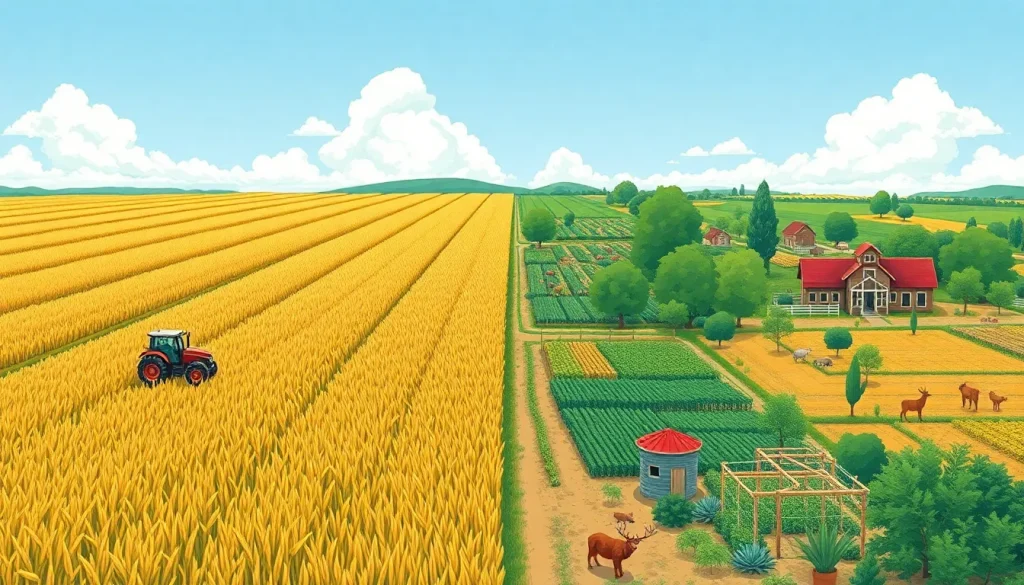
Monoculture is the agricultural practice of growing a single crop species on the same land year after year. Polyculture is the practice of growing multiple crop species simultaneously in the same area. These two approaches represent fundamentally different philosophies in farming: monoculture prioritizes specialization, uniformity, and economies of scale, while polyculture emphasizes ecological interactions, diversity, and resilience.
Monoculture is typical of industrial agriculture, where vast fields of a single high-yield crop—such as corn, wheat, or soy—are planted to maximize output and simplify management. This system relies heavily on mechanization, synthetic fertilizers, and pesticides. In contrast, polyculture encompasses a range of techniques including intercropping, companion planting, and agroforestry, and is common in traditional and sustainable farming systems. By growing multiple species together, polyculture mimics natural ecosystems, leveraging beneficial relationships among plants to enhance productivity and reduce external inputs.
Overview
Monoculture and polyculture represent two fundamental approaches to crop production. Monoculture dominates modern commercial agriculture, where vast fields of a single crop simplify planting, management, and harvesting. This system relies heavily on mechanization, synthetic fertilizers, and pesticides to maintain productivity. In contrast, polyculture mimics natural ecosystems by combining plants with different growth habits, root depths, and nutrient needs. It can range from simple mixtures of two crops (intercropping) to complex multi-story systems like forest gardens. While monoculture is often associated with high yields per unit of labor, polyculture can produce more total biomass and calories per unit of land when managed effectively.
History
Traditional agriculture throughout history was predominantly polycultural. Early farmers in the Fertile Crescent, Mesoamerica, and Asia grew mixtures of grains, legumes, and vegetables, often integrating livestock. The shift toward monoculture began with the advent of mechanized farming in the 18th and 19th centuries, accelerating with the Green Revolution of the mid-20th century. High-yielding crop varieties, synthetic inputs, and irrigation enabled vast monocultures that dramatically increased food production. However, the environmental and social costs of monoculture have led to renewed interest in polyculture and agroecological methods, drawing on ancient practices and modern ecological science.
How It Works
Monoculture simplifies the agricultural system to a single species, allowing uniform application of inputs and standardized management. Farmers can optimize conditions for that crop, using specialized machinery for planting, fertilizing, and harvesting. The system depends on external inputs to replace ecological functions: fertilizers supply nutrients, pesticides control pests, and irrigation provides water. In polyculture, multiple species interact to create beneficial synergies. For example, legumes fix nitrogen for neighboring plants, tall crops provide shade for shade-tolerant species, and diverse root systems improve soil structure and nutrient uptake. Pest populations are often suppressed because host plants are interspersed, making it harder for pests to spread. Polyculture can also include temporal diversity through crop rotations, which further disrupt pest cycles and improve soil health.
Benefits, Limitations and Trade-offs
Monoculture offers high efficiency in labor and machinery, consistent product quality, and simplified supply chains. It can produce large quantities of staple crops at low cost, supporting global food markets. However, it depletes soil organic matter, increases erosion, and requires continuous inputs of synthetic chemicals. The lack of genetic diversity makes crops vulnerable to catastrophic failures from pests or climate extremes. Polyculture, on the other hand, enhances biodiversity above and below ground, improves soil fertility naturally, and reduces the need for chemical inputs. It can provide more stable yields over time and diverse income streams for farmers. The trade-offs include higher labor requirements, more complex management, and challenges in mechanization and large-scale processing. Yields of a single target crop may be lower in polyculture, but total system productivity is often higher.
Environmental and Human Impacts
Monoculture has contributed to significant environmental degradation, including deforestation, soil erosion, water pollution from fertilizer runoff, and loss of biodiversity. The heavy use of pesticides can harm non-target organisms, including pollinators and beneficial insects, and pose health risks to farmworkers and communities. Monoculture systems are also major contributors to greenhouse gas emissions through fossil fuel use and soil carbon loss. Polyculture can mitigate many of these impacts by maintaining continuous ground cover, reducing chemical inputs, and sequestering carbon in soils. It supports a wider range of wildlife and can improve water retention and quality. For human communities, polyculture often aligns with smallholder farming and local food systems, enhancing food sovereignty and nutrition diversity. However, if not managed well, polyculture can also lead to lower yields of cash crops, potentially affecting farmer incomes in market-oriented economies.
Examples
Classic examples of monoculture include the vast corn and soybean fields of the United States Midwest, oil palm plantations in Southeast Asia, and wheat farms in the Eurasian steppe. These systems are highly mechanized and integrated into global commodity chains. Polyculture examples include the “Three Sisters” system of Native Americans, where corn, beans, and squash are grown together: corn provides a trellis for beans, beans fix nitrogen, and squash shades the soil. In tropical regions, agroforestry systems combine trees with crops like coffee or cacao, providing habitat and additional products. Rice-fish farming in Asia integrates aquaculture with paddy rice, where fish eat pests and fertilize the crop. These systems demonstrate how polyculture can be adapted to diverse environments and cultural contexts.
FAQ
What is monoculture vs polyculture?
Monoculture is farming a single crop species over a large area, while polyculture is growing multiple crops together in the same space. They represent contrasting approaches to agriculture with different trade-offs.
How does polyculture work?
Polyculture works by combining plants with complementary characteristics—such as different root depths, nutrient needs, and growth habits—to create beneficial interactions. This can improve soil fertility, reduce pests, and increase total productivity.
Why does monoculture vs polyculture matter?
The choice affects food security, environmental sustainability, and farmer livelihoods. Monoculture can produce large amounts of cheap food but degrades ecosystems; polyculture can be more resilient and sustainable but faces economic and practical challenges.
References
- Food and Agriculture Organization of the United Nations (FAO). 'The State of the World's Biodiversity for Food and Agriculture.'
- Altieri, M.A. (1999). 'The ecological role of biodiversity in agroecosystems.' Agriculture, Ecosystems & Environment.
- Gliessman, S.R. (2015). 'Agroecology: The Ecology of Sustainable Food Systems.' CRC Press.
- Pretty, J. (2008). 'Agricultural sustainability: concepts, principles and evidence.' Philosophical Transactions of the Royal Society B.