In brief
At a glance
Quick Facts
- Primary greenhouse gases
- Carbon dioxide (CO₂), methane (CH₄), nitrous oxide (N₂O), and fluorinated gases are the main GHGs targeted by mitigation efforts.
- Global temperature goal
- The Paris Agreement aims to limit global warming to well below 2°C, preferably to 1.5°C, compared to pre-industrial levels.
- Adaptation finance needs
- Developing countries require an estimated $140–300 billion per year by 2030 for adaptation, according to the UN Environment Programme.
- Mitigation potential of forests
- Forests absorb about 2.6 billion tonnes of CO₂ annually, making forest conservation a key mitigation strategy.
- Coastal adaptation
- Mangroves can reduce wave height by up to 66%, providing natural coastal defense and supporting adaptation.
- Energy efficiency
- Improving energy efficiency in buildings, transport, and industry could deliver over 40% of the emissions reductions needed by 2040.
- Early warning systems
- Just 24 hours' notice of an impending hazardous event can reduce damage by 30%, highlighting the value of adaptation.
- Synergies
- Urban green roofs can lower building energy use (mitigation) and reduce urban heat island effects (adaptation).
Key Takeaways
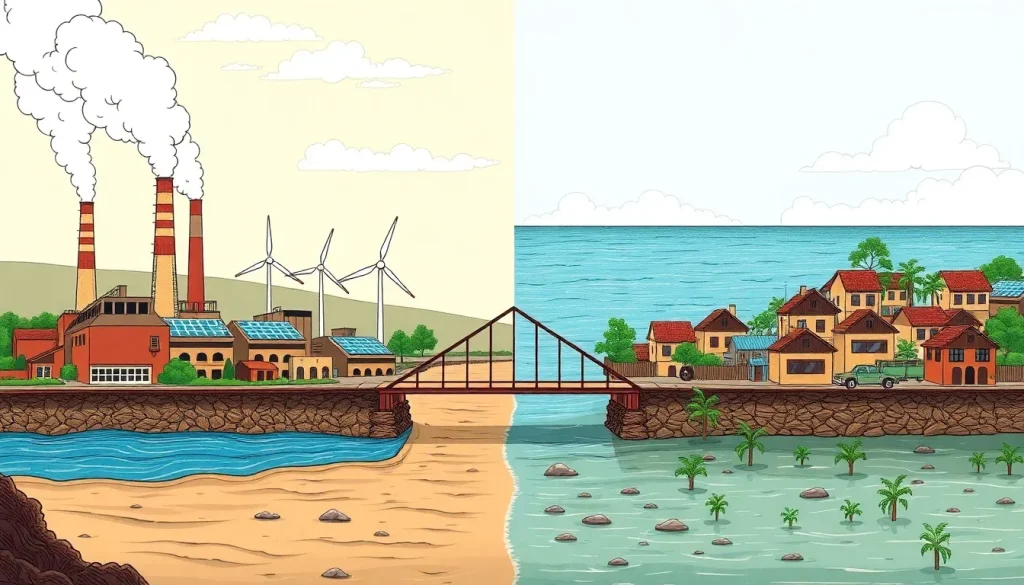
- Climate mitigation focuses on reducing greenhouse gas emissions to slow global warming, while climate adaptation involves adjusting to the impacts of climate change that are already occurring or are unavoidable.
- Mitigation addresses the root cause of climate change, whereas adaptation manages its consequences on human and natural systems.
- Both strategies are essential: mitigation limits the severity of future climate change, and adaptation reduces vulnerability to current and projected impacts.
- Effective climate action requires integrating mitigation and adaptation to build a sustainable, resilient future, as neither alone is sufficient.
What Is Climate Mitigation vs Climate Adaptation?
Climate mitigation refers to efforts to reduce or prevent the emission of greenhouse gases (GHGs) into the atmosphere, or to enhance the sinks that absorb these gases, in order to limit the magnitude of future climate change. Mitigation addresses the root cause of global warming by targeting human activities that release carbon dioxide, methane, and other heat-trapping gases. Key mitigation strategies include shifting from fossil fuels to renewable energy sources, improving energy efficiency, protecting and expanding forests, and promoting sustainable agriculture. The ultimate goal of mitigation is to stabilize greenhouse gas concentrations in the atmosphere at a level that would prevent dangerous anthropogenic interference with the climate system, as outlined in the United Nations Framework Convention on Climate Change (UNFCCC).
Climate adaptation, on the other hand, involves adjusting to the current and expected effects of climate change. It seeks to reduce the vulnerability of human and natural systems to climate impacts, such as rising sea levels, more intense heatwaves, altered precipitation patterns, and increased frequency of extreme weather events. Adaptation measures can be reactive, responding to impacts that have already occurred, or anticipatory, preparing for projected changes. Examples include constructing flood defenses, developing drought-resistant crop varieties, improving water management, and relocating communities from high-risk areas. While mitigation tackles the causes of climate change, adaptation addresses its symptoms. Both are necessary components of a comprehensive climate strategy, as even with aggressive mitigation, some degree of climate change is already locked in due to past emissions.
Overview
The concepts of climate mitigation and adaptation emerged from the scientific recognition that human activities are altering the global climate. Early international climate policy, such as the 1992 UNFCCC, emphasized mitigation as the primary response, calling for stabilization of GHG concentrations. The 1997 Kyoto Protocol set binding emission reduction targets for developed countries. However, as the impacts of climate change became more apparent and progress on mitigation proved slow, adaptation gained prominence. The 2015 Paris Agreement marked a turning point by establishing a global goal on adaptation and requiring all countries to submit national climate plans that include both mitigation and adaptation measures. Today, the Intergovernmental Panel on Climate Change (IPCC) regularly assesses both strategies, highlighting their interdependence. Mitigation and adaptation are now seen as two pillars of climate action, with increasing attention to their synergies and trade-offs.
How It Works
Mitigation works by reducing the flow of GHGs into the atmosphere or by increasing the capacity of natural or artificial sinks to remove them. This can be achieved through a variety of approaches:
- Energy transition: Replacing fossil fuel-based power with renewable sources such as solar, wind, hydro, and nuclear energy.
- Energy efficiency: Improving insulation, using LED lighting, and adopting efficient industrial processes to lower energy demand.
- Carbon sequestration: Enhancing natural sinks like forests, soils, and oceans, or deploying technologies such as direct air capture and carbon capture and storage (CCS).
- Reducing non-CO₂ emissions: Limiting methane from agriculture and waste, and phasing out fluorinated gases used in refrigeration.
Adaptation works by adjusting systems to minimize harm from climate impacts. It involves assessing risks, identifying vulnerabilities, and implementing measures to increase resilience. Adaptation can be structural, such as building higher sea walls or redesigning drainage systems; institutional, like developing early warning systems and updating building codes; or behavioral, such as changing planting dates or conserving water. Because climate impacts vary by region, adaptation is often local and context-specific. For example, coastal communities may focus on sea-level rise, while inland agricultural areas may prioritize drought-resistant crops. Effective adaptation requires continuous monitoring and flexible planning to account for evolving climate conditions.
Importance and Impact
Both mitigation and adaptation are critical for minimizing the risks of climate change. Mitigation is essential to avoid the most catastrophic long-term scenarios, such as multi-meter sea-level rise, widespread ecosystem collapse, and extreme heat that exceeds human tolerance. Without significant mitigation, the costs of adaptation would become insurmountable, and some impacts would be irreversible. The IPCC warns that limiting warming to 1.5°C above pre-industrial levels requires rapid and far-reaching transitions in energy, land, urban infrastructure, and industrial systems.
Adaptation is equally important because even if emissions were halted today, the climate would continue to change due to the inertia of the Earth system. Past emissions have already committed the planet to some degree of warming, sea-level rise, and other impacts. Adaptation measures save lives, protect livelihoods, and reduce economic losses. For instance, early warning systems for storms and heatwaves have been shown to significantly reduce mortality. Investing in adaptation also yields co-benefits, such as improved air quality, enhanced biodiversity, and greater food security. The IPCC emphasizes that adaptation and mitigation must be pursued together; focusing on one at the expense of the other increases climate risks.
Examples
Mitigation and adaptation are implemented at various scales, from international agreements to local projects. Here are some illustrative examples:
- Mitigation: The European Union’s Emissions Trading System (EU ETS) is a cap-and-trade program that sets a limit on total GHG emissions from power plants and industrial facilities, allowing companies to buy and sell emission allowances.
- Mitigation: Costa Rica generates over 98% of its electricity from renewable sources, primarily hydropower, wind, and geothermal, demonstrating a national commitment to decarbonization.
- Adaptation: The Netherlands, a low-lying country, has an extensive system of dikes, storm surge barriers, and spatial planning measures to manage flood risk from sea-level rise and river flooding.
- Adaptation: In Bangladesh, floating gardens made of water hyacinth and bamboo allow farmers to grow vegetables during monsoon floods, ensuring food security in a flood-prone region.
- Integrated approach: Mangrove restoration projects in countries like Indonesia and Mexico serve both mitigation (carbon sequestration) and adaptation (coastal protection and habitat for fisheries).
Benefits, Limitations and Trade-offs
Mitigation and adaptation each offer distinct benefits but also face limitations and potential trade-offs. Mitigation provides global benefits by reducing the overall rate of climate change, protecting all countries regardless of who reduces emissions. It also brings co-benefits such as improved air quality, reduced health costs, and energy independence. However, mitigation requires upfront investments and can face political and economic resistance, particularly from industries reliant on fossil fuels. Additionally, the benefits of mitigation are long-term and diffuse, making it challenging to motivate immediate action.
Adaptation offers more immediate and localized benefits, directly protecting communities and economies from climate impacts. It can be tailored to specific needs and often yields quick returns on investment. However, adaptation has limits; some impacts may be too severe to adapt to, especially under high warming scenarios. There is also a risk of maladaptation, where actions taken to adapt inadvertently increase vulnerability or emissions. For example, widespread use of air conditioning to cope with heatwaves can increase energy demand and GHG emissions if powered by fossil fuels. Trade-offs between mitigation and adaptation can arise when adaptation measures, such as desalination plants or pumped drainage systems, are energy-intensive. Conversely, some mitigation actions, like large-scale bioenergy crop plantations, can compete with land for food production and affect water resources, potentially undermining adaptation. An integrated approach seeks to maximize synergies—such as urban green spaces that cool cities (adaptation) and sequester carbon (mitigation)—while minimizing conflicts.
What Individuals Can Do
Individuals can contribute to both mitigation and adaptation through everyday choices and community engagement. For mitigation, actions include:
- Reducing energy use at home by improving insulation, using energy-efficient appliances, and turning off lights and electronics when not in use.
- Choosing low-carbon transportation options such as walking, cycling, public transit, or electric vehicles.
- Adopting a more plant-based diet, as livestock production is a significant source of methane and requires large amounts of land and water.
- Reducing waste, recycling, and composting to lower methane emissions from landfills.
- Supporting renewable energy by installing solar panels or choosing green energy providers.
For adaptation, individuals can:
- Stay informed about local climate risks, such as flood zones or heatwave patterns, and prepare emergency plans.
- Make homes more resilient by installing flood barriers, using fire-resistant materials, or creating shade through landscaping.
- Conserve water through rainwater harvesting and efficient fixtures to cope with droughts.
- Participate in community resilience efforts, such as tree-planting initiatives or neighborhood watch programs for extreme weather.
- Advocate for policies that support both mitigation and adaptation at local and national levels.
FAQ
What is climate mitigation?
Climate mitigation involves actions to reduce or prevent greenhouse gas emissions, such as using renewable energy, improving energy efficiency, and protecting forests, to limit future global warming.
How does climate adaptation work?
Climate adaptation works by adjusting to actual or expected climate impacts. It includes measures like building flood defenses, developing drought-resistant crops, and creating early warning systems to reduce vulnerability.
Why do we need both mitigation and adaptation?
Mitigation addresses the root cause of climate change by reducing emissions, while adaptation manages the impacts that are already unavoidable. Both are necessary because even with strong mitigation, some climate change is locked in, and adaptation alone cannot prevent catastrophic warming.
References
- IPCC, 2022: Climate Change 2022: Impacts, Adaptation and Vulnerability. Contribution of Working Group II to the Sixth Assessment Report.
- UNFCCC (United Nations Framework Convention on Climate Change). Official website and text of the Convention and Paris Agreement.
- World Resources Institute (WRI). 'Mitigation and Adaptation.' Explainer article on the two strategies.