In brief
At a glance
Quick Facts
- Definition of Bioaccumulation
- The net accumulation of a substance in an organism from all sources over time.
- Definition of Biomagnification
- The increase in concentration of a substance in organisms at successively higher trophic levels.
- Key Difference
- Bioaccumulation occurs within an individual; biomagnification occurs across a food chain.
- Common Substances
- Mercury, DDT, PCBs, dioxins, and other persistent organic pollutants.
- Primary Route
- Uptake from water, food, or air; biomagnification is driven by dietary transfer.
- Measurement Metrics
- Bioaccumulation factor (BAF) and biomagnification factor (BMF).
- Human Exposure
- Mainly through consumption of contaminated fish and seafood.
- Regulatory Frameworks
- Stockholm Convention on POPs and Minamata Convention on Mercury.
Key Takeaways
- Bioaccumulation is the buildup of substances, such as toxic chemicals, in an individual organism over time, while biomagnification is the increase in concentration of those substances as they move up the food chain.
- Bioaccumulation occurs within a single organism, whereas biomagnification occurs across multiple trophic levels in an ecosystem.
- Both processes primarily involve persistent, fat-soluble substances that are not easily broken down or excreted, such as heavy metals and certain organic pollutants.
- Understanding the distinction is critical for assessing environmental and human health risks, particularly from pollutants like mercury and DDT, which can reach dangerous levels in top predators.
What Is Bioaccumulation vs Biomagnification?
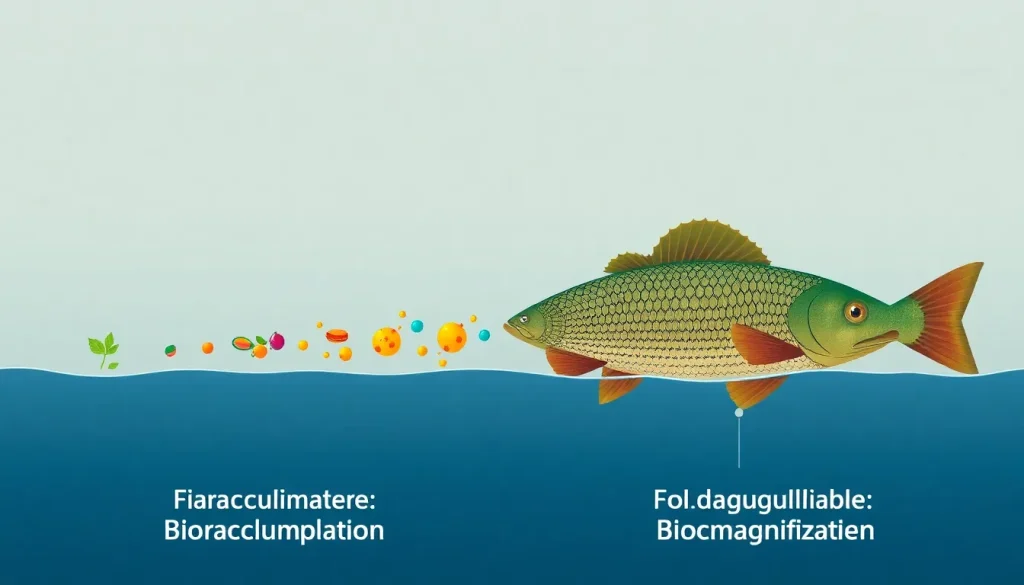
Bioaccumulation and biomagnification are two related but distinct processes that describe how substances, particularly toxic chemicals, build up in living organisms and ecosystems. Bioaccumulation refers to the net accumulation of a substance in an organism from all sources, including water, air, and food, over time. It occurs when the rate of intake exceeds the rate of elimination or metabolic breakdown. In contrast, biomagnification (also called biological magnification) is the process by which the concentration of a substance increases in organisms at successively higher trophic levels in a food chain or web. While bioaccumulation is a prerequisite for biomagnification, the two terms are not interchangeable: bioaccumulation happens within an individual organism, while biomagnification describes the increasing concentration across a food chain.
Both processes are most commonly associated with persistent, bioaccumulative, and toxic substances (PBTs), such as heavy metals (e.g., mercury, lead) and persistent organic pollutants (POPs) like DDT, PCBs, and dioxins. These substances are typically lipophilic (fat-soluble) and resistant to degradation, allowing them to accumulate in fatty tissues and magnify through food webs. Understanding the distinction between bioaccumulation and biomagnification is essential for environmental toxicology, risk assessment, and the development of regulations to protect ecosystems and human health.
Overview
Bioaccumulation and biomagnification are key concepts in ecotoxicology, the study of the effects of toxic substances on biological organisms. They explain how certain chemicals, even when present in the environment at low concentrations, can reach harmful levels in organisms. Bioaccumulation begins with the uptake of a substance from the environment—through respiration, ingestion, or dermal contact—and its subsequent storage in tissues, often in fatty deposits. If the substance is not easily metabolized or excreted, it accumulates over the organism’s lifetime. Biomagnification then amplifies this effect across the food chain: predators consume multiple prey items, each containing the accumulated substance, leading to higher concentrations in the predator’s body. This process can result in top predators, including humans, having tissue concentrations millions of times higher than those in the surrounding environment.
The distinction between the two processes is not merely academic; it has profound implications for environmental monitoring and public health. For example, a substance that bioaccumulates but does not biomagnify may pose a risk to individual organisms but not necessarily to entire food webs. Conversely, a substance that biomagnifies can threaten entire populations of top predators, even if environmental concentrations are low. Both processes are influenced by factors such as the chemical’s properties, the organism’s biology, and the structure of the food web.
How It Works
Bioaccumulation occurs when an organism absorbs a substance at a rate faster than it can eliminate it. The primary routes of uptake are direct absorption from water (in aquatic organisms), ingestion of contaminated food or sediment, and inhalation (in terrestrial animals). Once inside the organism, the substance may be stored in fatty tissues, bound to proteins, or incorporated into bone. The key factor is the substance’s lipophilicity, which determines its tendency to partition into lipids rather than water. Highly lipophilic substances, such as PCBs and DDT, are readily absorbed and slowly eliminated, leading to high bioaccumulation factors (BAFs). The BAF is the ratio of the substance’s concentration in the organism to its concentration in the environment.
Biomagnification, on the other hand, is driven by the structure of the food web. At each trophic level, organisms consume prey that have already accumulated the substance. Because the substance is not easily broken down or excreted, it becomes more concentrated in the predator’s tissues. The biomagnification factor (BMF) is the ratio of the substance’s concentration in the predator to that in its prey. For biomagnification to occur, the substance must be persistent, bioaccumulative, and not readily metabolized. Additionally, the food chain must be long enough for significant magnification to occur. In aquatic ecosystems, for example, concentrations of mercury can increase by a factor of ten million from water to top predators like large fish or fish-eating birds.
Environmental and Human Impacts
The environmental impacts of bioaccumulation and biomagnification are most evident in top predators, which often suffer from reproductive failure, developmental abnormalities, and increased mortality due to high tissue concentrations of toxic substances. Classic examples include the decline of bald eagle and peregrine falcon populations in the mid-20th century, linked to DDT biomagnification, which caused eggshell thinning and reduced hatching success. In aquatic ecosystems, mercury biomagnification has led to advisories against consuming certain fish species, particularly large predatory fish like tuna, shark, and swordfish, due to high methylmercury levels.
For humans, the primary exposure route to biomagnified substances is through diet, especially the consumption of fish and other seafood. Methylmercury is a potent neurotoxin that can impair cognitive development in children and cause neurological damage in adults. Persistent organic pollutants, such as PCBs and dioxins, have been linked to cancer, immune system suppression, and endocrine disruption. Indigenous communities and populations that rely heavily on marine mammals or fish for subsistence are particularly vulnerable to the health effects of biomagnified contaminants. The impacts extend beyond direct toxicity: bioaccumulation and biomagnification can alter ecosystem dynamics by affecting predator behavior, reproduction, and survival, leading to cascading effects throughout the food web.
Examples
One of the most well-documented examples of biomagnification is DDT (dichlorodiphenyltrichloroethane) in aquatic food chains. DDT, a pesticide used extensively in the mid-20th century, entered waterways and was absorbed by plankton. Small fish eating the plankton accumulated DDT in their tissues, and as larger fish consumed smaller fish, concentrations increased. Birds of prey, such as ospreys and eagles, that fed on these fish experienced DDT levels high enough to cause eggshell thinning, leading to population crashes. This phenomenon was a driving force behind the ban of DDT in many countries and the rise of modern environmental regulations.
Another prominent example is mercury, particularly methylmercury, in aquatic systems. Inorganic mercury from industrial sources is converted by bacteria into methylmercury, which is easily absorbed by organisms and biomagnifies efficiently. In Japan, the Minamata Bay disaster of the 1950s and 1960s demonstrated the severe human health consequences of consuming fish contaminated with methylmercury from industrial wastewater. More recently, studies have shown that polar bears, at the top of the Arctic food web, carry high body burdens of mercury and persistent organic pollutants due to long-range atmospheric transport and biomagnification through the marine food chain.
Common Misconceptions
A common misconception is that bioaccumulation and biomagnification are the same process. While they are related, they operate at different scales: bioaccumulation is an individual-level process, whereas biomagnification is an ecosystem-level phenomenon. Another misunderstanding is that all chemicals bioaccumulate and biomagnify. In reality, only substances with specific properties—such as high lipophilicity, resistance to metabolism, and long biological half-lives—exhibit significant bioaccumulation and biomagnification. Water-soluble substances, for example, are typically excreted rapidly and do not accumulate to the same extent.
Some people also assume that biomagnification always results in the highest concentrations in the largest animals. While top predators often have the highest concentrations, the process depends on the food chain structure and the chemical’s properties. In some cases, organisms at lower trophic levels may have higher concentrations if they have slower elimination rates or if the chemical is metabolized differently. Additionally, the term “biomagnification” is sometimes incorrectly used to describe any increase in concentration, but it specifically refers to increases through trophic transfer, not simply accumulation over time within an organism.
Solutions
Addressing bioaccumulation and biomagnification requires a combination of regulatory, technological, and behavioral approaches. At the international level, the Stockholm Convention on Persistent Organic Pollutants aims to eliminate or restrict the production and use of POPs, including many substances known to bioaccumulate and biomagnify. Similarly, the Minamata Convention on Mercury seeks to reduce mercury emissions and releases globally. National regulations, such as the U.S. Clean Air Act and Clean Water Act, also play a critical role in limiting the release of bioaccumulative toxins into the environment.
On a technological front, improved industrial processes can reduce or eliminate the use of persistent toxic substances. For example, alternatives to mercury in products and manufacturing have been developed. Wastewater treatment technologies can remove heavy metals and organic pollutants before discharge. Environmental remediation efforts, such as dredging contaminated sediments and capping, can reduce the availability of legacy pollutants. For individuals, dietary choices can minimize exposure: following fish consumption advisories, choosing smaller, younger fish (which tend to have lower contaminant levels), and reducing intake of top predator species can lower the risk of ingesting biomagnified toxins. Public education and transparent monitoring of contaminant levels in food and the environment are essential for informed decision-making.
FAQ
What is the difference between bioaccumulation and biomagnification?
Bioaccumulation is the buildup of a substance in a single organism over time, while biomagnification is the increasing concentration of that substance as it moves up the food chain from prey to predator.
How does biomagnification affect humans?
Humans can be exposed to biomagnified toxins by eating contaminated fish or other animals. This can lead to health issues such as neurological damage from mercury or increased cancer risk from PCBs.
Why are some chemicals more likely to biomagnify?
Chemicals that are fat-soluble, resistant to metabolic breakdown, and have long biological half-lives are more likely to bioaccumulate and biomagnify because they are stored in fatty tissues and not easily excreted.
References
- U.S. Environmental Protection Agency. (n.d.). Bioaccumulation and Biomagnification. Retrieved from https://www.epa.gov
- World Health Organization. (n.d.). Persistent Organic Pollutants (POPs). Retrieved from https://www.who.int
- Newman, M. C. (2015). Fundamentals of Ecotoxicology: The Science of Pollution. CRC Press.