In brief
At a glance
Quick Facts
- Primary energy consumer
- LED lighting accounts for 50–70% of total energy use in most vertical farms.
- Water savings potential
- Can reduce water use by 70–95% compared to open-field agriculture through recirculation.
- Land productivity
- Yields per square meter can be 10 to 100 times higher than conventional farming, depending on the crop.
- Typical crops
- Commercially viable crops are mainly leafy greens, herbs, and microgreens; staple grains are not yet feasible.
- Energy source matters
- Carbon footprint can be higher than field farming if powered by fossil fuels, but lower with renewables.
- Year-round production
- Controlled environments allow continuous harvests independent of seasons and weather.
- Pesticide use
- Most vertical farms eliminate the need for synthetic pesticides due to sealed environments.
- Capital intensity
- High initial investment and operational costs limit widespread adoption without premium pricing or subsidies.
Key Takeaways
- Vertical farming dramatically reduces land and water use per unit of food produced compared to conventional agriculture, but requires significantly more energy, primarily for artificial lighting and climate control.
- The sustainability of vertical farming hinges on the energy source: if powered by fossil fuels, its carbon footprint can exceed that of field farming; if powered by renewables, it can be a low-impact production method.
- Vertical farms enable year-round, local food production in urban areas, reducing transportation distances and providing fresh produce with minimal pesticide use.
- Current economic and energy constraints limit vertical farming to high-value, short-cycle crops like leafy greens and herbs, and it is not a replacement for staple crops grown in open fields.
What Is Vertical Farming: Energy, Land and Water Trade-Offs?
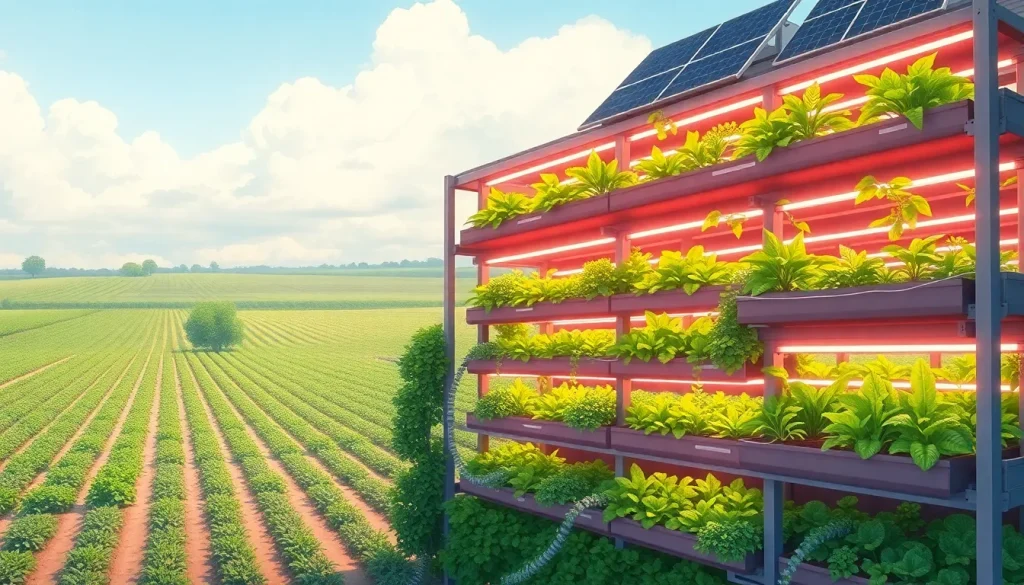
Vertical farming is a method of growing crops in vertically stacked layers, often integrated into controlled indoor environments such as warehouses, shipping containers, or purpose-built structures. This approach relies on soilless cultivation techniques like hydroponics, aeroponics, or aquaponics, and uses artificial lighting—typically LED—to provide the light spectrum needed for photosynthesis. The term “energy, land, and water trade-offs” refers to the central resource calculus of vertical farming: it uses substantially less land and water than conventional agriculture, but at the cost of higher energy consumption, mainly for lighting and climate control. Understanding these trade-offs is essential for evaluating the role vertical farming can play in sustainable food systems.
Vertical farming is part of the broader category of controlled-environment agriculture (CEA), which aims to optimize plant growth by precisely managing temperature, humidity, light, CO₂, and nutrients. Unlike traditional farming, which is subject to weather, seasons, and soil quality, vertical farms can produce crops year-round in any location. This decoupling from natural ecosystems offers potential benefits such as reduced land use, near-elimination of agricultural runoff, and the ability to grow food closer to urban consumers. However, the high energy demand—often met by electricity from the grid—raises questions about the overall environmental footprint and economic viability. The trade-offs among energy, land, and water are thus central to the debate on whether vertical farming can be a sustainable complement to conventional agriculture.
Overview
Vertical farming encompasses a range of systems, from small-scale container farms to large industrial facilities with multiple growing tiers. The common thread is the use of controlled-environment agriculture (CEA) technology to create optimal growing conditions independent of external climate. Crops are typically grown in nutrient-rich water solutions (hydroponics), misted with nutrients (aeroponics), or in systems that integrate fish waste as fertilizer (aquaponics). Artificial lighting, predominantly from energy-efficient LEDs, replaces sunlight, while heating, ventilation, and air conditioning (HVAC) systems maintain temperature and humidity. Sensors and automation often monitor and adjust conditions in real time.
The resource trade-offs are inherent to the design. By stacking plants vertically, land productivity per square meter can be many times higher than in open fields. Water is recirculated in closed-loop systems, drastically cutting consumption. However, the energy required to power lights, pumps, and climate control systems is substantial. This energy demand is the primary factor in both operational costs and environmental impact. The choice of energy source—whether from fossil fuels, nuclear, or renewables—determines the carbon footprint and overall sustainability of the operation.
How It Works
Vertical farms create a sealed or semi-sealed environment where all plant needs are supplied artificially. The key components include:
- Lighting: LED fixtures provide specific light spectra (mainly red and blue wavelengths) optimized for photosynthesis. Lights are often placed close to the plants and can be adjusted in intensity and duration to maximize growth while minimizing energy use.
- Climate control: HVAC systems regulate temperature, humidity, and air circulation. CO₂ may be enriched to boost photosynthesis. Precise control prevents disease and allows faster growth cycles.
- Nutrient delivery: In hydroponics, plant roots are submerged in or periodically flooded with a nutrient solution. Aeroponics mists roots with nutrients. These systems recirculate water, capturing and reusing any excess, which can reduce water use by over 90% compared to soil-based farming.
- Automation and monitoring: Sensors track environmental parameters and plant health, often feeding data to software that adjusts conditions automatically. Robotics may handle planting, harvesting, and packaging.
The energy trade-off arises because natural sunlight and rainfall are replaced by electricity-dependent systems. While a field farm uses solar energy directly, a vertical farm must convert electricity into light and climate control, leading to higher energy inputs per unit of output. However, the controlled conditions eliminate losses from weather, pests, and diseases, resulting in higher yields per area and more predictable production.
What the Evidence Shows
Research comparing vertical farming to conventional agriculture consistently highlights stark differences in resource use. Studies indicate that vertical farms can use 70–95% less water per kilogram of produce, thanks to recirculating systems that capture transpiration and runoff. Land use efficiency is also dramatically higher: a vertical farm can produce the equivalent of several hectares of field-grown crops on a fraction of the land area, with yields per square meter often reported as 10 to 100 times greater, depending on the crop and system design.
Energy use, however, is the critical counterpoint. Life-cycle analyses show that energy consumption per unit of produce in vertical farms can be 10 to 100 times higher than in open-field agriculture, even with efficient LEDs. This energy is primarily for lighting (often 50–70% of total energy use) and climate control. The carbon footprint therefore depends heavily on the electricity grid mix. When powered by coal or natural gas, vertical farming can have a larger carbon footprint than conventional farming, including transportation. When powered by renewable sources, the footprint can be significantly lower. Evidence also shows that vertical farming is currently economically viable only for high-value, fast-growing crops such as lettuce, basil, and microgreens, while staple crops like wheat, rice, and corn remain far from cost-competitive.
Benefits, Limitations and Trade-offs
The benefits of vertical farming are closely tied to its resource efficiencies and operational advantages:
- Water conservation: Closed-loop systems can reduce water use by up to 95% compared to traditional irrigation, making it suitable for water-scarce regions.
- Land sparing: High productivity per square meter can reduce pressure on natural ecosystems and arable land, potentially allowing reforestation or habitat restoration.
- Reduced chemical inputs: The controlled environment minimizes pest and disease pressure, often eliminating the need for synthetic pesticides and herbicides.
- Local production and food security: Farms can be sited in or near cities, shortening supply chains, reducing transportation emissions, and providing fresh produce year-round.
- Climate resilience: Production is insulated from extreme weather, droughts, and seasonal variability.
However, significant limitations and trade-offs exist:
- High energy demand: The reliance on artificial lighting and climate control makes energy the largest operational cost and environmental concern.
- Capital and operational costs: Initial investment in infrastructure, LEDs, and automation is high, and ongoing electricity costs can be prohibitive without subsidies or premium pricing.
- Limited crop variety: Only certain crops—primarily leafy greens, herbs, and some fruits like strawberries—are economically viable. Staple grains and root vegetables are not yet suitable due to their longer growth cycles, lower value, or physical requirements.
- Technical expertise: Operating a vertical farm requires knowledge of plant science, engineering, and data analysis, which can be a barrier to entry.
- Energy source dependency: The environmental benefit is only realized if the energy supply is low-carbon; otherwise, the carbon footprint can be worse than field farming.
The core trade-off is between land/water savings and energy use. A vertical farm can be seen as substituting energy for land and water. Whether this substitution is beneficial depends on local context: in arid regions with abundant renewable energy, it may be highly advantageous; in areas with cheap fossil fuel electricity and ample arable land, it may be less so.
Environmental and Human Impacts
The environmental impacts of vertical farming are multifaceted. On the positive side, reduced land use can help preserve biodiversity and ecosystems. Water recycling prevents nutrient runoff that causes eutrophication in conventional agriculture. Local production can lower food miles and associated emissions, though transportation is often a small fraction of total food system emissions. The absence of pesticides benefits both ecosystems and farm workers.
On the negative side, the high energy consumption can lead to significant greenhouse gas emissions if the electricity is not from renewable sources. The manufacturing of LEDs, sensors, and building materials also carries an embodied carbon and resource footprint. Indoor farms may contribute to urban heat islands if waste heat is not managed, though they can also be integrated into building systems to reuse heat. From a human perspective, vertical farms can create skilled jobs in urban areas and improve access to fresh produce in food deserts. However, the high cost of produce may limit accessibility for lower-income populations unless supported by policy interventions.
Common Misconceptions
Misconception 1: Vertical farming can replace conventional agriculture and feed the world. In reality, vertical farming is suited to a narrow range of high-value, perishable crops. Staple crops like wheat, rice, and maize require vast areas and are not economically or energetically feasible to grow indoors at scale. Vertical farming is best seen as a complement to, not a replacement for, traditional farming.
Misconception 2: Vertical farming is always more sustainable. Sustainability depends on the energy source. A vertical farm powered by coal can have a larger carbon footprint per kilogram of produce than field-grown crops, even when accounting for transportation. The environmental benefit is contingent on a low-carbon electricity supply.
Misconception 3: Vertical farming uses no water. While it uses far less water than conventional farming, it still requires water for the nutrient solution and to replace losses from evaporation and plant transpiration. The water is recirculated, not eliminated.
Misconception 4: All vertical farm produce is organic. Most vertical farms use synthetic nutrient solutions and are not certified organic under many standards, which often require soil-based cultivation. However, they typically avoid synthetic pesticides.
FAQ
What is vertical farming?
Vertical farming is the practice of growing crops in vertically stacked layers within controlled indoor environments, using soilless techniques like hydroponics and artificial lighting to optimize growth.
How does vertical farming save water?
It saves water by recirculating nutrient solutions in closed-loop systems, capturing and reusing water that would otherwise be lost to drainage or evaporation in conventional farming.
Why does vertical farming use so much energy?
Energy is needed to replace natural sunlight with LED lighting and to power climate control systems that maintain optimal temperature, humidity, and air flow. Lighting alone can account for over half of total energy use.
References
- Despommier, D. (2010). The Vertical Farm: Feeding the World in the 21st Century. Thomas Dunne Books.
- Kozai, T., Niu, G., & Takagaki, M. (Eds.). (2019). Plant Factory: An Indoor Vertical Farming System for Efficient Quality Food Production. Academic Press.
- Benke, K., & Tomkins, B. (2017). Future food-production systems: vertical farming and controlled-environment agriculture. Sustainability: Science, Practice and Policy, 13(1), 13-26.