In brief
At a glance
Quick Facts
- Verdict
- Promising
- Problem addressed
- Car-centric street design causing safety and accessibility issues
- Evidence strength
- Moderate
- Potential scale
- Global
- Relative cost
- Moderate
- Time to impact
- Years
Quick verdict
Complete Streets is a promising and increasingly adopted approach to street design that prioritizes safety and accessibility for all users, including pedestrians, cyclists, transit riders, and motorists. Evidence from numerous cities indicates that well-implemented Complete Streets projects can reduce traffic crashes, encourage active transportation, and support local economies. However, the strength of evidence varies, and success depends heavily on context, design quality, and community engagement. While not a panacea, Complete Streets offers a practical, scalable framework for transforming car-dominated roadways into vibrant, equitable public spaces.
Problem addressed
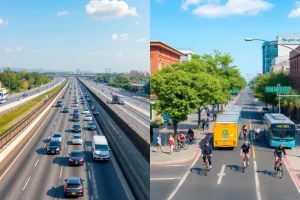
For much of the 20th century, streets were designed primarily to move motor vehicles as quickly as possible. This approach marginalized pedestrians, cyclists, and transit users, creating dangerous conditions that contribute to traffic fatalities and injuries, particularly among vulnerable populations such as children, the elderly, and people with disabilities. In the United States, pedestrian fatalities have risen sharply in recent years, with over 7,500 deaths in 2022 according to the Governors Highway Safety Association. The car-centric design also discourages walking and cycling, exacerbating public health issues like obesity and cardiovascular disease, while isolating those who cannot or do not drive. Complete Streets aims to rectify this imbalance by ensuring that streets are planned, designed, operated, and maintained to enable safe, comfortable, and convenient travel for everyone, regardless of age, ability, or mode of transport.
How the solution works
Complete Streets is not a single design template but a policy framework and design philosophy. At the policy level, jurisdictions adopt ordinances or resolutions requiring that all transportation projects consider the needs of all users. This shifts the default from car-centric planning to a multimodal approach. Policies can be adopted at the state, regional, or local level, and they often mandate that engineers and planners routinely include pedestrian, bicycle, and transit infrastructure in all projects, unless exceptional circumstances apply. Policies typically require that all transportation projects, whether new construction, reconstruction, or maintenance, include Complete Streets elements unless an exception is documented. Common exceptions include streets where non-motorized use is prohibited, cost is excessively disproportionate, or there is a documented lack of need. The policy also often establishes a process for community input and performance metrics to track progress.
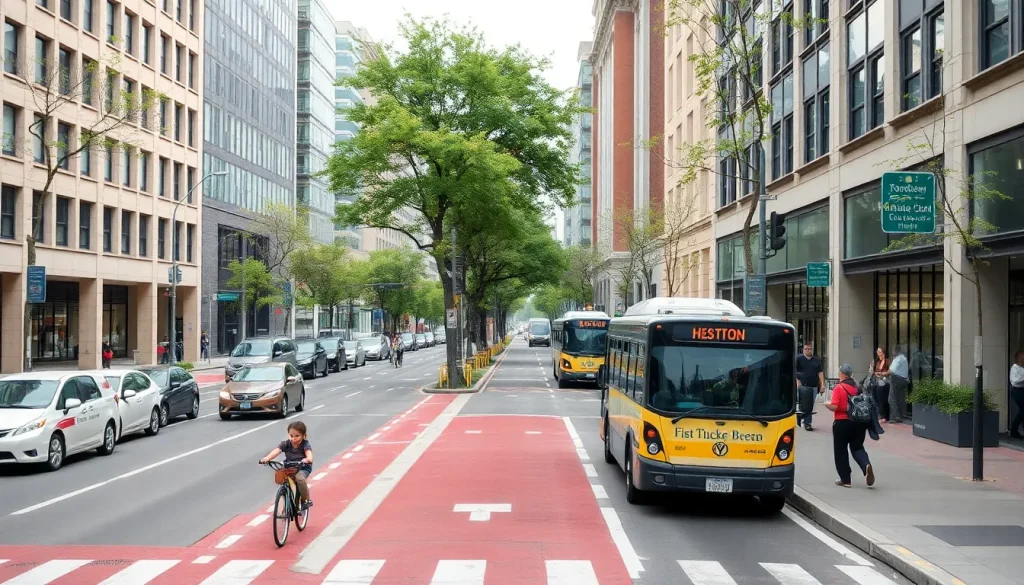
At the design level, Complete Streets incorporate a variety of elements depending on context: sidewalks, bike lanes (protected or buffered), safe crossings with high-visibility markings, median islands, accessible transit stops, curb extensions, traffic calming measures like speed humps or chicanes, street trees, lighting, and street furniture. The specific mix is tailored to the street’s function, surrounding land use, and community input. The goal is to create a network of streets that safely accommodates all modes, making active and shared transportation viable and attractive. Implementation often involves a combination of quick-build, low-cost materials to test designs and gather feedback, followed by permanent construction.
Evidence strength
The evidence base for Complete Streets is growing but remains moderate in rigor. Numerous before-and-after studies have documented safety improvements: for example, a review by the Federal Highway Administration found that adding pedestrian infrastructure and traffic calming can reduce crashes by 20-50%. Research in cities like New York and San Francisco has shown that protected bike lanes and pedestrian plazas lead to significant declines in injuries for all road users. A 2018 study in the Journal of Transport & Health found that Complete Streets interventions were associated with increased physical activity and reduced obesity rates at the county level. A 2020 systematic review in the Journal of Safety Research found that Complete Streets and similar interventions were associated with a 10-30% reduction in crashes, though the authors noted high heterogeneity and risk of bias in many studies. The Centers for Disease Control and Prevention has recognized Complete Streets as a strategy to increase physical activity and reduce obesity.
However, many studies are observational and lack control groups, making it difficult to isolate the effect of Complete Streets from other factors like changes in traffic volume or economic conditions. Evidence on economic benefits is promising but largely based on case studies and correlational analyses. More controlled, longitudinal research is needed to establish causal links and quantify the full range of outcomes. Additionally, the heterogeneity of Complete Streets designs makes it challenging to generalize findings across contexts.
Potential scale
Complete Streets policies have been adopted by over 1,500 jurisdictions in the United States alone, according to Smart Growth America, and the concept has spread internationally. The potential scale is global, as the principles can be applied in any community with streets. However, the impact depends on the extent of implementation: isolated projects have limited effect, while a connected network of Complete Streets can transform travel behavior across a city or region. Scaling up requires sustained political commitment, funding, and a shift in engineering standards and professional training. The potential reduction in traffic fatalities and increase in active transportation could be substantial if adopted widely, but achieving that scale remains a challenge. In many places, car-centric planning is deeply institutionalized, and retrofitting existing infrastructure is a slow, incremental process.
Cost considerations
Costs vary widely. Retrofitting an existing street with full Complete Streets features can be expensive, ranging from hundreds of thousands to millions of dollars per mile, depending on the scope and existing conditions. However, when incorporated into routine repaving or new construction, the marginal cost is often modest—typically 5-20% more than a conventional project. Low-cost, quick-build interventions using paint, bollards, and planters can be implemented for a fraction of the cost and yield immediate benefits. Long-term economic returns, including reduced crash costs, health savings from increased physical activity, and higher property values, can outweigh initial investments. A 2015 study by the Urban Land Institute found that walkable streets can increase retail sales by 30-50% and property values by 5-15%. Funding can come from a variety of sources, including federal transportation grants, local capital improvement budgets, and public-private partnerships. Some cities have used value capture mechanisms to fund improvements. Nevertheless, securing upfront funding can be a barrier, especially for smaller municipalities, and the distribution of costs and benefits may not be equitable without careful planning.
Implementation time
Adopting a Complete Streets policy can be accomplished in months to a year, depending on the political process. Quick-build demonstration projects can be installed in weeks and provide near-immediate safety and usage benefits. Permanent infrastructure, however, typically takes years from planning to construction, involving design, public engagement, environmental review, and funding cycles. The timeline also depends on the scale of the project: a single corridor can be transformed in 2-5 years, while a citywide network may take 20-30 years. Behavioral changes—such as shifts from driving to walking or cycling—may take several years to materialize as the network becomes more connected and cultural norms evolve. Full build-out of a citywide Complete Streets network is a multi-decade endeavor. The time to impact is thus variable: some benefits (e.g., reduced speeds) appear quickly, while others (e.g., mode shift, health outcomes) emerge over the long term.
Environmental benefits
By making walking, cycling, and transit more attractive, Complete Streets can reduce vehicle miles traveled (VMT) and associated greenhouse gas emissions. Studies suggest that comprehensive multimodal networks can lead to a 5-15% reduction in VMT in urban areas. A 2019 study in Transportation Research Part D estimated that a 10% shift from car to active modes could reduce urban CO2 emissions by 5-10%, depending on the city. Additionally, Complete Streets often incorporate green infrastructure—such as street trees, bioswales, and permeable pavements—which can manage stormwater runoff, improve air quality by filtering pollutants, and mitigate the urban heat island effect. The magnitude of environmental benefits depends on the extent of mode shift and the integration of green elements. In some cases, if Complete Streets induce more development and economic activity, there could be a rebound effect that partially offsets emission reductions, though evidence on this is limited.
Social and economic co-benefits
Complete Streets generate a range of co-benefits. Safety improvements reduce fatalities and injuries, particularly among vulnerable road users. Increased physical activity from walking and cycling can lower rates of chronic disease, reducing healthcare costs. Research by the American Public Health Association suggests that for every dollar invested in walking and cycling infrastructure, communities can save up to $3 in healthcare costs over the long term. Improved accessibility enhances mobility for non-drivers, including older adults, children, and low-income households, promoting social equity. Economic benefits include increased retail sales along improved corridors (some studies report 30-50% reductions in commercial vacancies), higher property values, and job creation from construction and maintenance. Streets with trees and pedestrian amenities also foster social interaction and community cohesion. However, these benefits are not automatic; they depend on design quality, maintenance, and complementary policies to ensure equitable distribution.
Risks and unintended consequences
One significant risk is that Complete Streets improvements can contribute to gentrification and displacement if rising property values and desirability push out existing residents and businesses. Without affordable housing protections, the benefits may accrue disproportionately to wealthier newcomers. Community opposition is common, often from business owners concerned about loss of parking or from residents wary of change. Poorly designed Complete Streets can create conflicts between modes—for example, cyclists and pedestrians sharing crowded paths. If infrastructure is not maintained, it can deteriorate and become unsafe. There is also a risk of “greenwashing” if a policy is adopted but not meaningfully implemented. In some cases, Complete Streets projects have been removed after political backlash, wasting resources and eroding public trust. There is also the risk of “stakeholder fatigue” if engagement processes are prolonged without visible progress, leading to cynicism and disengagement.
Where it works best
Complete Streets are most effective in urban and suburban areas with moderate to high density, mixed land uses, and existing demand for walking, cycling, and transit. They work well on streets that are part of a connected network, not isolated segments. Success is more likely in communities with strong political leadership, supportive local policies (such as Vision Zero), and robust public engagement processes. Cities with strong mayoral leadership and dedicated funding streams, such as Seattle’s Levy to Move Seattle, have been able to accelerate implementation. Context-sensitive design is crucial: a Complete Street in a downtown commercial district will look different from one in a residential neighborhood. Places with a history of pedestrian activity and a climate conducive to year-round walking and cycling tend to see the greatest benefits.
Where it may not work
Rural highways with high speeds and very low pedestrian volumes may not be suitable for full Complete Streets treatments, though some elements like wider shoulders or improved crossings can be adapted. Areas with extreme climates (e.g., heavy snow, intense heat) require special design considerations to ensure year-round usability. Places with deeply entrenched car culture and political opposition may face insurmountable barriers to adoption. Without ongoing maintenance and enforcement, Complete Streets infrastructure can fall into disrepair or be misused, undermining its effectiveness. In some low-density suburban areas, the lack of destinations within walking distance may limit the mode shift potential, though Complete Streets can still improve safety for those who do walk or bike. In some post-industrial cities with declining populations and fiscal stress, the cost of building and maintaining Complete Streets may be difficult to justify without a clear economic development strategy.
Comparison with alternatives
Compared to conventional car-centric design, Complete Streets offers a safer, more equitable, and more sustainable approach. Unlike “road diets” (which specifically reduce vehicle lanes), Complete Streets is a broader policy framework that can include road diets as one tool. “Shared space” designs remove all traffic controls and curbs, relying on negotiation between users; Complete Streets generally retain separation to ensure safety for vulnerable users, though some shared space principles can be incorporated in low-speed environments. Compared to “traffic calming” alone, Complete Streets is more comprehensive, addressing not just speed but also accessibility and mode choice. Complete Streets complements other planning concepts such as transit-oriented development, Vision Zero, and the 15-minute city. It is not a competing alternative but an overarching philosophy that can incorporate various design strategies. The key distinction is that Complete Streets is a policy commitment to consider all users in every project, rather than a prescriptive design standard.
Case studies
New York City’s transformation under the Bloomberg administration is a prominent example. The city implemented hundreds of miles of bike lanes, pedestrian plazas (such as Times Square), and bus rapid transit corridors. Studies found that traffic injuries declined, retail sales increased, and cycling surged. Charlotte, North Carolina, adopted Urban Street Design Guidelines in 2007 and built a network of Complete Streets, contributing to a more walkable downtown and revitalized neighborhoods. Portland, Oregon, has been a pioneer in Complete Streets, with a policy adopted in 2007 and a network of neighborhood greenways and bike boulevards that prioritize cyclists and pedestrians while maintaining local vehicle access. Copenhagen’s decades-long shift to pedestrian and cycling infrastructure—though not labeled Complete Streets—demonstrates the long-term potential: today, over 40% of trips are by bike. However, not all projects succeed; some have faced backlash and removal, underscoring the need for community buy-in and adaptive management. For instance, a protected bike lane in a U.S. city was removed after business owners complained about loss of parking, highlighting the importance of stakeholder engagement.
Final assessment
Complete Streets is a well-grounded, practical approach that has demonstrated real-world benefits in safety, public health, and economic vitality. The evidence, while not yet definitive, is sufficiently strong to recommend its adoption, particularly in urban and suburban contexts. Success hinges on context-sensitive design, meaningful community engagement, and complementary policies to manage risks like gentrification. For communities seeking to create safer, more livable streets, Complete Streets offers a flexible and proven framework—but it requires sustained commitment and investment to realize its full potential. As with any complex intervention, ongoing evaluation and adaptation are essential to ensure that the benefits are broadly shared and that unintended consequences are mitigated. Ultimately, Complete Streets is not a one-size-fits-all solution but a flexible approach that, when thoughtfully applied, can help create streets that are not just conduits for movement but places for people.
FAQ
What is a Complete Street?
A Complete Street is one designed to enable safe and convenient access for all users, including pedestrians, bicyclists, motorists, and transit riders of all ages and abilities. It is not a single design but a policy and design approach that tailors features to the local context.
Do Complete Streets reduce traffic speeds?
Yes, many Complete Streets elements—such as narrower lanes, curb extensions, and raised crossings—are traffic calming measures that naturally encourage lower speeds. Lower speeds reduce the severity of crashes and improve safety for all road users.
How much do Complete Streets cost?
Costs vary widely depending on the scope and existing conditions. Retrofitting a street can be expensive, but incorporating Complete Streets features into planned repaving or new construction often adds only 5-20% to the project cost. Low-cost, quick-build interventions can be implemented for a fraction of the cost of full reconstruction.
References
- Smart Growth America. Complete Streets Local Policy Workbook.
- Federal Highway Administration. Complete Streets: A Guide.
- National Association of City Transportation Officials (NACTO). Urban Street Design Guide.
- Institute of Transportation Engineers. Designing Walkable Urban Thoroughfares.
- World Resources Institute. Cities Safer by Design.