In brief
At a glance
Quick Facts
- Verdict
- Promising
- Problem addressed
- Car-dependent sprawl and unsustainable urban growth
- Evidence strength
- Moderate
- Potential scale
- Regional
- Relative cost
- High
- Time to impact
- Decades
Quick verdict
Transit-oriented development is a promising urban planning strategy that has demonstrated tangible benefits in increasing public transit use, fostering walkable communities, and enhancing local economic vitality. However, its effectiveness is highly context-dependent, and evidence for city-wide reductions in car travel and greenhouse gas emissions remains mixed. When implemented with strong affordable housing policies and community engagement, TOD can be a powerful tool for sustainable urban growth; without such safeguards, it risks exacerbating social inequities.
Problem addressed
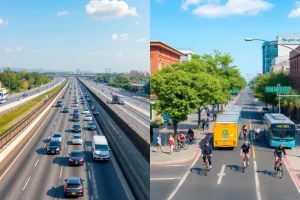
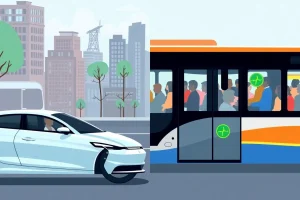
Transit-oriented development targets the negative consequences of automobile-dependent urban sprawl: traffic congestion, air pollution, greenhouse gas emissions, inefficient land consumption, social isolation, and limited access to jobs and services for non-drivers. By reshaping the built environment around high-quality public transit, TOD aims to reduce the need for private car ownership and long commutes, thereby mitigating environmental harm and improving quality of life.
How the solution works
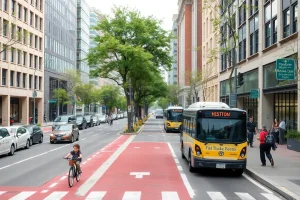
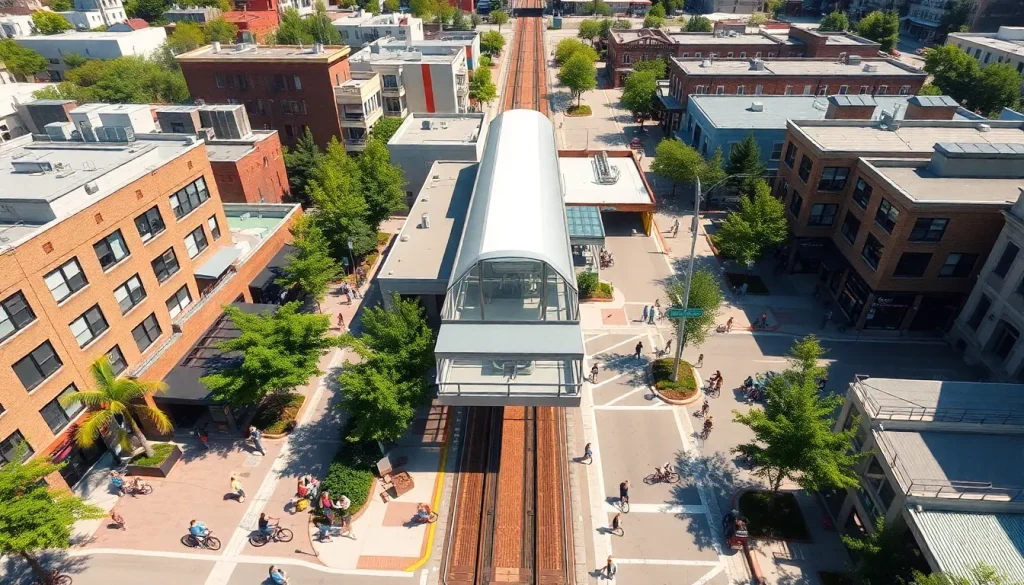
TOD works by concentrating a mix of housing, employment, retail, and public amenities within a short walking distance (typically 400–800 meters) of a transit station. Key design principles include high-density development, pedestrian- and bicycle-friendly streetscapes, reduced parking supply, and seamless integration with the transit network. The proximity and design encourage residents and workers to use transit, walk, or cycle for daily trips, reducing vehicle miles traveled. Additionally, the compact form preserves open space and agricultural land on the urban periphery.
Evidence strength
The evidence base for TOD is substantial but uneven. Numerous studies, including meta-analyses, show that residents of TODs are more likely to use transit and own fewer cars than those in conventional suburban neighborhoods. For example, research consistently finds that doubling residential density near transit can increase transit ridership by 10–30%. However, the net impact on regional vehicle travel and emissions is less clear, as some trips may be replaced by longer transit journeys or offset by increased travel due to higher accessibility. Evidence on gentrification and displacement is mixed: some studies find that TOD raises nearby property values and attracts higher-income households, potentially displacing lower-income renters, while others show that with inclusionary zoning, displacement can be mitigated. Long-term, controlled studies are rare, and most evidence comes from cross-sectional analyses or case studies.
Potential scale
TOD can be applied at the scale of a single station area, a transit corridor, or an entire metropolitan region. Its potential is greatest in cities with expanding transit networks and strong market demand for urban living. Globally, many cities in Asia, Europe, and Latin America have integrated TOD principles into their growth strategies. However, scaling TOD requires significant investment in transit infrastructure, supportive land-use regulations, and coordination across multiple jurisdictions. In regions with stagnant or declining populations, the market may not support dense redevelopment, limiting scale.
Cost considerations
The costs of TOD are front-loaded and substantial, primarily for transit construction (e.g., light rail, metro, or bus rapid transit systems) and associated infrastructure. Public subsidies are often required. However, TOD can generate long-term economic returns through increased property tax revenues, reduced per-capita infrastructure costs compared to sprawl, and savings on transportation and health expenditures. Cost-effectiveness varies widely: in high-demand areas, TOD can be financially self-sustaining; in weaker markets, ongoing subsidies may be needed. The social costs of gentrification must also be factored in.
Implementation time
Implementing TOD is a long-term endeavor. Planning and building a new transit line can take 10–20 years, and full build-out of station-area development may take decades. However, policy changes such as upzoning and parking reforms can be enacted relatively quickly (1–3 years) to encourage TOD. Benefits in terms of transit ridership and walkability begin to accrue as development occurs, but the full environmental and social impacts may not be realized for a generation.
Environmental benefits
TOD can reduce per capita greenhouse gas emissions by lowering vehicle miles traveled and promoting energy-efficient urban forms. Studies suggest that compact, transit-oriented development can cut transportation-related emissions by 20–40% compared to conventional suburban development. It also reduces land consumption, preserves greenfields, and can improve local air quality by reducing car use. However, the net environmental benefit depends on the carbon intensity of the transit system and the extent to which TOD replaces rather than adds to overall travel demand.
Social and economic co-benefits
Beyond environmental gains, TOD can improve public health by encouraging walking and cycling, reduce household transportation costs (often the second-largest expense after housing), and increase access to jobs and services for low-income households if affordable housing is included. It can foster social interaction and community cohesion through public spaces and mixed uses. Economically, TOD can boost local retail, increase property values, and attract businesses seeking transit-accessible locations. Agglomeration benefits from higher densities can enhance productivity.
Risks and unintended consequences
The most significant risk is gentrification and displacement: as neighborhoods become more desirable, rents and property values rise, potentially pushing out existing low-income residents and small businesses. Without proactive measures, TOD can create enclaves of affluence rather than inclusive communities. Other risks include increased transit crowding, loss of local character, and the potential for “transit deserts” where development is dense but poorly connected to the transit station. There is also a risk of induced demand: improved accessibility may attract more residents and jobs, increasing overall travel and offsetting some environmental gains.
Where it works best
TOD is most effective in growing metropolitan areas with strong demand for urban living, existing or planned high-capacity transit, and supportive policy frameworks. It thrives where local governments have the capacity to coordinate land use and transportation planning, and where there is political will to invest in public transit and affordable housing. Cities with a history of compact development, such as many in Europe and Asia, have a natural advantage. In the United States, older cities with legacy rail systems and walkable neighborhoods are prime candidates.
Where it may not work
TOD is less suitable in low-density, car-dependent suburbs where transit ridership potential is low and the built environment is resistant to change. In regions with weak real estate markets, the private sector may be unwilling to invest in dense development near transit. Places with fragmented governance or strong opposition to density and mixed uses may struggle to implement TOD. Additionally, in cities where the transit system is unreliable or unsafe, TOD may fail to attract residents or businesses.
Comparison with alternatives
Compared to business-as-usual sprawl, TOD offers clear environmental and social advantages. However, it is not the only approach to sustainable urban development. Alternatives include greenfield eco-cities, which can be designed from scratch but often lack existing communities and infrastructure; transit-adjacent development (TAD), which places development near transit but without the pedestrian-oriented design and mix of uses, often resulting in car-dependent enclaves; and demand-management strategies like congestion pricing and telecommuting, which can reduce car travel without changing land use. TOD is most powerful when combined with these complementary measures.
Case studies
Arlington, Virginia (Rosslyn-Ballston Corridor): Since the 1970s, Arlington County has concentrated high-density, mixed-use development around five Metro stations. The corridor has seen a dramatic increase in property values and transit ridership, with over 40% of residents commuting by transit. However, the area has also experienced rising housing costs, prompting the county to adopt affordable housing policies.
Curitiba, Brazil: Curitiba’s bus rapid transit (BRT) system, integrated with land-use planning since the 1970s, is a pioneering example of TOD. High-density development is concentrated along dedicated busways, and the city has achieved high transit mode share and relatively low congestion. The model has been replicated worldwide, though some critics note that the system now faces capacity constraints.
Tokyo, Japan: Tokyo’s extensive rail network is complemented by dense, mixed-use development around stations, often built by private rail companies. This model has resulted in one of the world’s highest transit mode shares and low car ownership. The integration of real estate and transit operations has been financially sustainable, though land prices near stations are extremely high.
Portland, Oregon: Portland’s light rail system and associated TOD have been credited with increasing transit ridership and revitalizing neighborhoods. However, studies have shown that gentrification and displacement have occurred in some station areas, highlighting the need for equitable development policies.
Final assessment
Transit-oriented development is a well-grounded strategy for creating more sustainable, livable cities. The evidence supports its ability to increase transit use, reduce car dependency, and generate economic value, but these benefits are not automatic. Success requires careful planning, long-term investment, and robust policies to ensure affordability and inclusivity. TOD is not a one-size-fits-all solution; it works best in contexts with strong transit and market conditions, and it must be part of a broader package of sustainable mobility and housing strategies. For cities committed to equitable growth, TOD remains a vital tool, but it must be implemented with vigilance against unintended social harms.
FAQ
What is the difference between transit-oriented development and transit-adjacent development?
Transit-oriented development (TOD) is designed to maximize the benefits of transit by creating a dense, walkable, mixed-use environment that encourages transit use. Transit-adjacent development (TAD) is simply located near transit but may lack pedestrian-friendly design, have ample parking, and not integrate land uses, often resulting in car-dependent behavior despite proximity to transit.
Does transit-oriented development always lead to gentrification?
No, but it is a significant risk. Research shows that TOD can increase property values and attract higher-income residents, which may displace existing low-income households. However, with proactive policies such as inclusionary zoning, community land trusts, and rent control, cities can mitigate displacement and create mixed-income communities.
Can transit-oriented development work in low-density suburbs?
It is challenging. TOD relies on a critical mass of residents and workers within walking distance of transit to support frequent service and vibrant street life. In very low-density areas, it may be more effective to focus on improving bus service and creating pedestrian-friendly corridors before attempting full TOD. However, some suburban retrofits, like transforming strip malls into mixed-use centers with bus rapid transit, have shown promise.
References
- Cervero, R., & Kockelman, K. (1997). Travel demand and the 3Ds: Density, diversity, and design. Transportation Research Part D, 2(3), 199-219.
- Institute for Transportation and Development Policy. (2017). TOD Standard v3.0.
- National Academies of Sciences, Engineering, and Medicine. (2021). Transit-Oriented Development: A Review of the Evidence. Washington, DC: The National Academies Press.
- World Bank. (2015). Transforming Cities with Transit: Transit and Land-Use Integration for Sustainable Urban Development.
- Transit Cooperative Research Program. (2004). TCRP Report 102: Transit-Oriented Development in the United States: Experiences, Challenges, and Prospects.