In brief
At a glance
Quick Facts
- Invented by
- Fritz Haber and Carl Bosch in the early 20th century
- Chemical reaction
- N₂ + 3H₂ → 2NH₃ (ammonia)
- Typical conditions
- 400–500°C and 150–300 bar with an iron catalyst
- Hydrogen source
- Primarily from natural gas (methane steam reforming)
- Global energy consumption
- About 1–2% of the world's total energy supply
- Annual ammonia production
- Over 150 million metric tons
- Population supported
- Roughly half of the global population depends on food grown with synthetic nitrogen
- Environmental impact
- Major source of greenhouse gas emissions and nitrogen pollution
Key Takeaways
- The Haber-Bosch process is an industrial method that synthesizes ammonia from atmospheric nitrogen, providing the foundation for synthetic nitrogen fertilizers essential to modern agriculture.
- It is estimated that without this process, global food production could support only about half of the current world population.
- The process is highly energy-intensive, relying primarily on fossil fuels, and contributes significantly to greenhouse gas emissions and nitrogen pollution.
- While indispensable for food security, the widespread use of synthetic nitrogen fertilizers has led to environmental challenges such as water eutrophication, soil acidification, and biodiversity loss, necessitating more sustainable practices.
What Is The Haber-Bosch Process and the Global Food System?
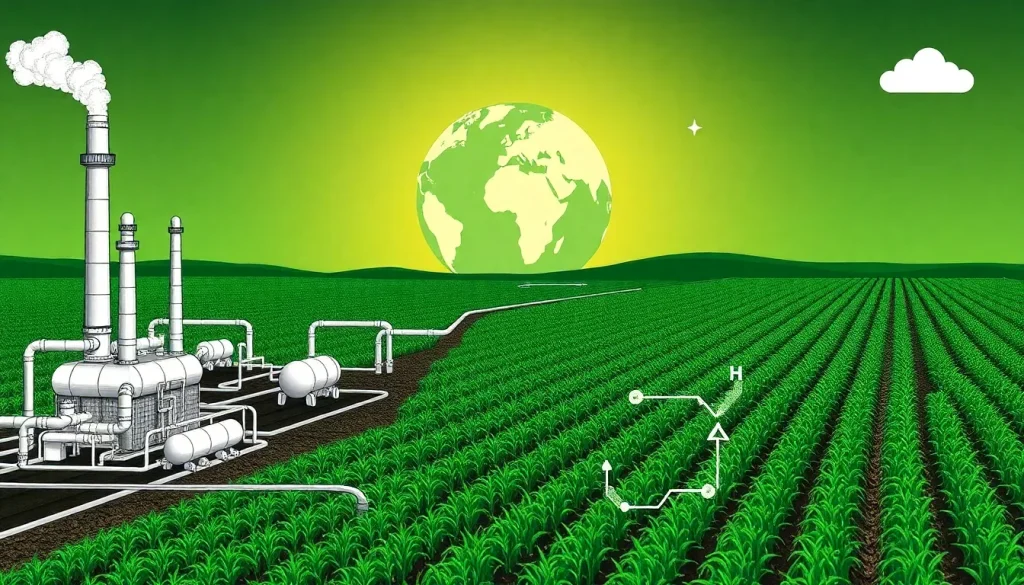
The Haber-Bosch process is an industrial chemical reaction that converts atmospheric nitrogen (N₂) into ammonia (NH₃) by reacting it with hydrogen (H₂) under high temperatures and pressures in the presence of a catalyst. This ammonia is the primary feedstock for synthetic nitrogen fertilizers, which are essential for modern agriculture. The global food system encompasses all activities related to the production, processing, distribution, consumption, and disposal of food. The Haber-Bosch process is a cornerstone of this system because it provides the reactive nitrogen necessary to sustain high crop yields, enabling the food supply to support a global population that has quadrupled since its invention.
Before the Haber-Bosch process, the main sources of reactive nitrogen for agriculture were limited: manure, crop rotation with legumes, and naturally occurring nitrate deposits. These sources could not meet the demands of a growing population. The process effectively industrialized the conversion of inert atmospheric nitrogen into a form usable by plants, breaking a critical bottleneck in food production. Today, synthetic nitrogen fertilizers produced via the Haber-Bosch process account for roughly half of the nitrogen input to global agriculture, making it one of the most significant technological interventions in human history.
History
The need for fixed nitrogen became acute in the late 19th century as natural nitrate deposits were being depleted and agricultural demand grew. In 1908, German chemist Fritz Haber first demonstrated the synthesis of ammonia from its elements in a laboratory. The challenge was then taken up by Carl Bosch at BASF, who scaled the process to industrial levels, solving immense engineering problems related to high-pressure vessels and catalysts. The first commercial plant began operation in 1913. Initially, the ammonia was used primarily for explosives during World War I, but after the war, its application shifted to fertilizers, transforming global agriculture.
The process spread gradually, but its adoption accelerated dramatically during the Green Revolution of the mid-20th century, when high-yielding crop varieties required large inputs of nitrogen fertilizer. Since then, global ammonia production has grown exponentially, and the Haber-Bosch process has become one of the most important industrial processes in the world.
How It Works
The Haber-Bosch process combines nitrogen from the air with hydrogen, typically derived from natural gas (methane) through steam reforming, to produce ammonia. The overall chemical reaction is:
N₂ + 3H₂ ⇌ 2NH₃
The reaction is reversible and exothermic, meaning it releases heat. To achieve a commercially viable yield, the process operates under conditions of high temperature (400–500°C) and high pressure (150–300 bar) in the presence of an iron-based catalyst, often promoted with potassium and aluminum oxides. The high temperature speeds up the reaction, while the high pressure shifts the equilibrium toward ammonia formation. The catalyst lowers the activation energy, making the reaction feasible at industrial scale.
After synthesis, the ammonia is condensed and separated from unreacted gases, which are recycled back into the reactor. The ammonia can then be used directly as a fertilizer (anhydrous ammonia) or converted into other nitrogen fertilizers such as urea, ammonium nitrate, and diammonium phosphate. The hydrogen production step is the most energy-intensive part of the process, accounting for the majority of its carbon footprint.
Importance and Impact
The Haber-Bosch process is often described as one of the most important inventions of the 20th century because of its profound impact on food production. By providing an abundant and affordable source of reactive nitrogen, it removed the natural limit on crop yields imposed by nitrogen availability. This enabled the dramatic increase in agricultural productivity that has supported a global population growth from about 1.6 billion in 1900 to over 8 billion today.
Without synthetic nitrogen fertilizers, it is estimated that global food production would be roughly half of current levels. To compensate, vast areas of natural ecosystems would need to be converted to farmland, leading to massive deforestation and biodiversity loss. The process has thus not only fed billions but also spared land for nature, albeit with its own environmental costs. It is a central pillar of the modern food system, influencing everything from crop prices to dietary patterns and international trade.
Environmental and Human Impacts
Despite its benefits, the Haber-Bosch process and the resulting use of nitrogen fertilizers have significant environmental consequences. The production of ammonia is energy-intensive, consuming about 1–2% of the world’s total energy supply and emitting large quantities of carbon dioxide (CO₂) from the burning of fossil fuels. Additionally, the application of nitrogen fertilizers leads to the release of nitrous oxide (N₂O), a potent greenhouse gas with a global warming potential nearly 300 times that of CO₂.
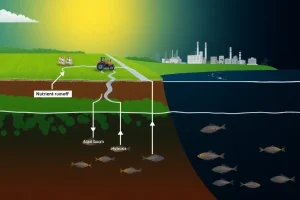
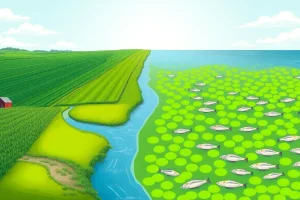
Excess nitrogen from agricultural fields often runs off into waterways or leaches into groundwater, causing eutrophication—an overgrowth of algae that depletes oxygen and creates dead zones in lakes, rivers, and coastal areas. This harms aquatic life and can contaminate drinking water supplies with nitrates, posing health risks such as methemoglobinemia (blue baby syndrome). Nitrogen oxides also contribute to air pollution, including the formation of particulate matter and ground-level ozone, which can cause respiratory problems. Furthermore, the overuse of nitrogen fertilizers can lead to soil acidification and a loss of biodiversity in terrestrial ecosystems.
Benefits, Limitations and Trade-offs
The primary benefit of the Haber-Bosch process is its role in ensuring global food security. It has made it possible to produce enough food for a large and growing population, reducing hunger and malnutrition in many parts of the world. It has also contributed to economic development by increasing agricultural productivity and lowering food costs.
However, the process has limitations and trade-offs. It is heavily dependent on fossil fuels, both as a feedstock for hydrogen and as an energy source, making it vulnerable to energy price fluctuations and a contributor to climate change. Access to synthetic fertilizers is uneven globally; many smallholder farmers in developing countries cannot afford them, leading to soil nutrient depletion and lower yields. In contrast, in many industrialized regions, over-application of nitrogen fertilizers is common, exacerbating environmental problems. The trade-off between food production and environmental protection is a central challenge: reducing nitrogen use could lower crop yields and threaten food security, while continuing current practices risks long-term ecological damage.
Connections to Other Systems
The Haber-Bosch process is deeply interconnected with several global systems. In the energy system, it is a major consumer of natural gas and a significant source of industrial CO₂ emissions. In the climate system, it contributes to both direct emissions from production and indirect emissions from fertilizer use (N₂O). The water system is affected by nitrate pollution, which can travel across borders through rivers and groundwater. Economically, the process links energy markets, fertilizer markets, and food commodity markets, with price shocks in one area cascading to others. It also intersects with public health through air and water quality, and with biodiversity through habitat alteration. Efforts to decarbonize the process—such as using green hydrogen from renewable energy—could reshape these connections, but such technologies are not yet widely deployed at scale.
FAQ
What is the Haber-Bosch process?
It is an industrial chemical reaction that synthesizes ammonia from nitrogen and hydrogen gases under high temperature and pressure, using a catalyst.
How does the Haber-Bosch process work?
Atmospheric nitrogen and hydrogen (usually from natural gas) are combined over an iron catalyst at around 400-500°C and 150-300 bar, producing ammonia. The ammonia is then used to make fertilizers.
Why does the Haber-Bosch process matter for global food supply?
It provides the reactive nitrogen needed for crop growth on a massive scale. Without it, global food production would be insufficient to feed the current population, and an estimated half of the world's people would not have enough food.
References
- Smil, V. (2001). Enriching the Earth: Fritz Haber, Carl Bosch, and the Transformation of World Food Production. MIT Press.
- Erisman, J. W., et al. (2008). How a century of ammonia synthesis changed the world. Nature Geoscience, 1(10), 636-639.
- IPCC (Intergovernmental Panel on Climate Change) reports on agriculture, forestry, and other land use, covering nitrogen fertilizer impacts.