In brief
At a glance
Quick Facts
- Primary limiting nutrient
- Phosphorus is often the limiting nutrient in freshwater ecosystems, meaning its availability controls algal growth.
- Major source
- Agriculture accounts for the largest share of phosphorus pollution globally, through fertilizer and manure runoff.
- Eutrophication trigger
- Excess phosphorus causes eutrophication, a process of excessive plant and algal growth that depletes oxygen.
- Toxic blooms
- Cyanobacterial blooms can produce toxins harmful to humans, pets, and wildlife, and can contaminate drinking water.
- Dead zones
- The Gulf of Mexico hypoxic zone, largely driven by nutrient pollution, can exceed 15,000 square kilometers in summer.
- Legacy phosphorus
- Phosphorus can accumulate in lake sediments and be released for decades, delaying recovery even after inputs are reduced.
- Wastewater contribution
- Untreated or partially treated sewage is a significant point source of phosphorus, especially in areas without advanced treatment.
- Economic cost
- Nutrient pollution costs the U.S. economy billions of dollars annually in lost tourism, fisheries, and water treatment.
Key Takeaways
- Phosphorus pollution is the over-enrichment of water with phosphorus, a nutrient essential for life but harmful in excess.
- It primarily originates from agricultural fertilizers, livestock manure, and untreated or partially treated sewage.
- Excess phosphorus fuels explosive growth of algae and cyanobacteria, leading to toxic blooms, oxygen-starved dead zones, and biodiversity loss.
- Effective solutions combine source reduction, improved wastewater treatment, and landscape management to intercept phosphorus before it reaches waterways.
What Is Phosphorus Pollution Explained?
Phosphorus pollution refers to the contamination of water bodies with phosphorus compounds at concentrations that disrupt natural ecological balance. Phosphorus is a naturally occurring element that is vital for plant growth and is a key component of DNA, cell membranes, and energy transfer in all living organisms. In aquatic ecosystems, phosphorus is often the limiting nutrient, meaning its scarcity controls the rate at which algae and plants grow. When human activities add large amounts of phosphorus to rivers, lakes, and coastal waters, this natural limitation is removed, triggering a cascade of environmental problems collectively known as eutrophication.
Phosphorus pollution is a form of nutrient pollution, alongside nitrogen pollution, and is recognized as one of the most widespread water quality problems globally. It is not a single chemical but a group of phosphorus-containing substances, including dissolved orthophosphates (the most bioavailable form), particulate phosphorus bound to soil particles, and organic phosphorus from plant and animal matter. The pollution can be point source, such as a pipe discharging from a sewage treatment plant, or nonpoint source, like runoff from farm fields carrying fertilizer and eroded soil. Because phosphorus binds tightly to soil particles, much of the pollution is linked to erosion and sediment transport, making it a persistent challenge in watershed management.
Overview
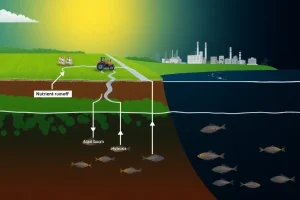
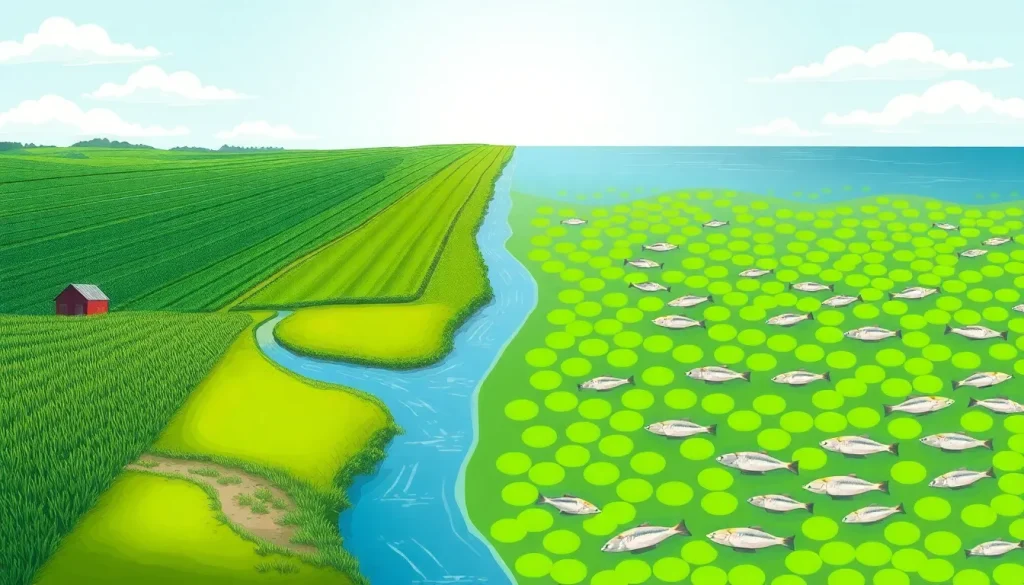
Phosphorus is an essential nutrient for all life, but in aquatic environments, its overabundance sets off a chain reaction of ecological degradation. Under natural conditions, phosphorus enters water bodies slowly through weathering of rocks and decomposition of organic matter. Human activities have dramatically accelerated this cycle, primarily through the use of phosphorus-rich fertilizers in agriculture, the discharge of human and animal waste, and industrial effluents. Once in a lake, river, or coastal zone, the added phosphorus stimulates excessive growth of algae and aquatic plants. When these organisms die and decompose, the process consumes dissolved oxygen, creating hypoxic (low-oxygen) or anoxic (no-oxygen) conditions that can kill fish and other aquatic life. This process, known as eutrophication, is the central mechanism of phosphorus pollution’s impact.
The scale of phosphorus pollution is global. Freshwater lakes, reservoirs, and slow-moving rivers are particularly vulnerable, but coastal marine systems also suffer when phosphorus-laden rivers discharge into the sea. Iconic examples include the hypoxic “dead zone” in the Gulf of Mexico, driven largely by agricultural phosphorus and nitrogen from the Mississippi River Basin, and the toxic cyanobacterial blooms that have plagued Lake Erie for decades. The problem is not limited to large systems; small ponds and streams can also experience severe eutrophication. Because phosphorus cycles slowly and can be stored in sediments for years, even after external inputs are reduced, recovery can take decades.
How It Works
Phosphorus pollution operates through a well-understood biogeochemical pathway. In most freshwater systems, phosphorus is the limiting nutrient for primary production—the growth of algae and aquatic plants. When phosphorus enters a water body in excess, it removes this growth constraint, leading to a rapid increase in algal biomass, often called an algal bloom. The bloom may consist of green algae, diatoms, or cyanobacteria (blue-green algae), some of which produce potent toxins harmful to humans, pets, and wildlife.
As the bloom dies and sinks, bacteria and fungi decompose the organic matter, consuming dissolved oxygen in the process. This biological oxygen demand can deplete oxygen levels in deeper waters, especially during summer when thermal stratification prevents mixing. The result is hypoxia or anoxia, which can cause fish kills and force mobile organisms to flee. In addition, the dense blooms shade out submerged aquatic vegetation, destroying habitat for fish and invertebrates. Phosphorus can also bind to sediments and be released back into the water under low-oxygen conditions, creating an internal loading cycle that sustains eutrophication long after external sources are controlled.
Main Causes or Drivers
The primary human activities that drive phosphorus pollution are:
- Agricultural runoff: The largest contributor globally. Phosphorus is applied to croplands as synthetic fertilizer and manure to boost yields. When application exceeds crop uptake, or when heavy rain falls shortly after application, phosphorus is washed into nearby streams and rivers. Soil erosion from tilled fields also carries particulate phosphorus.
- Livestock operations: Concentrated animal feeding operations (CAFOs) generate vast quantities of manure rich in phosphorus. If not properly managed, manure can leak from storage lagoons or be over-applied to land, leading to runoff.
- Municipal and industrial wastewater: Sewage contains phosphorus from human waste, food residues, and detergents. Many treatment plants remove only a portion of phosphorus, and combined sewer overflows can release untreated sewage during storms. Industrial sources include food processing, pulp and paper mills, and fertilizer manufacturing.
- Urban stormwater: Phosphorus from lawn fertilizers, pet waste, leaf litter, and detergents washes off impervious surfaces into storm drains, which often discharge directly into water bodies without treatment.
- Septic systems: Poorly maintained or failing septic tanks can leach phosphorus into groundwater, which eventually reaches surface waters.
- Atmospheric deposition: A minor but measurable source, primarily from dust and combustion of biomass or fossil fuels, though this is more significant for nitrogen.
Environmental and Human Impacts
The environmental consequences of phosphorus pollution are severe and multifaceted:
- Harmful algal blooms (HABs): Cyanobacterial blooms can produce toxins such as microcystins and anatoxins, which pose health risks to humans and animals through drinking water, recreational contact, and consumption of contaminated fish or shellfish.
- Dead zones: Hypoxic areas where oxygen levels are too low to support most marine life. The Gulf of Mexico dead zone, fueled by Mississippi River nutrients, can cover thousands of square kilometers and devastates fisheries.
- Loss of biodiversity: Eutrophication favors fast-growing, opportunistic species over sensitive ones, reducing the variety of plants, invertebrates, and fish. Submerged aquatic vegetation declines, and fish communities shift toward tolerant, often less desirable species.
- Drinking water contamination: Treatment plants must remove algal toxins, taste-and-odor compounds, and organic matter, increasing costs. In severe cases, water supplies become temporarily unusable, as happened in Toledo, Ohio, in 2014 due to a Lake Erie cyanotoxin event.
- Economic losses: Fisheries collapse, tourism declines, property values drop, and water treatment costs rise. The U.S. EPA estimates that nutrient pollution costs the U.S. economy billions of dollars annually.
Solutions
Addressing phosphorus pollution requires a combination of regulatory, technological, and land-management strategies:
- Source reduction: Optimizing fertilizer application rates and timing using soil testing and precision agriculture reduces excess phosphorus. Banning or limiting phosphorus in lawn fertilizers and detergents has proven effective in many regions.
- Erosion control: Conservation tillage, cover crops, buffer strips, and riparian zone restoration trap soil-bound phosphorus before it reaches waterways.
- Manure management: Proper storage, treatment, and transport of animal waste, along with limits on application rates based on crop needs, prevent runoff from livestock operations.
- Wastewater treatment upgrades: Advanced treatment technologies, such as chemical precipitation and biological phosphorus removal, can achieve very low effluent phosphorus concentrations. Retrofitting older plants and separating stormwater from sewage reduce discharges.
- Constructed wetlands and detention basins: These engineered systems capture and remove phosphorus from agricultural drainage and urban runoff through sedimentation, plant uptake, and microbial processes.
- In-lake management: For already eutrophic water bodies, techniques like alum treatment (which binds phosphorus in sediments), dredging, and aeration can mitigate symptoms, though they do not address external sources.
- Policy and regulation: Water quality standards, total maximum daily loads (TMDLs), and nutrient trading programs create legal frameworks to limit phosphorus inputs. International agreements, such as the Great Lakes Water Quality Agreement, coordinate efforts across borders.
Common Misconceptions
Misconception: Phosphorus pollution is only a problem in developing countries. While developing nations face acute challenges due to limited wastewater treatment, phosphorus pollution is widespread in industrialized countries as well. Intensive agriculture and legacy phosphorus in sediments affect water bodies across North America, Europe, and parts of Asia.
Misconception: Algae blooms are always toxic. Not all algal blooms produce toxins, but even non-toxic blooms can cause ecological harm through oxygen depletion and habitat alteration. The presence of a bloom does not automatically mean the water is unsafe, but caution is warranted because toxin production can be unpredictable.
Misconception: Once phosphorus inputs are stopped, the problem goes away quickly. Recovery is often slow because phosphorus accumulates in sediments and can be recycled back into the water for years or decades. Internal loading can sustain eutrophic conditions long after external sources are reduced, requiring additional in-lake interventions.
Misconception: Phosphorus pollution is the same as nitrogen pollution. While both are nutrients that cause eutrophication, they differ in their sources, behavior, and management. Phosphorus is typically the limiting nutrient in freshwaters, while nitrogen often limits primary production in marine systems. However, both must be managed to protect water quality fully.
FAQ
What is phosphorus pollution?
Phosphorus pollution is the excessive input of phosphorus into water bodies, mainly from agricultural runoff, sewage, and industrial waste, causing eutrophication and harmful algal blooms.
How does phosphorus pollution affect water quality?
It stimulates overgrowth of algae and cyanobacteria, which deplete oxygen when they decompose, creating dead zones, releasing toxins, and degrading drinking water sources.
Why is phosphorus pollution a problem?
It harms aquatic ecosystems, kills fish, contaminates drinking water, threatens human health, and causes significant economic losses in fisheries, tourism, and water treatment.
References
- U.S. Environmental Protection Agency. (n.d.). Nutrient Pollution: The Problem. https://www.epa.gov/nutrientpollution/problem
- Carpenter, S. R. (2008). Phosphorus control is critical to mitigating eutrophication. Proceedings of the National Academy of Sciences, 105(32), 11039-11040.
- Schindler, D. W., et al. (2016). Reducing phosphorus to curb lake eutrophication is a success. Environmental Science & Technology, 50(17), 8923-8929.