In brief
At a glance
Quick Facts
- Primary chemical reaction
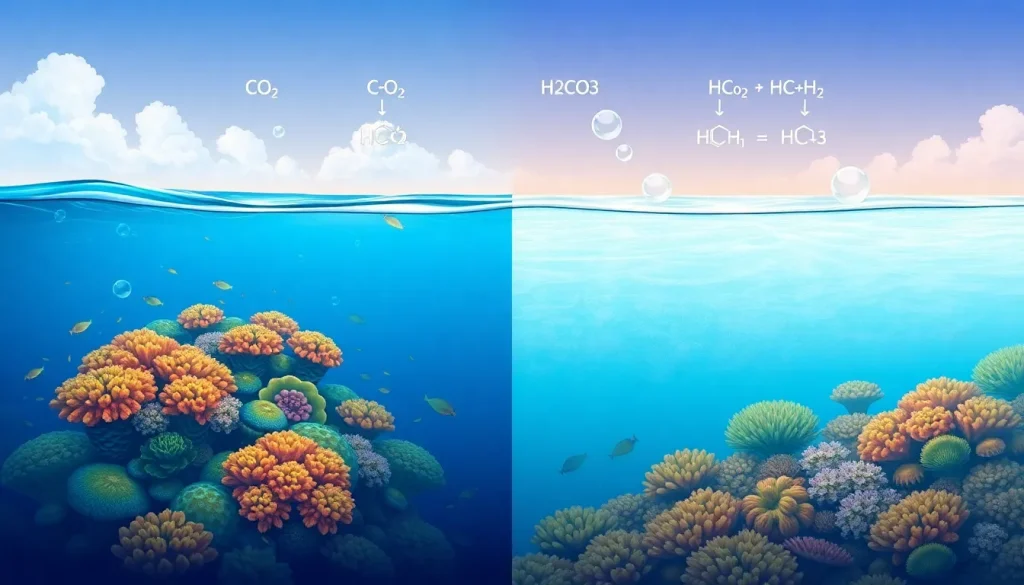
- CO₂ + H₂O → H₂CO₃ → H⁺ + HCO₃⁻
- pH change since Industrial Revolution
- Decreased from ~8.2 to ~8.1 (30% increase in acidity)
- Projected pH by 2100 (high emissions)
- Could drop to ~7.8–7.9
- Key ion affected
- Carbonate ion (CO₃²⁻) concentration decreases
- Most vulnerable organisms
- Corals, mollusks, pteropods, foraminifera, some plankton
- Ocean CO₂ absorption
- About 25% of human-emitted CO₂ is absorbed by the ocean
- Rate of change
- Current acidification is 10 times faster than any time in the last 55 million years
- Economic risk
- Global shellfish aquaculture worth billions of dollars is threatened
Key Takeaways
- Carbon dioxide (CO₂) from the atmosphere dissolves in seawater, forming carbonic acid and lowering the ocean’s pH — a process called ocean acidification.
- The chemical changes reduce the concentration of carbonate ions, which are essential building blocks for shells and skeletons of many marine organisms.
- Ocean acidification is a direct consequence of rising atmospheric CO₂ levels, primarily from fossil fuel burning and deforestation.
- Impacts ripple through marine ecosystems, affecting coral reefs, shellfish, plankton, and the larger food web, with consequences for fisheries and human economies.
- While reducing CO₂ emissions is the most effective long-term solution, local adaptation strategies and further research are critical to mitigate harm.
What Is How Carbon Dioxide Changes Ocean Chemistry?
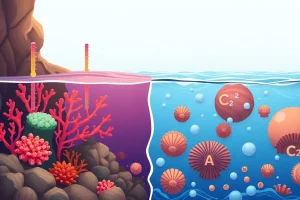
How carbon dioxide changes ocean chemistry refers to the cascade of chemical reactions that occur when excess CO₂ from the atmosphere dissolves into seawater. This process, commonly known as ocean acidification, fundamentally alters the ocean’s carbonate chemistry. The ocean naturally absorbs about a quarter of the CO₂ released by human activities, which helps moderate climate change but comes at a cost: the absorbed CO₂ reacts with water to form carbonic acid, which then dissociates into bicarbonate and hydrogen ions. The increase in hydrogen ions lowers the pH of seawater, making it more acidic. This shift also reduces the availability of carbonate ions, a critical component for many marine organisms that build shells and skeletons from calcium carbonate.
Ocean acidification is distinct from climate change, though both are driven by rising CO₂. While climate change refers to global warming and its effects, ocean acidification is a direct chemical response to CO₂ absorption. The ocean’s average surface pH has already dropped from about 8.2 to 8.1 since the Industrial Revolution, representing a roughly 30% increase in acidity. Because the ocean is a complex, interconnected system, these chemical changes have far-reaching biological and ecological consequences that are still being studied.
Overview
The ocean plays a vital role in the global carbon cycle, absorbing roughly one-third of the CO₂ emitted by human activities. This absorption has historically buffered the atmosphere from even higher CO₂ levels, but it has come at a cost to ocean chemistry. When CO₂ dissolves in seawater, it does not simply remain as a dissolved gas; it undergoes a series of reversible reactions that alter the balance of carbon species in the water. The net effect is an increase in hydrogen ion concentration (lower pH) and a decrease in carbonate ion concentration. These changes are measurable and have been observed across the world’s oceans, from surface waters to the deep sea.
The ocean’s chemistry is naturally variable, with pH fluctuating by season, depth, and region. However, the current rate of change is unprecedented in millions of years. The ocean’s buffering capacity — its ability to resist pH changes — is being overwhelmed by the sheer volume of CO₂ entering the system. This overview sets the stage for understanding the detailed chemical mechanisms, the evidence for acidification, and the wide-ranging impacts on marine life and human society.
How It Works
The chemical process begins when atmospheric CO₂ dissolves in seawater. Unlike oxygen or nitrogen, CO₂ reacts with water to form carbonic acid (H₂CO₃). This weak acid quickly dissociates into bicarbonate ions (HCO₃⁻) and hydrogen ions (H⁺). The increase in hydrogen ions is what lowers the pH, making the water more acidic. Some of the hydrogen ions then combine with carbonate ions (CO₃²⁻) to form more bicarbonate. This reduces the concentration of carbonate ions, which are essential for calcifying organisms. The overall reaction can be summarized as: CO₂ + H₂O + CO₃²⁻ → 2HCO₃⁻. In essence, the ocean’s carbonate ion supply is being consumed to neutralize the added CO₂.
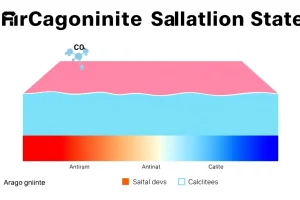
The pH scale is logarithmic, so even a small numerical drop represents a significant increase in acidity. Since the Industrial Revolution, ocean surface pH has fallen by about 0.1 units, corresponding to a 30% increase in hydrogen ion concentration. By the end of this century, under high-emission scenarios, pH could drop by another 0.3–0.4 units, making the ocean more acidic than it has been in tens of millions of years. This rapid shift leaves little time for marine organisms to adapt through evolution. The chemistry also affects the saturation state of calcium carbonate minerals — aragonite and calcite — which are used by corals, pteropods, and foraminifera to build their structures. As carbonate ions become scarcer, these organisms struggle to form and maintain their shells.
Importance and Impact
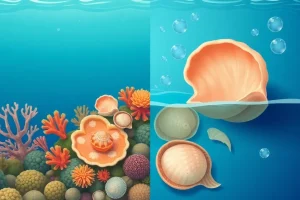
Ocean acidification matters because it directly threatens the base of the marine food web and the many ecosystem services the ocean provides. Calcifying organisms — including corals, mollusks (such as oysters, clams, and pteropods), and certain plankton — are particularly vulnerable. Laboratory and field studies show that under lower pH conditions, these organisms exhibit reduced calcification rates, weaker shells, and higher mortality. Coral reefs, already stressed by warming waters and pollution, face additional erosion and slower growth, jeopardizing the rich biodiversity they support.
Beyond calcifiers, acidification can affect fish behavior and physiology. Research indicates that elevated CO₂ levels can impair the sensory abilities of some fish, making them less able to detect predators or navigate. These changes can disrupt entire food webs, from phytoplankton to top predators. For human communities, the impacts are economic and social: fisheries and aquaculture industries that depend on shellfish and healthy reef ecosystems are at risk. Coastal protection provided by coral reefs may also diminish, exposing shorelines to greater erosion and storm damage. The cultural and subsistence value of marine resources for many indigenous and coastal communities adds another layer of importance.
Environmental and Human Impacts
The environmental impacts of ocean acidification are already visible in some regions. Oyster hatcheries in the Pacific Northwest of the United States experienced massive larval die-offs in the mid-2000s, traced to upwelling of acidified water. Coral reefs worldwide are showing reduced calcification rates, and pteropods — tiny marine snails at the base of the food web — exhibit shell dissolution in naturally acidified waters. These effects can cascade: pteropods are a key food source for salmon, herring, and other commercially important fish, so their decline could ripple through the ecosystem.
Human communities that rely on seafood for protein and income are particularly vulnerable. Globally, over three billion people depend on marine and coastal biodiversity for their livelihoods. The shellfish aquaculture industry, worth billions of dollars, faces direct threats from acidification, especially in regions with cold, CO₂-rich upwelling waters. Coral reef degradation affects tourism, fisheries, and coastal protection. While some species may benefit from increased CO₂ (e.g., certain seagrasses and algae), the overall balance of marine ecosystems is likely to shift in unpredictable ways, potentially favoring invasive species and disrupting traditional food webs. The socioeconomic consequences could be severe, especially for developing nations with limited adaptive capacity.
Common Misconceptions
Misconception: Ocean acidification means the ocean will become acidic. The ocean is alkaline, with a pH above 7. Acidification refers to a shift toward the acidic end of the scale, not that the ocean will become acidic (pH below 7). Even under extreme scenarios, the ocean’s pH is expected to remain above 7, but the change is still harmful to many organisms.
Misconception: Ocean acidification is the same as climate change. While both are caused by CO₂ emissions, they are distinct phenomena. Climate change involves warming and its effects, while ocean acidification is a chemical change in seawater. They interact but are not the same.
Misconception: The ocean’s buffering capacity will prevent acidification. The ocean does have a natural buffering system, but it operates on timescales of thousands of years. The rapid rate of CO₂ increase overwhelms this buffer, leading to measurable acidification.
Misconception: Only shell-building organisms are affected. While calcifiers are most visibly impacted, acidification can also affect fish behavior, reproduction, and the physiology of non-calcifying species, with broader ecosystem consequences.
Solutions
The most fundamental solution to ocean acidification is to reduce atmospheric CO₂ emissions by transitioning to renewable energy sources, improving energy efficiency, and protecting and restoring forests and other natural carbon sinks. International agreements like the Paris Agreement aim to limit global warming, which would also slow acidification. However, even if emissions were halted today, the ocean would continue to absorb excess CO₂ from the atmosphere for decades, and pH would continue to decline for some time due to the lag in the carbon cycle.
Adaptation strategies can help some marine systems and human communities cope. For example, shellfish hatcheries can buffer water chemistry or time water intake to avoid low-pH events. Protecting and restoring seagrass meadows, mangroves, and salt marshes can locally mitigate acidification because these ecosystems absorb CO₂. Marine protected areas can reduce other stressors (like overfishing and pollution), giving ecosystems a better chance to adapt. Research into selective breeding of more resilient shellfish strains is also underway. On a policy level, incorporating ocean acidification into coastal management and international climate frameworks is essential. Public education and reducing local nutrient runoff (which can exacerbate acidification) are additional steps.
FAQ
What is ocean acidification?
Ocean acidification is the process by which the ocean becomes more acidic (lower pH) due to the absorption of excess carbon dioxide from the atmosphere. It involves chemical reactions that reduce carbonate ion availability.
How does carbon dioxide change ocean chemistry?
CO₂ dissolves in seawater and forms carbonic acid, which releases hydrogen ions, lowering pH. These hydrogen ions combine with carbonate ions, reducing their concentration and making it harder for marine organisms to build shells.
Why does ocean acidification matter?
It threatens marine life, especially shell-building organisms, disrupts food webs, and impacts human communities that depend on fisheries, aquaculture, and coral reef protection.
References
- Doney, S. C., Fabry, V. J., Feely, R. A., & Kleypas, J. A. (2009). Ocean Acidification: The Other CO₂ Problem. Annual Review of Marine Science.
- IPCC (2013). Climate Change 2013: The Physical Science Basis. Contribution of Working Group I to the Fifth Assessment Report.
- NOAA Ocean Acidification Program. (n.d.). What is Ocean Acidification? Retrieved from https://oceanacidification.noaa.gov/