In brief
The ocean is often described as Earth’s largest climate regulator.
It absorbs heat.
It stores carbon.
It generates oxygen.
It supports fisheries, biodiversity, weather systems, and the livelihoods of billions of people.
Less widely appreciated is another vital role: the ocean absorbs approximately one-quarter of the carbon dioxide (CO₂) emitted by human activities, slowing the pace of atmospheric warming. This service has greatly reduced the intensity of climate change that humanity has experienced so far. (IPCC)
However, this climate benefit comes with an important consequence.
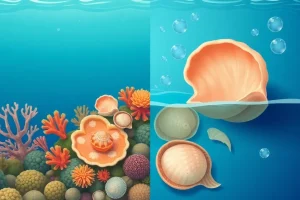
When carbon dioxide dissolves into seawater, it changes ocean chemistry. The water becomes less alkaline (more acidic), carbonate ions become less available, and many marine organisms find it increasingly difficult to build shells and skeletons.
This process is known as ocean acidification.
Unlike oil spills or plastic pollution, ocean acidification is largely invisible. It cannot be seen from satellites or coastlines. Yet it affects marine ecosystems from tropical coral reefs to the deepest polar waters.
For many years, ocean acidification was considered one of the planetary boundaries approaching a dangerous threshold. Recent research published in 2025 indicates that, using updated assessments of aragonite saturation and ecological impacts, the global ocean had entered the uncertainty range of the planetary boundary by around 2020, with much of the upper ocean already beyond that threshold. (DOI)
Ocean acidification is therefore no longer viewed simply as an ocean problem.
It is an Earth-system challenge affecting biodiversity, fisheries, climate regulation, food security, and the long-term resilience of marine ecosystems.
Quick Answer
Ocean acidification is the long-term reduction in the pH of seawater caused primarily by the absorption of human-produced carbon dioxide from the atmosphere.
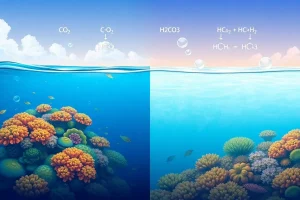
When CO₂ dissolves in seawater, it forms carbonic acid, increasing hydrogen ion concentrations and reducing carbonate ions that many marine organisms need to build shells and skeletons.
Major consequences include:
- Reduced coral calcification
- Weaker shells in mollusks and plankton
- Changes in marine food webs
- Reduced habitat quality
- Risks to fisheries
- Increased stress when combined with warming and oxygen loss
Recent research indicates that the ocean acidification planetary boundary has likely been crossed under updated assessment methods, highlighting increasing risks for marine ecosystems. (DOI)
What Is Ocean Acidification?
Ocean acidification refers to the gradual decline in seawater pH caused by increasing atmospheric carbon dioxide.
Importantly, this does not mean the ocean becomes acidic like vinegar or lemon juice.
Modern seawater remains alkaline, with an average surface pH above 8.
Instead, ocean acidification means:
- pH decreases slightly.
- Hydrogen ion concentration increases.
- Carbonate ions become less available.
- Seawater chemistry shifts.
Even relatively small pH changes matter because marine organisms evolved under remarkably stable ocean chemistry over thousands of years.
How Ocean Acidification Happens
The chemistry follows a predictable sequence.
Step 1: Carbon dioxide enters the atmosphere
Human activities release CO₂ through:
- Burning fossil fuels
- Cement production
- Deforestation
- Land-use change
Step 2: The ocean absorbs carbon dioxide
The ocean naturally exchanges gases with the atmosphere.
As atmospheric CO₂ rises, more dissolves into surface waters.
The ocean has absorbed a substantial share of anthropogenic carbon emissions, helping moderate atmospheric warming. (IPCC)
Step 3: Carbonic acid forms
Dissolved CO₂ reacts with water:
CO₂ + H₂O → H₂CO₃
forming carbonic acid.
Step 4: Carbonic acid releases hydrogen ions
Carbonic acid partially dissociates, increasing hydrogen ion concentrations.
More hydrogen ions mean lower pH.
Step 5: Carbonate ions decline
Hydrogen ions combine with carbonate ions.
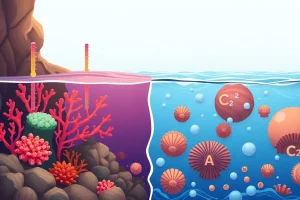
As carbonate becomes less available, organisms that build calcium carbonate structures face increasing difficulty.
This final step is often more biologically important than the pH change itself. (IPCC)
The Carbonate System
The ocean contains several related forms of dissolved inorganic carbon:
- Dissolved carbon dioxide
- Carbonic acid
- Bicarbonate ions
- Carbonate ions
Marine organisms rely heavily on carbonate ions to produce calcium carbonate.
Calcium carbonate exists primarily in two mineral forms:
- Aragonite
- Calcite
Many corals, shellfish, and plankton require sufficient aragonite saturation to grow efficiently.
Declining saturation states increase biological stress.
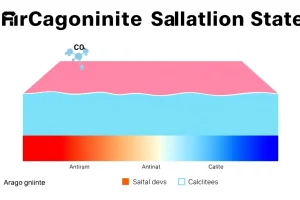
Why Aragonite Saturation Matters
Scientists increasingly monitor aragonite saturation state rather than pH alone.
Higher saturation means conditions favor shell formation.
Lower saturation makes calcification more difficult and, under sufficiently low conditions, existing calcium carbonate structures may begin to dissolve.
Because many ecologically important organisms depend upon aragonite, this measure forms the basis of the planetary-boundary assessment.
Ocean Acidification as a Planetary Boundary
The Planetary Boundaries framework originally classified ocean acidification as a boundary approaching high risk.
A revised assessment published in 2025 incorporated improved observations, ecological indicators, and updated estimates of pre-industrial conditions.
The study concluded:
- Global average ocean conditions entered the uncertainty range of the boundary by around 2020.
- More than 40% of the surface ocean exceeded the boundary.
- Up to 60% of waters down to 200 meters had crossed it.
The researchers proposed a revised precautionary boundary corresponding to roughly a 10% reduction from pre-industrial aragonite saturation. (DOI)
Evidence for Ocean Acidification
Multiple independent observations demonstrate ongoing chemical change.
Direct measurements
Long-term ocean monitoring stations consistently show declining surface-ocean pH.
These observations span decades across multiple ocean basins. (IPCC)
Atmospheric carbon dioxide
Atmospheric CO₂ concentrations have increased dramatically since the Industrial Revolution.
Ocean chemistry responds directly to this increase.
Carbonate chemistry
Scientists observe:
- Lower carbonate ion concentrations
- Lower aragonite saturation
- Lower calcite saturation
These observations match theoretical predictions remarkably well.
Laboratory experiments
Controlled experiments demonstrate that many calcifying organisms experience reduced calcification under lower carbonate saturation.
Responses vary among species.
Some tolerate changing conditions better than others.
Paleoclimate evidence
Geological records indicate that rapid ocean acidification occurred during several past environmental crises.
These episodes often coincided with major disruptions to marine ecosystems. (The Guardian)
Which Organisms Are Most Vulnerable?
Not every marine organism responds equally.
Sensitivity depends on physiology, habitat, life stage, and evolutionary history.
Coral Reefs
Corals construct skeletons from aragonite.
Reduced carbonate availability slows calcification and weakens reef growth.
Coral reefs also face simultaneous stress from:
- Ocean warming
- Marine heatwaves
- Pollution
- Overfishing
These combined pressures are often more damaging than acidification alone. (IPCC)
Shellfish
Many mollusks rely on calcium carbonate shells.
Examples include:
- Oysters
- Mussels
- Clams
- Scallops
Early life stages often appear especially sensitive.
Pteropods
Pteropods are tiny free-swimming marine snails.
They form an important food source for:
- Fish
- Seabirds
- Whales
Recent assessments estimate habitat reductions of up to 61% for polar pteropods under revised planetary-boundary analyses. (DOI)
Plankton
Some plankton species build calcium carbonate structures.
Changes in plankton communities may influence marine food webs and carbon cycling.
Echinoderms
Sea urchins and some starfish may experience developmental or reproductive effects depending on species and environmental conditions.
Ecosystem Consequences
Ocean acidification affects more than individual organisms.
It influences entire ecosystems.
Coral reef degradation
Slower reef growth reduces habitat complexity.
Thousands of species depend on coral reefs for shelter and food.
Food-web disruption
Changes affecting plankton or shell-forming organisms may propagate upward through marine food webs.
Fisheries
Commercial fisheries depend on healthy marine ecosystems.
Some economically important species may become more vulnerable during early life stages.
Coastal protection
Healthy reefs reduce wave energy and protect shorelines.
Weaker reef growth may reduce this natural protection over time.
Ocean Acidification and Climate Change
Ocean acidification is sometimes called the “evil twin” of climate change because both result primarily from rising atmospheric carbon dioxide.
However, they differ fundamentally.
Climate change involves:
- Heat
Ocean acidification involves:
- Chemistry
Reducing warming alone does not prevent acidification if atmospheric CO₂ continues rising.
Likewise, reducing acidification requires lowering carbon dioxide emissions.
Multiple Stressors
Marine organisms rarely experience acidification in isolation.
They often face:
- Ocean warming
- Marine heatwaves
- Deoxygenation
- Pollution
- Overfishing
- Habitat destruction
Combined stresses can produce larger ecological impacts than any single pressure acting alone. (IPCC)
Why Polar Oceans Change Faster
Cold water dissolves carbon dioxide more efficiently than warm water.
As a result:
- Polar oceans absorb more CO₂.
- Acidification often progresses faster.
- Aragonite saturation declines sooner.
Many polar species therefore face earlier exposure to chemically challenging conditions.
Can Marine Species Adapt?
Some organisms demonstrate remarkable resilience.
Possible responses include:
- Physiological acclimation
- Evolutionary adaptation
- Shifts in geographic range
- Behavioral changes
However:
- Adaptation capacity differs greatly among species.
- Rapid environmental change may outpace adaptation.
- Combined stressors reduce resilience.
Scientists therefore expect a mixture of winners and losers rather than uniform responses.
Solutions
Ocean acidification can only be addressed by reducing the underlying driver: atmospheric carbon dioxide.
Key strategies include:
Reduce greenhouse-gas emissions
Lower fossil-fuel emissions reduce future acidification.
Protect blue-carbon ecosystems
Mangroves, seagrasses, and salt marshes:
- Store carbon
- Support biodiversity
- Improve coastal resilience
Reduce additional stressors
Improving water quality, sustainable fisheries, and habitat protection helps marine ecosystems better withstand acidification.
Expand monitoring
Long-term ocean observations improve understanding of regional vulnerability.
Marine protected areas
Protected ecosystems generally exhibit greater resilience than heavily degraded ones.
Common Misunderstandings
“Ocean acidification means the ocean becomes acidic.”
No.
The ocean remains alkaline.
Its pH simply becomes slightly lower.
“Ocean acidification is caused by pollution.”
The primary driver is atmospheric carbon dioxide absorbed by seawater.
“Every marine species responds the same way.”
Responses differ widely among organisms, habitats, and life stages.
Some species tolerate changing chemistry better than others.
“If climate change stopped tomorrow, acidification would disappear immediately.”
No.
Ocean chemistry responds gradually.
Past carbon dioxide emissions continue influencing the ocean for decades and longer.
Frequently Asked Questions
What causes ocean acidification?
The primary cause is the absorption of human-produced carbon dioxide by seawater. (IPCC)
Is ocean acidification the same as climate change?
No.
Both result largely from rising CO₂, but climate change involves warming while ocean acidification involves changes in seawater chemistry.
Why are carbonate ions important?
Marine organisms use carbonate ions to build shells and skeletons made of calcium carbonate.
Has the ocean acidification planetary boundary been crossed?
Recent research published in 2025 concludes that the global ocean had entered the uncertainty range of the planetary boundary by around 2020 using updated assessment methods. (DOI)
Which organisms are most vulnerable?
Corals, shellfish, pteropods, and many other calcifying organisms are generally among the most sensitive.
Can ocean acidification be reversed?
The most effective long-term solution is reducing atmospheric carbon dioxide emissions. Local conservation measures improve ecosystem resilience but cannot fully offset ongoing global acidification. (IPCC)
Conclusion
Ocean acidification is one of the clearest examples of how human activities alter the Earth system in ways that are both widespread and largely invisible.
By absorbing vast quantities of atmospheric carbon dioxide, the ocean has slowed the pace of climate warming. At the same time, this essential service has changed seawater chemistry, reducing carbonate availability for many marine organisms and placing increasing pressure on coral reefs, shellfish, plankton, and marine food webs.
Recent assessments suggest that ocean acidification has now moved beyond the safe operating space defined by the Planetary Boundaries framework, particularly when ecological indicators and subsurface ocean conditions are considered. These findings reinforce the view that acidification is not a distant future concern but an ongoing Earth-system challenge. (DOI)
Protecting the ocean requires more than conserving marine habitats. It ultimately depends on reducing carbon dioxide emissions while strengthening the resilience of marine ecosystems through sustainable fisheries, pollution reduction, habitat restoration, and effective ocean governance.
The chemistry of the ocean may be changing molecule by molecule, but its consequences extend from microscopic plankton to global fisheries, coastal economies, and the stability of one of Earth’s most important life-support systems.