In brief
At a glance
Quick Facts
- Definition
- A tax on the carbon content of fossil fuels, intended to reduce CO₂ emissions.
- Purpose
- To internalize the social cost of carbon and incentivize cleaner energy.
- How it's applied
- Typically levied per ton of CO₂ emitted, or on fuel at point of production or import.
- Revenue use
- Often returned to households as dividends or used to fund green projects.
- Global adoption
- Implemented in over 25 countries, including Sweden, Canada, and Switzerland.
- Effectiveness
- Studies show carbon taxes reduce emissions while having modest economic impacts.
Key Takeaways
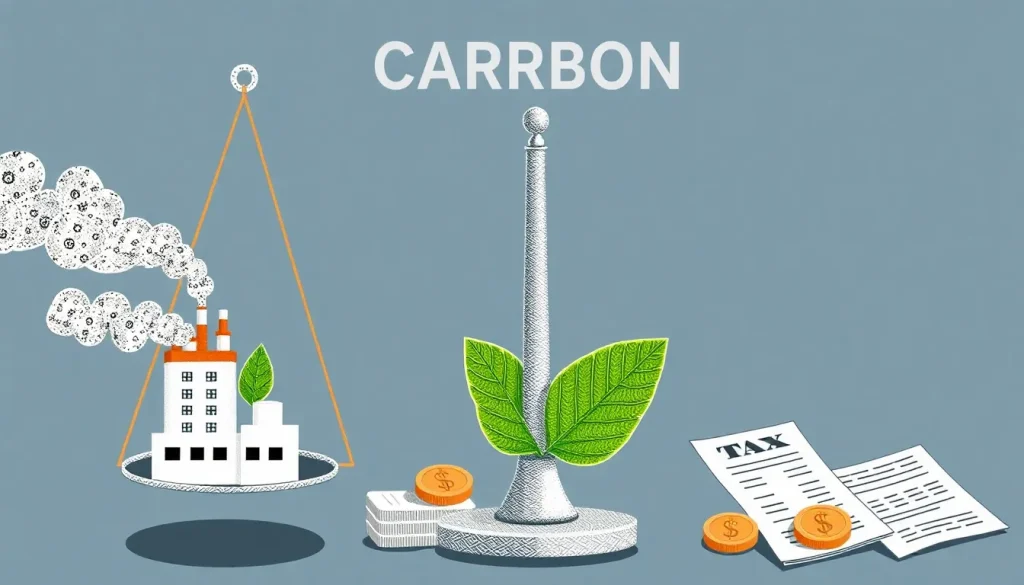
- A carbon tax is a fee imposed on the carbon content of fossil fuels, making polluting activities more expensive and encouraging a shift to cleaner energy.
- It is a market-based policy tool that puts a price on carbon dioxide emissions, allowing businesses and consumers to respond efficiently.
- Revenue from a carbon tax can be used to reduce other taxes, return money to households, or invest in green infrastructure.
- By internalizing the social cost of carbon, a carbon tax helps address climate change while minimizing economic disruption.
What Is a Carbon Tax?
A carbon tax is a form of pollution tax that levies a fee on the carbon content of fossil fuels. The tax is typically expressed as a price per metric ton of carbon dioxide (CO₂) emitted, or equivalently, per ton of carbon content in the fuel. It is designed to make activities that produce greenhouse gas emissions more expensive, thereby encouraging businesses and individuals to reduce their carbon footprint. Unlike regulations that mandate specific technologies or emission limits, a carbon tax uses market forces to achieve environmental goals. By raising the cost of carbon-intensive goods and services, it provides a financial incentive for energy efficiency, fuel switching, and investment in renewable energy.
The concept is rooted in the economic principle of externalities: the cost of climate change caused by greenhouse gas emissions is not borne by the emitters but by society at large. A carbon tax internalizes this external cost, aligning private incentives with social welfare. It is considered a key policy instrument for mitigating climate change, as it can be applied broadly across an economy and adjusted over time to meet emission reduction targets. While the tax itself increases energy prices, governments often pair it with measures to offset the burden on households and businesses, such as rebates or cuts to other taxes.
How It Works
A carbon tax is typically applied at the point where fossil fuels enter the economy—such as at the mine, wellhead, or port of entry. The tax rate is set per ton of CO₂ that will be emitted when the fuel is burned. For example, coal has a higher carbon content per unit of energy than natural gas, so it faces a higher tax per unit of energy produced. The tax cascades through the supply chain, increasing the price of carbon-intensive goods and services. This price signal encourages producers to adopt cleaner technologies and consumers to choose lower-carbon options, such as electric vehicles or energy-efficient appliances. The effectiveness of the tax depends on the rate: a higher tax provides a stronger incentive to reduce emissions. Governments may also adjust the tax over time to meet emission reduction targets, often starting low and increasing gradually to give businesses time to adapt.
Implementation can vary. Some jurisdictions apply the tax directly to fuel suppliers, while others tax large emitters based on measured emissions. The revenue generated can be used in different ways: it may be returned to citizens as a dividend (often called a “carbon fee and dividend”), used to reduce other taxes (such as income or corporate taxes), or directed toward environmental programs. The administrative costs are generally low because the tax leverages existing fuel supply chains and tax collection systems.
Importance and Impact
Carbon taxes are important because they address the root cause of climate change—the emission of greenhouse gases—by putting a direct price on carbon. By making pollution costly, they drive innovation in clean energy and energy efficiency. The impact of a carbon tax can be seen in reduced emissions, as well as in shifts in energy consumption patterns. For example, in Sweden, which has had a carbon tax since 1991, emissions have fallen while the economy has grown. The tax also generates significant revenue, which can be used to reduce other taxes (such as income or payroll taxes), fund public services, or be returned to citizens as a dividend. This revenue recycling can offset the regressive nature of the tax, as lower-income households tend to spend a larger share of their income on energy.
Beyond emission reductions, carbon taxes can improve public health by reducing co-pollutants like sulfur dioxide and particulate matter. They also send a long-term signal to markets, encouraging investment in research and development of low-carbon technologies. The overall economic impact is often modest, especially when revenue is recycled efficiently, and many studies suggest that a well-designed carbon tax can achieve climate goals without harming economic growth.
Benefits, Limitations and Trade-offs
The primary benefit of a carbon tax is its efficiency: it achieves emission reductions at the lowest possible cost by allowing businesses and individuals to choose the most cost-effective ways to reduce their carbon footprint. It also provides a clear and predictable price signal, which encourages long-term investment in clean technologies. Additionally, it can be implemented relatively quickly and with low administrative costs compared to other regulatory approaches.
However, a carbon tax also has limitations. It can be regressive, disproportionately affecting low-income households unless paired with compensatory measures. There is also the risk of “carbon leakage,” where industries relocate to countries with weaker climate policies, potentially undermining the environmental benefits. To address this, some jurisdictions implement border carbon adjustments. Politically, carbon taxes can be unpopular due to the direct increase in energy prices, making public acceptance a significant challenge. Trade-offs include balancing the tax rate to achieve environmental goals while maintaining economic competitiveness and social equity.
Common Misconceptions
One common misconception is that a carbon tax is just another way for governments to raise revenue. In reality, many carbon tax proposals are designed to be revenue-neutral, with the proceeds returned to households or used to cut other taxes. Another misconception is that a carbon tax alone can solve climate change. While it is a powerful tool, it must be part of a broader policy package that includes regulations, subsidies for clean energy, and international cooperation. Some also believe that a carbon tax will cripple the economy, but evidence from jurisdictions with carbon taxes shows that economic growth can continue while emissions decline, especially if the revenue is recycled efficiently.
Additionally, there is a misconception that carbon taxes are the same as cap-and-trade systems. While both put a price on carbon, a tax sets the price directly and lets the market determine the quantity of emissions reduced, whereas cap-and-trade sets a limit on emissions and lets the market determine the price. Both can be effective, but they have different administrative and political characteristics.
Examples
Several countries and regions have implemented carbon taxes with varying designs. Sweden introduced a carbon tax in 1991, which is now among the highest in the world at over $100 per ton of CO₂. The tax covers fossil fuels used in heating and transportation, with some exemptions for industry. Canada’s federal carbon tax, implemented in 2019, started at $20 per ton and is set to increase to $170 per ton by 2030. The revenue is returned to households through rebates. British Columbia’s carbon tax, introduced in 2008, was one of the first in North America and is revenue-neutral, with proceeds used to reduce corporate and personal income taxes. Other examples include Switzerland, which levies a tax on heating and process fuels, and Singapore, which introduced a carbon tax in 2019 targeting large emitters.
These examples illustrate the diversity in design: some taxes cover a broad base, while others focus on specific sectors; some are revenue-neutral, while others use the funds for green investments. The effectiveness varies, but overall, they have contributed to emission reductions without significant economic harm.
FAQ
What is a carbon tax?
A carbon tax is a fee imposed on the carbon content of fossil fuels, designed to reduce greenhouse gas emissions by making polluting activities more expensive.
How does a carbon tax work?
It sets a price per ton of CO₂ emitted, which increases the cost of carbon-intensive goods and services, encouraging businesses and consumers to switch to cleaner alternatives.
Why does a carbon tax matter?
It matters because it is an efficient, market-based tool to combat climate change by internalizing the social cost of carbon, driving innovation, and generating revenue that can be used to offset economic impacts.
References
- World Bank. (2023). State and Trends of Carbon Pricing.
- IMF. (2019). Fiscal Monitor: How to Mitigate Climate Change.
- IPCC. (2022). Climate Change 2022: Mitigation of Climate Change.