In brief
At a glance
Quick Facts
- Definition
- A voluntary transaction where a service user pays a service provider for an ecosystem service, conditional on continued provision.
- Key Principle
- Conditionality—payment is made only if the ecosystem service is delivered or maintained.
- First National PES Program
- Costa Rica launched its national PES program in 1997, funded by a fuel tax and water tariffs.
- Common Services Traded
- Carbon sequestration, watershed protection, biodiversity conservation, and landscape beauty.
- Scale
- PES schemes range from local watershed agreements to international carbon markets like REDD+.
- Economic Rationale
- PES corrects market failures by internalizing the positive externalities of ecosystem management.
- Challenges
- Additionality, leakage, permanence, high transaction costs, and equity concerns.
- Global Reach
- PES programs exist on every continent, with significant initiatives in Latin America, Asia, and Africa.
Key Takeaways
- Payments for Ecosystem Services (PES) are voluntary transactions where a service user or buyer pays a land steward to provide or maintain an ecosystem service.
- PES programs aim to correct market failures by assigning economic value to nature’s benefits, such as clean water, carbon sequestration, and biodiversity.
- Conditionality—payment only upon verified service delivery—is a defining feature that distinguishes PES from traditional subsidies.
- While PES can incentivize conservation and support rural livelihoods, challenges like additionality, leakage, and equity must be carefully managed.
What Is Payments for Ecosystem Services?
Payments for Ecosystem Services (PES) is a market-based conservation approach in which beneficiaries of ecosystem services pay landowners or resource managers to adopt practices that secure or enhance those services. It is a voluntary transaction where a well-defined environmental service is “bought” by at least one buyer from at least one provider, if and only if the provider secures service provision (conditionality). PES falls under the broader category of environmental policy instruments that use economic incentives rather than command-and-control regulations. The core idea is to internalize the positive externalities of ecosystem management, making conservation financially attractive to those who control the land.
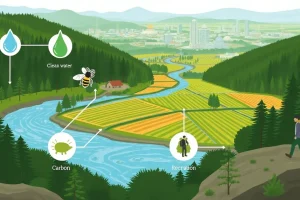
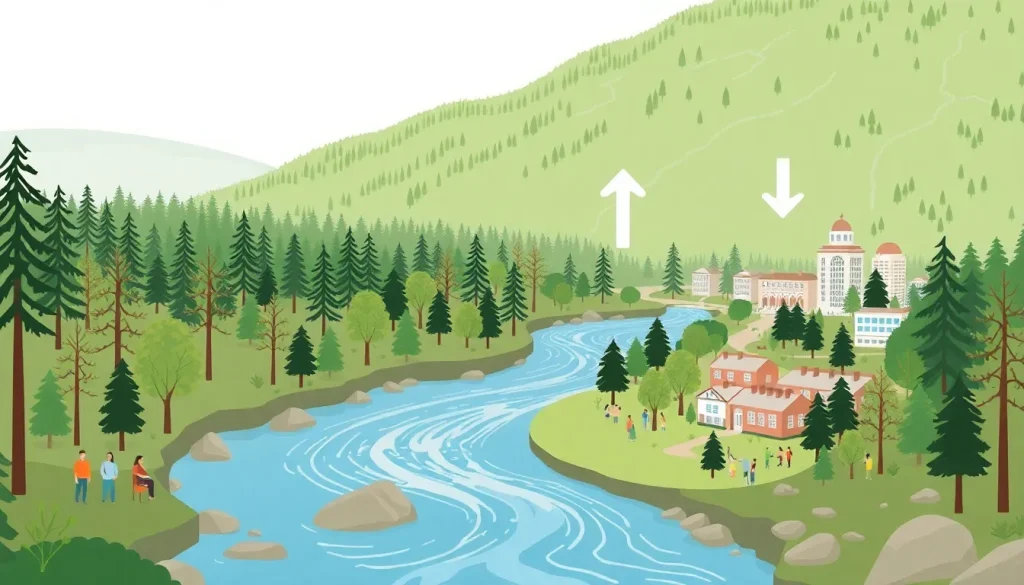
Ecosystem services are the benefits people obtain from ecosystems, such as water purification, flood control, carbon storage, pollination, and scenic beauty. These services are often undervalued or not priced in markets, leading to their degradation. PES creates a direct link between those who benefit and those who can provide the service, turning conservation into a source of income. For example, a downstream water utility might pay upstream farmers to adopt sustainable land practices that reduce sedimentation and improve water quality. PES schemes can be public (government-funded), private (business-funded), or hybrid, and they operate at local, national, and international scales.
History
The concept of Payments for Ecosystem Services emerged from environmental economics in the late 20th century, recognizing that ecosystem services are public goods often provided without compensation. Early precursors include the United States Conservation Reserve Program (1985), which paid farmers to retire environmentally sensitive land, though it was not strictly conditional on service delivery. The modern PES framework crystallized in the 1990s, with Costa Rica’s 1996 Forestry Law establishing a national PES program often cited as a pioneering model. International initiatives like REDD+ (Reducing Emissions from Deforestation and Forest Degradation) later expanded PES to global carbon markets. The Millennium Ecosystem Assessment (2005) further popularized the concept by categorizing ecosystem services and highlighting their decline, spurring interest in market-based solutions.

How It Works
PES involves five key criteria: a voluntary transaction, a well-defined ecosystem service, at least one buyer, at least one provider, and conditionality. The process typically begins with identifying the service and its beneficiaries. A payment mechanism is established, often through an intermediary like a trust fund or government agency. Providers (e.g., farmers, forest communities) enter into contracts to implement specific land-use practices (e.g., reforestation, conservation agriculture). Payments are made only upon verification that the agreed-upon service has been delivered or maintained. Monitoring and enforcement are critical to ensure compliance. Payments can be in cash or in-kind, and may be financed by user fees, public budgets, or private investments.
Examples
Costa Rica’s PES program, launched in 1997, pays landowners for forest conservation, reforestation, and sustainable forest management, funded by a fuel tax and water tariffs. The Vittel (Nestlé Waters) program in France pays farmers to adopt low-input dairy farming to protect the quality of mineral water sources. China’s Sloping Land Conversion Program (Grain for Green) pays farmers to convert cropland on steep slopes to forest or grassland to control erosion. In Ecuador, the city of Quito established a water fund (FONAG) where water users contribute to finance upstream conservation. These examples illustrate the diversity of PES in terms of scale, funding, and services targeted.
Benefits, Limitations and Trade-offs
PES can provide direct financial incentives for conservation, potentially improving rural livelihoods and securing ecosystem services. It can be more cost-effective than regulatory approaches and can align economic development with environmental goals. However, PES faces challenges: additionality (would the service have been provided anyway?), leakage (does conservation in one area shift degradation elsewhere?), permanence (are the benefits long-lasting?), and high transaction costs. There are also equity concerns: PES may favor larger, wealthier landowners and marginalize poorer communities or those without formal land tenure. Trade-offs can arise between different services (e.g., planting fast-growing trees for carbon may reduce water yield). Effective design and governance are essential to mitigate these issues.
Importance and Impact
PES is important because it addresses the failure of markets to value ecosystem services, which are critical for human well-being. By creating economic incentives, PES can shift land-use decisions toward conservation. Globally, PES programs have directed billions of dollars toward ecosystem protection, contributing to forest conservation, watershed management, and biodiversity preservation. They have also raised awareness of the economic value of nature. However, the overall impact varies widely; rigorous impact evaluations show mixed results, with some programs achieving significant environmental gains and others showing minimal additionality. The long-term sustainability of PES depends on stable funding, strong institutions, and adaptive management.
Common Misconceptions
One misconception is that PES is simply a subsidy. Unlike subsidies, PES is conditional on service delivery and involves a voluntary transaction. Another is that PES always leads to win-win outcomes for environment and poverty; in reality, trade-offs are common. Some believe PES is only about carbon sequestration, but it covers a wide range of services including water, biodiversity, and landscape beauty. Finally, there is a misconception that PES can replace public regulation; it is often most effective as part of a broader policy mix.
FAQ
What is payments for ecosystem services?
PES is a market-based conservation tool where beneficiaries of ecosystem services pay land managers to protect or restore those services, with payment conditional on results.
How does payments for ecosystem services work?
A buyer (e.g., water utility) contracts with a provider (e.g., farmer) to implement practices that secure a service (e.g., clean water). Payment is made after verification of service delivery.
Why does payments for ecosystem services matter?
It addresses the undervaluation of nature by creating economic incentives for conservation, helping to sustain vital services like clean water, carbon storage, and biodiversity.
References
- Wunder, S. (2005). Payments for environmental services: Some nuts and bolts. CIFOR Occasional Paper No. 42.
- Engel, S., Pagiola, S., & Wunder, S. (2008). Designing payments for environmental services in theory and practice: An overview of the issues. Ecological Economics, 65(4), 663-674.
- Millennium Ecosystem Assessment (2005). Ecosystems and Human Well-being: Synthesis.