In brief
At a glance
Quick Facts
- Verdict
- Mixed
- Problem addressed
- Atmospheric CO2 accumulation
- Evidence strength
- Moderate
- Potential scale
- Global
- Relative cost
- High
- Time to impact
- Decades
Quick verdict
Direct air capture (DAC) is a technically demonstrated but early-stage technology that removes CO2 directly from the atmosphere. It holds promise as a complementary tool for addressing residual emissions and achieving net-negative emissions, but its high costs, large energy requirements, and unproven scalability mean it is not yet a viable large-scale climate solution. Its ultimate role depends on significant technological improvements, cost reductions, and robust policy support.
Problem addressed
DAC targets the accumulation of carbon dioxide in the atmosphere, the primary driver of anthropogenic climate change. Even with aggressive emissions reductions, many climate scenarios require the removal of billions of tonnes of CO2 annually by mid-century to limit warming to 1.5°C or 2°C. DAC offers a potential method to directly reduce atmospheric CO2 concentrations, addressing legacy emissions and offsetting hard-to-abate sectors such as aviation, agriculture, and industrial processes.
How the solution works
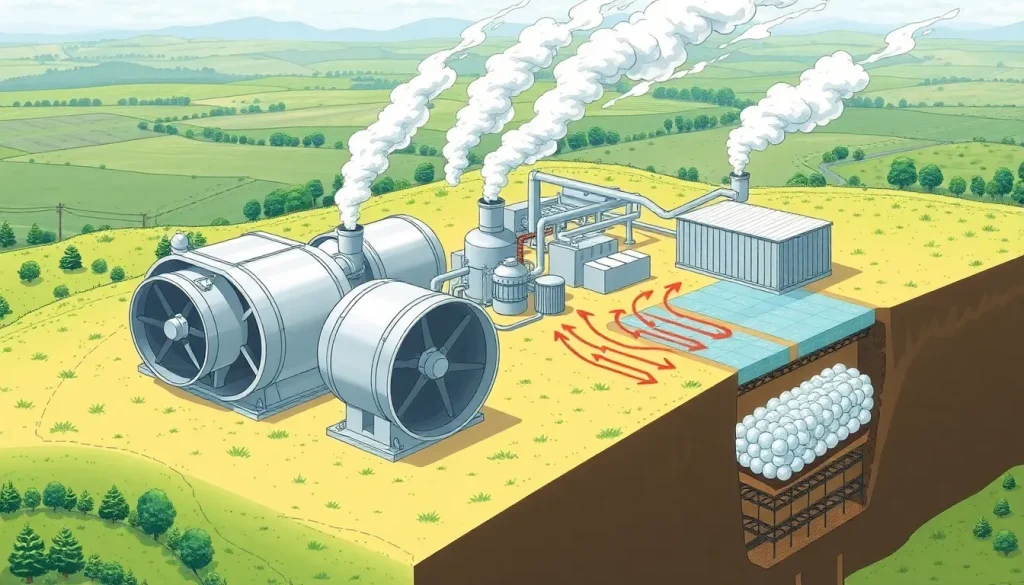
DAC systems use chemical processes to capture CO2 from ambient air. In liquid solvent systems, air is passed through a solution (e.g., potassium hydroxide) that binds CO2, which is then released through high-temperature calcination. In solid sorbent systems, air flows over filters or materials (e.g., amine-based sorbents) that adsorb CO2; the sorbent is then heated or subjected to a vacuum to release a concentrated CO2 stream. The captured CO2 can be compressed and either permanently stored underground in geological formations (e.g., saline aquifers, basalt rock) or utilized in products like synthetic fuels or chemicals. Only permanent storage results in net-negative emissions.
Evidence strength
DAC has been demonstrated at pilot and small commercial scales. Companies such as Climeworks (Switzerland) and Carbon Engineering (Canada) operate facilities capturing hundreds to thousands of tonnes of CO2 per year. However, the evidence base for large-scale, cost-effective deployment is limited. Peer-reviewed studies on real-world performance at scale are scarce, and cost estimates vary widely. The technology is still in early deployment, with many unknowns regarding long-term performance, energy integration, and environmental impacts. Current evidence is sufficient to prove technical feasibility but insufficient to confirm economic viability or scalability to climate-relevant levels.
Potential scale
The theoretical potential of DAC is vast because the atmosphere is a ubiquitous resource. However, practical scalability is constrained by high energy requirements, sorbent production, land use, and the need for extensive CO2 transport and storage infrastructure. Current global capacity is on the order of thousands of tonnes per year, while climate scenarios often envision billions of tonnes per year by mid-century. Scaling up by a factor of a million would require an unprecedented industrial mobilization, akin to building a new global industry. Limits include the availability of low-carbon energy, suitable storage geology, and the manufacturing capacity for sorbents and equipment.
Cost considerations
Current costs for DAC are high, with estimates ranging from $250 to $600 per tonne of CO2 captured, depending on the technology and energy source. Future cost projections vary widely; optimistic estimates suggest $100–200 per tonne at scale, but these are unproven. Costs are driven by energy inputs, capital expenses, and sorbent materials. Without a strong carbon price or policy support, DAC is not economically competitive with many other mitigation options. Cost-effectiveness relative to the climate benefit is uncertain and depends on the value assigned to a tonne of CO2 removed.
Implementation time
Individual DAC facilities can be built within a few years once the technology is mature, but scaling to climate-relevant levels would take decades. The first large-scale plants (around 1 MtCO2/year) are planned for the mid-2020s, but reaching gigatonne scale by 2050 would require sustained exponential growth. The climate impact is not immediate; it depends on cumulative removal over time. Even with rapid deployment, DAC would not significantly affect atmospheric CO2 concentrations for many years.
Environmental benefits
The primary environmental benefit is the direct reduction of atmospheric CO2 concentrations, helping to mitigate climate change. If coupled with permanent storage, DAC can provide verifiable negative emissions. It can also help address legacy emissions and hard-to-abate sectors. However, the net climate benefit depends on the carbon intensity of the energy used to power the process. If powered by fossil fuels without carbon capture, the net removal could be greatly reduced or even negated.
Social and economic co-benefits
DAC could create jobs in manufacturing, construction, and operation of facilities. It might provide a pathway for fossil fuel companies to transition toward carbon management. It could also enable continued use of fossil fuels in some sectors while still meeting climate goals, though this is controversial. DAC may support the development of CO2 utilization industries, such as synthetic fuels or building materials, potentially creating new economic opportunities.
Risks and unintended consequences
High energy requirements could lead to increased emissions if powered by fossil fuels, negating the climate benefit. Large-scale deployment could compete for land, water, and renewable energy resources, potentially affecting food production or ecosystems. There is a moral hazard risk: the promise of future DAC might reduce the urgency of cutting emissions now. CO2 storage poses risks of leakage and induced seismicity. Sorbent production and disposal could have environmental impacts, including chemical pollution and resource depletion.
Where it works best
DAC is location-flexible because air is everywhere, but it works best where there is access to abundant low-carbon energy (renewables or nuclear), suitable geology for CO2 storage (e.g., saline aquifers, basalt formations), and supportive policy and carbon markets. Regions with high renewable potential and existing oil and gas infrastructure for storage might be early adopters. Iceland, with its geothermal energy and basalt storage, is an example of favorable conditions.
Where it may not work
DAC is less suitable in regions without access to abundant clean energy or storage capacity. High costs make it unviable in areas without strong carbon pricing or subsidies. It may face public opposition regarding land use or storage safety. In developing countries with more pressing energy access needs, DAC might be a lower priority compared to other development goals. Additionally, in areas with high water stress, the water requirements of some DAC processes could be problematic.
Comparison with alternatives
DAC is one of several carbon dioxide removal (CDR) methods. Compared to afforestation/reforestation, it uses less land but is far more expensive and energy-intensive. Compared to bioenergy with carbon capture and storage (BECCS), it avoids land competition but has higher energy demands. DAC is more scalable than some methods but less mature. It is often seen as a backstop technology for emissions that are difficult to eliminate. Unlike nature-based solutions, DAC offers permanent storage and easier quantification, but at a higher cost.
Case studies
The Climeworks Orca plant in Iceland (operational since 2021) captures 4,000 tonnes CO2/year using solid sorbent DAC and geothermal energy, with storage in basalt rock via the Carbfix process. This is the first commercial DAC facility with permanent storage. Carbon Engineering’s pilot in British Columbia has been testing liquid solvent DAC since 2015, and they are planning a large-scale plant in Texas (1 MtCO2/year) with Oxy Low Carbon Ventures, though it is not yet operational. These projects demonstrate technical viability but also highlight the gap to gigatonne-scale deployment.
Final assessment
DAC is a promising but unproven technology for large-scale carbon removal. It is not a substitute for rapid emissions reductions but could play a critical complementary role, especially for hard-to-abate emissions and legacy CO2. Its future depends on sustained R&D, cost reductions through learning and scale, and strong policy support. Given the urgency of climate action, DAC should be pursued as part of a portfolio of solutions, but not relied upon as a silver bullet. The most prudent approach is to accelerate emissions cuts while investing in DAC to determine if it can become a viable tool at scale.
FAQ
How does direct air capture differ from carbon capture at power plants?
Direct air capture removes CO2 directly from the ambient air, where concentrations are about 0.04%, while carbon capture at power plants captures CO2 from concentrated flue gas streams (typically 4-15% CO2). DAC is more energy-intensive and costly because of the lower concentration, but it can address dispersed emissions and legacy CO2, whereas point-source capture only prevents new emissions.
What is the current cost of direct air capture?
Current cost estimates for DAC range from $250 to $600 per tonne of CO2 captured, depending on the technology and energy source. These costs are expected to decline with technological learning and scale, but projections of $100-200 per tonne at large scale remain unproven.
Can direct air capture solve climate change on its own?
No. DAC is not a standalone solution. It is energy-intensive, expensive, and cannot be scaled quickly enough to offset continued high emissions. It should be viewed as a complement to rapid and deep emissions reductions, particularly for addressing residual emissions from hard-to-abate sectors and for achieving net-negative emissions later this century.
References
- IPCC Special Report on Global Warming of 1.5°C (2018)
- IEA Direct Air Capture report (2022)
- National Academies of Sciences, Engineering, and Medicine. (2019). Negative Emissions Technologies and Reliable Sequestration: A Research Agenda.
- Keith, D. W., et al. (2018). A process for capturing CO2 from the atmosphere. Joule, 2(8), 1573-1594.
- Climeworks AG. (2023). Orca plant in Iceland.