In brief
At a glance
Quick Facts
- Status
- Six of nine boundaries transgressed (2023 assessment)
- Control variable
- Multiple control variables for each of nine Earth-system processes
- Proposed boundary
- All nine boundaries within safe limits (zero transgressions)
- Current value
- Six boundaries transgressed: climate change, biosphere integrity, land-system change, freshwater change, biogeochemical flows, novel entities
- Pre-industrial baseline
- Holocene epoch (~11,700 years) with all boundaries within safe operating space
Current status
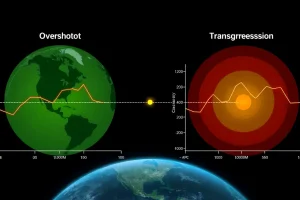
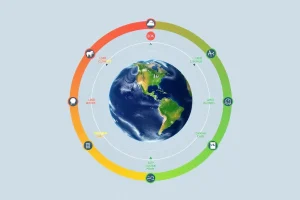
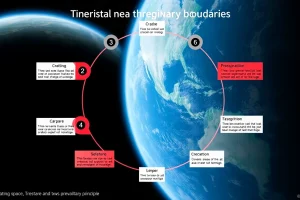
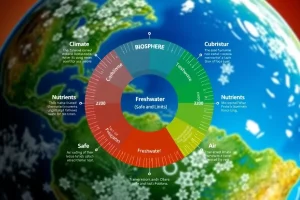
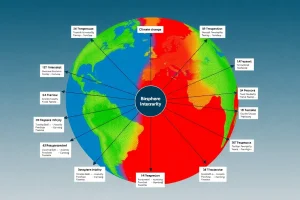
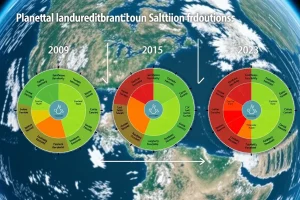
The planetary boundaries framework, first proposed in 2009 and updated in 2015 and 2023, identifies nine Earth-system processes that regulate the stability and resilience of the planet. As of the 2023 assessment, six of these nine boundaries are assessed to be transgressed: climate change, biosphere integrity (genetic diversity and functional integrity), land-system change, freshwater change, biogeochemical flows (nitrogen and phosphorus), and novel entities (including synthetic chemicals and plastics). The remaining three boundaries—stratospheric ozone depletion, atmospheric aerosol loading, and ocean acidification—are currently within the safe operating space, though ocean acidification is approaching its boundary. This status indicates that human activities have pushed the Earth system outside the stable Holocene-like conditions that have supported human civilization.
Control variable
The planetary boundaries framework does not rely on a single control variable; instead, it defines specific control variables for each of the nine Earth-system processes. These variables are chosen to reflect the most critical aspects of each process that determine the risk of crossing a threshold. For example, the climate change boundary uses atmospheric CO₂ concentration (ppm) and radiative forcing (W/m²) as control variables. Biosphere integrity is tracked by genetic diversity (extinction rate) and functional integrity (e.g., net primary production human appropriation). The overall state of the Earth system is often summarized by the number of boundaries that have been transgressed, providing a dashboard-like indicator of planetary health. This multi-variable approach acknowledges that Earth-system stability depends on a complex interplay of processes, not a single metric.
Proposed boundary or threshold
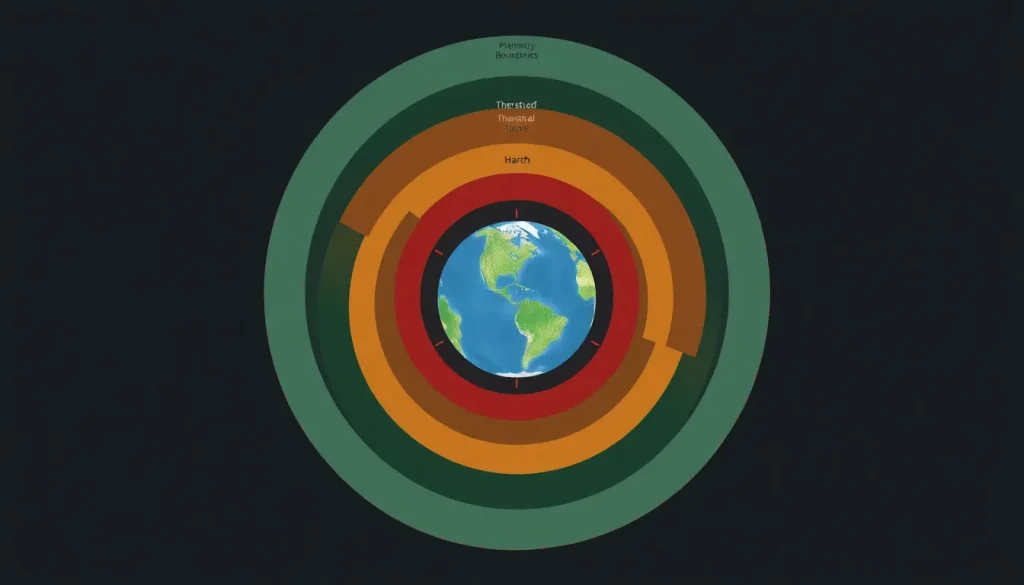
The planetary boundaries framework proposes a safe operating space for each of the nine processes, defined by a boundary value that should not be crossed to avoid triggering non-linear, abrupt, or irreversible environmental changes at the global or regional scale. For example, the climate change boundary is set at 350 ppm CO₂ and a radiative forcing of +1.0 W/m² relative to pre-industrial levels. The biosphere integrity boundary is defined as an extinction rate of less than 10 extinctions per million species-years (E/MSY) and a functional integrity limit of 90% remaining Holocene-average biodiversity intactness. The overall safe operating space is the zone where all nine boundaries are respected. The framework also defines a zone of increasing risk (uncertainty) beyond the boundary and a high-risk zone where thresholds may be crossed, leading to potentially catastrophic Earth-system changes. The proposed boundary values are based on the best available scientific understanding of Earth-system dynamics, paleo-climatic records, and observed responses to human pressures.
Current measured value
As of the 2023 update, six boundaries are assessed to be transgressed. The climate change boundary is exceeded, with atmospheric CO₂ concentrations around 417 ppm (2022) and radiative forcing estimated at 2.91 W/m². Biosphere integrity is severely compromised: the extinction rate is estimated at over 100 E/MSY, and functional integrity has fallen below the proposed boundary, with human appropriation of net primary production and loss of biodiversity intactness. Land-system change has crossed its boundary, with global forest cover now below the proposed 75% of original forest cover. Freshwater change is transgressed, as both blue water consumption and green water anomalies exceed safe limits. Biogeochemical flows of nitrogen and phosphorus are far beyond the safe boundary, with global nitrogen fixation rates more than double the proposed limit. Novel entities, including plastics and synthetic chemicals, are being released at rates that exceed the planet’s capacity to assess and manage their impacts. The remaining boundaries—stratospheric ozone depletion, atmospheric aerosol loading, and ocean acidification—are within the safe operating space, though ocean acidification is nearing its boundary.
How the boundary is calculated
The planetary boundaries framework is not a single calculation but a synthesis of multiple Earth-system models, observational data, and expert assessments. For each boundary, scientists identify a control variable that captures the essence of the process and a threshold beyond which the risk of destabilization increases sharply. The boundary value is set at a safe distance from the threshold, incorporating a precautionary buffer to account for uncertainties and the risk of interacting boundaries. For example, the climate boundary of 350 ppm CO₂ was derived from paleoclimate evidence showing that during the Holocene, CO₂ levels did not exceed 300 ppm, and that exceeding 350 ppm risks triggering ice-sheet melting and other feedbacks. The current value is based on direct atmospheric measurements. For novel entities, the boundary is qualitative, as no global threshold can be quantified; it is considered transgressed because the rate of chemical production and release far exceeds society’s ability to assess and manage their impacts. The overall assessment of how many boundaries are crossed is a simple count, but the framework emphasizes that boundaries interact, so transgressing multiple boundaries amplifies risks.
Historical trend
During the Holocene (the past ~11,700 years), all planetary boundary control variables remained within relatively stable ranges, providing the environmental conditions that allowed human civilizations to develop and thrive. Since the Industrial Revolution, and particularly since the mid-20th century (the “Great Acceleration”), human pressures have driven most control variables sharply upward. Atmospheric CO₂ has risen from ~280 ppm to over 420 ppm. The rate of species extinctions has increased by at least 100-fold. Reactive nitrogen production has more than doubled. Land-system change has accelerated, with forest cover declining from over 60% to below 60% of original forest area. The first planetary boundary to be transgressed was likely biosphere integrity (genetic diversity) in the mid-20th century, followed by climate change, biogeochemical flows, and others. The number of transgressed boundaries has increased from three in 2009 (when the framework was first published) to six in 2023, reflecting both worsening trends and improved scientific understanding.
What is driving the change
The primary driver of planetary boundary transgression is the exponential growth of human activities since the Industrial Revolution, including population growth, resource consumption, and technological change. The burning of fossil fuels for energy, industrial processes, and transportation is the main driver of climate change and ocean acidification. Agricultural expansion and intensification drive land-system change, freshwater use, and biogeochemical flows (nitrogen and phosphorus). Industrial production and consumerism are responsible for novel entities, including plastics, synthetic chemicals, and heavy metals. Deforestation and habitat destruction are the main causes of biosphere integrity loss. These drivers are deeply embedded in the global economic system, which prioritizes short-term growth over long-term sustainability. The scale of human enterprise has now reached a point where it rivals or exceeds natural Earth-system processes, leading to the Anthropocene—a proposed new geological epoch defined by human dominance of the planet.
What crossing the boundary means
Crossing a planetary boundary does not imply an immediate catastrophe, but it signals that the Earth system is moving into a state of increased risk, where feedback loops and tipping points could trigger abrupt, irreversible, and potentially catastrophic changes. For example, transgressing the climate boundary increases the risk of ice-sheet collapse, permafrost thaw, and Amazon dieback, which would further accelerate warming. Crossing the biosphere integrity boundary undermines the resilience of ecosystems, reducing their capacity to provide essential services such as pollination, water purification, and carbon sequestration. Transgressing multiple boundaries simultaneously can lead to cascading effects, where the failure of one system amplifies pressures on others. The framework warns that the Earth system may be approaching a planetary threshold—a global tipping point beyond which the system shifts to a new, less hospitable state, with severe consequences for human societies and the biosphere.
Regional variations
While the planetary boundaries framework is global in scope, several boundaries operate at sub-global scales, and their transgression manifests differently across regions. For instance, freshwater change is assessed globally but is highly variable regionally; some basins are severely water-stressed while others are not. Land-system change is measured globally by forest cover, but deforestation is concentrated in tropical regions, while temperate and boreal forests may be stable or expanding. Biogeochemical flows of nitrogen and phosphorus cause eutrophication in specific watersheds and coastal zones, with hotspots in agricultural regions. Atmospheric aerosol loading is a regional boundary, with high concentrations of particulate matter in South and East Asia affecting monsoon patterns. The framework acknowledges that some boundaries must be managed at regional scales, and that global aggregate metrics may mask critical local transgressions. This regionality complicates governance, as actions in one region can have teleconnected effects elsewhere.
Interaction with other boundaries
Planetary boundaries are not independent; they interact in complex ways that can amplify risks. Climate change exacerbates biosphere integrity loss by shifting habitats and increasing extinction risks. Land-system change contributes to climate change through deforestation and carbon release, and also affects freshwater cycles. Biogeochemical flows of nitrogen and phosphorus pollute waterways, harming aquatic ecosystems and contributing to biodiversity loss. Ocean acidification, driven by CO₂ emissions, interacts with climate change to stress marine organisms. Novel entities, such as plastics, can transport invasive species and pollutants, affecting biosphere integrity. The framework emphasizes that transgressing multiple boundaries can create synergistic effects, pushing the Earth system closer to tipping points. For example, the combination of climate change, land-use change, and biodiversity loss increases the risk of large-scale ecosystem collapses, such as the Amazon rainforest transitioning to a savanna state. Understanding these interactions is crucial for effective policy responses, as addressing one boundary in isolation may be insufficient.
Impacts on people and ecosystems
Transgressing planetary boundaries has profound and often inequitable impacts on human well-being and ecosystems. Climate change leads to more frequent and intense extreme weather events, sea-level rise, and disruptions to food and water security. Biosphere integrity loss reduces ecosystem services, including crop pollination, pest control, and nutrient cycling, threatening agricultural productivity and livelihoods. Freshwater change exacerbates water scarcity, affecting drinking water supplies, sanitation, and irrigation. Biogeochemical flows cause harmful algal blooms, dead zones in coastal waters, and nitrate contamination of groundwater, posing health risks. Novel entities, such as endocrine-disrupting chemicals and microplastics, have unknown long-term health effects. These impacts disproportionately affect vulnerable populations, including low-income communities, Indigenous peoples, and developing nations, who have contributed least to the problem. The erosion of Earth-system resilience undermines the foundation of human civilization, increasing the risk of conflict, displacement, and economic instability.
Possible pathways back toward the safe zone
Returning to the safe operating space requires transformative changes across multiple sectors. Key pathways include: rapid decarbonization of the global economy to reduce greenhouse gas emissions and limit climate change; protecting and restoring ecosystems, particularly forests, wetlands, and grasslands, to enhance biosphere integrity and carbon sequestration; shifting to sustainable agriculture practices that reduce nitrogen and phosphorus use, improve soil health, and minimize land conversion; implementing circular economy principles to reduce the production and release of novel entities; improving water management through efficiency, conservation, and equitable allocation; and strengthening international governance mechanisms to address transboundary and global environmental issues. The framework also calls for a shift in societal values and economic systems away from GDP growth and toward well-being within planetary boundaries. Scenarios suggest that it is still possible to return to the safe operating space, but the window of opportunity is narrowing, and the required actions are unprecedented in scale and speed.
Scientific uncertainty
The planetary boundaries framework is subject to significant scientific uncertainties. The exact position of thresholds for many processes is poorly known, and the boundary values are often based on expert judgment and precautionary principles rather than precise empirical data. For some boundaries, such as novel entities and atmospheric aerosol loading, global control variables are not yet quantifiable, leading to qualitative assessments. The interactions between boundaries are complex and not fully understood, making it difficult to predict cascading effects. The framework’s reliance on global aggregate metrics may overlook critical regional dynamics and tipping points. Additionally, the choice of control variables and boundary values involves normative judgments about acceptable risk and the desired state of the Earth system. Ongoing research aims to refine the boundaries, improve Earth-system models, and incorporate feedbacks and tipping points more explicitly. Despite these uncertainties, the framework is widely regarded as a useful heuristic for understanding and communicating the scale of human impacts on the planet.
Criticism and alternative frameworks
The planetary boundaries framework has faced criticism from various perspectives. Some scientists argue that the concept of a single global boundary for processes like freshwater use or land-system change is overly simplistic, as these issues are inherently regional and context-dependent. Others question the choice of control variables and the setting of boundary values, suggesting that they are arbitrary or not sufficiently grounded in empirical evidence. The framework has also been criticized for its potential to be misinterpreted as a license to pollute up to the boundary, or for focusing attention on global limits while neglecting local environmental justice concerns. Alternative or complementary frameworks include the “doughnut economics” model, which combines planetary boundaries with social foundations to define a safe and just space for humanity. The “Earth-system tipping points” approach focuses on specific, well-defined tipping elements and their thresholds. The “safe and just Earth system boundaries” concept extends the framework to include justice considerations. Despite criticisms, the planetary boundaries framework has been influential in shaping global environmental policy and discourse, including the United Nations Sustainable Development Goals.
FAQ
What is the difference between a planetary boundary and an environmental threshold?
An environmental threshold typically refers to a local or regional limit for a specific pollutant or resource, beyond which harm occurs. A planetary boundary is a global-scale limit for an Earth-system process, beyond which the risk of destabilizing the entire planet increases sharply. Planetary boundaries are designed to prevent crossing large-scale tipping points that could lead to irreversible changes.
How many planetary boundaries have been crossed?
As of the 2023 update by Richardson et al., six of the nine planetary boundaries are assessed to be transgressed: climate change, biosphere integrity, land-system change, freshwater change, biogeochemical flows, and novel entities. The remaining three—stratospheric ozone depletion, atmospheric aerosol loading, and ocean acidification—are within the safe operating space, though ocean acidification is approaching its boundary.
Why is the planetary boundaries framework important?
The framework provides a science-based dashboard for understanding the state of the Earth system and the risks of human activities. It highlights the interconnectedness of environmental issues and the need for systemic solutions. It has influenced international policy, including the Sustainable Development Goals, and serves as a communication tool for the urgency of staying within a safe operating space.
References
- Rockström, J., et al. (2009). "A safe operating space for humanity." Nature, 461, 472–475.
- Steffen, W., et al. (2015). "Planetary boundaries: Guiding human development on a changing planet." Science, 347(6223), 1259855.
- Richardson, K., et al. (2023). "Earth beyond six of nine planetary boundaries." Science Advances, 9(37), eadh2458.
- Steffen, W., et al. (2018). "Trajectories of the Earth System in the Anthropocene." Proceedings of the National Academy of Sciences, 115(33), 8252-8259.
- Persson, L., et al. (2022). "Outside the Safe Operating Space of the Planetary Boundary for Novel Entities." Environmental Science & Technology, 56(3), 1510-1521.