In brief
At a glance
Quick Facts
- Definition of sustainability reporting
- The practice of disclosing environmental, social, and governance (ESG) information to stakeholders through structured reports.
- Definition of sustainability performance
- The actual measurable outcomes of an organization’s activities on the environment, society, and economy.
- Key reporting frameworks
- Global Reporting Initiative (GRI), Sustainability Accounting Standards Board (SASB), Task Force on Climate-related Financial Disclosures (TCFD), and International Sustainability Standards Board (ISSB).
- Common performance metrics
- Greenhouse gas emissions, water consumption, waste generation, employee turnover, diversity ratios, and community investment.
- Assurance in reporting
- Third-party verification of reported data to enhance credibility, similar to financial audits.
- Greenwashing risk
- Occurs when an organization’s reporting exaggerates or misrepresents its sustainability performance.
- Regulatory trend
- Jurisdictions like the EU are moving toward mandatory sustainability reporting to improve data quality and comparability.
- Materiality concept
- Reporting focuses on issues that are most significant to the business and its stakeholders, not all possible topics.
Key Takeaways
- Sustainability reporting is the practice of disclosing ESG data, while sustainability performance is the actual environmental and social impact of an organization’s activities.
- High-quality reporting can drive better performance by focusing management attention, but it does not guarantee improved outcomes.
- Stakeholders use both concepts to evaluate corporate responsibility: reporting provides transparency, while performance reflects real-world change.
- Confusing reporting with performance can lead to greenwashing, where organizations appear sustainable without making substantive improvements.
What Is Sustainability Reporting vs Sustainability Performance?
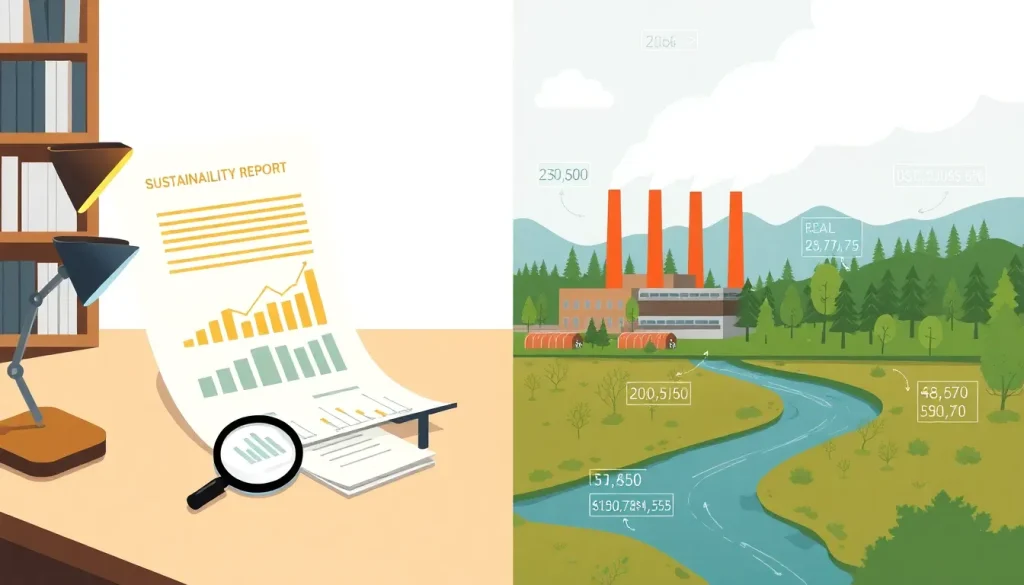
Sustainability reporting is the process by which an organization communicates its environmental, social, and governance (ESG) impacts, goals, and management approaches to stakeholders. It typically involves the publication of structured documents—such as annual sustainability reports, integrated reports, or disclosures aligned with frameworks like the Global Reporting Initiative (GRI) or the Sustainability Accounting Standards Board (SASB). In contrast, sustainability performance refers to the actual, measurable outcomes of an organization’s activities on natural resources, communities, workers, and economic systems. Performance is assessed through indicators such as carbon emissions, water usage, waste generation, employee safety rates, and diversity metrics, independent of whether those results are publicly reported.
The distinction is critical because reporting and performance serve different functions. Reporting is a communication tool that can enhance transparency, build trust, and inform decision-making. Performance, however, is the underlying reality—the tangible progress toward or away from sustainability goals. An organization may produce a glossy, comprehensive report while its environmental footprint grows, or it may achieve significant reductions in emissions without ever issuing a formal report. Thus, evaluating sustainability requires looking beyond disclosures to verified outcomes, and understanding that the two concepts, while related, are not interchangeable.
Overview
Sustainability reporting has grown from a niche practice into a mainstream expectation for large corporations, driven by investor demand, regulatory requirements, and societal pressure. Frameworks such as the GRI Standards, the International Sustainability Standards Board (ISSB) guidelines, and the European Sustainability Reporting Standards (ESRS) provide structured approaches for disclosing ESG information. These reports often include narratives, quantitative data, and forward-looking statements about targets and risks. Meanwhile, sustainability performance is measured through operational data, life cycle assessments, audits, and third-party certifications. Performance metrics are increasingly integrated into enterprise resource planning systems and verified by external assurance providers to enhance credibility.
The relationship between reporting and performance is complex. Reporting can act as a catalyst for performance improvement by forcing organizations to collect data, set baselines, and identify inefficiencies. However, the act of reporting itself consumes resources and may divert attention from actual operational changes. Moreover, the choice of what to report—and how—can shape perceptions of performance, sometimes masking negative impacts. A clear understanding of both concepts is essential for investors, regulators, consumers, and civil society to hold organizations accountable for their sustainability claims.
How It Works
Sustainability reporting typically follows a cycle of data collection, analysis, disclosure, and assurance. Organizations identify material topics—issues that significantly affect their business and stakeholders—using frameworks like the GRI’s materiality principle or the SASB’s industry-specific standards. They then gather quantitative and qualitative data from internal departments, supply chains, and external sources. This information is compiled into a report that may follow a standardized structure, include performance against targets, and be reviewed by an independent assurer. Reporting can be mandatory in some jurisdictions (e.g., the EU’s Corporate Sustainability Reporting Directive) or voluntary, driven by stakeholder expectations.
Sustainability performance, on the other hand, is managed through operational changes, investment in cleaner technologies, supply chain management, and employee engagement. It is measured using key performance indicators (KPIs) such as greenhouse gas emissions intensity, water recycling rates, injury frequency, or percentage of renewable energy used. Performance data may be collected continuously through sensors and enterprise systems, then aggregated for internal decision-making or external reporting. The link between the two occurs when reported data reflects actual performance, but gaps can arise due to selective disclosure, estimation methods, or time lags between action and reporting.
Importance and Impact
Distinguishing between reporting and performance is vital for effective sustainability governance. Investors rely on reported data to assess risks and opportunities, but they also seek evidence of real-world impact to avoid greenwashing. Regulators use reporting mandates to increase transparency, yet the ultimate goal is to drive improved environmental and social outcomes. For civil society and consumers, performance matters more than polished reports; they want to see reduced pollution, fair labor practices, and responsible resource use. When reporting is decoupled from performance, trust erodes and the credibility of sustainability initiatives suffers.
The impact of conflating the two can be significant. Companies with strong reporting but weak performance may enjoy undeserved reputational benefits, while those with strong performance but limited reporting may be overlooked. This misalignment can misdirect capital away from truly sustainable enterprises. Conversely, robust reporting frameworks that require disclosure of performance data can accelerate progress by highlighting leaders and laggards, enabling benchmarking, and informing policy. Thus, the interplay between reporting and performance shapes market behavior and the pace of the transition to a sustainable economy.
Benefits, Limitations and Trade-offs
Sustainability reporting offers several benefits: it increases transparency, helps organizations manage ESG risks, and can improve stakeholder trust and brand value. It also provides a mechanism for accountability, as reported data can be audited and compared over time. However, reporting has limitations. It can be costly and time-consuming, especially for smaller organizations. The proliferation of different standards and frameworks can lead to confusion and reporting fatigue. Moreover, reporting may create an illusion of progress if it is not backed by genuine performance improvements—a phenomenon known as “greenwashing.”
On the performance side, the primary benefit is real-world positive impact: reduced emissions, conserved resources, improved livelihoods. Strong performance can lower operational costs, mitigate regulatory risks, and enhance reputation. Yet performance measurement itself is not without challenges. Data collection can be complex, especially for Scope 3 emissions or social indicators across global supply chains. There is a trade-off between the resources spent on reporting and those invested in performance improvement. Organizations must balance the need for transparency with the imperative to act, ensuring that reporting serves as a tool for accountability rather than a substitute for meaningful change.
Common Misconceptions
A widespread misconception is that a company with a glossy sustainability report must be performing well on ESG issues. In reality, reporting quality and sustainability performance are distinct dimensions. A company can produce a detailed, award-winning report while continuing to pollute or violate labor rights. Conversely, a company with strong environmental performance may issue only minimal disclosures. Another misunderstanding is that reporting automatically leads to better performance. While disclosure can drive improvement by raising internal awareness and external pressure, it is not a guarantee; performance depends on operational changes, investment, and leadership commitment.
Some also believe that standardized reporting frameworks ensure comparability of performance. In practice, differences in methodology, scope, and data quality can make cross-company comparisons challenging, even when the same framework is used. Finally, there is a tendency to view sustainability performance solely through reported metrics, ignoring unreported impacts. True performance assessment requires looking beyond reports to independent data, certifications, and on-the-ground outcomes.
Connections to Other Systems
Sustainability reporting and performance are deeply intertwined with financial markets, regulatory systems, and corporate governance. Reporting standards like those from the ISSB are designed to integrate with financial reporting, enabling investors to assess enterprise value in the context of sustainability risks and opportunities. Performance data feeds into ESG ratings and indices, which influence investment decisions and capital allocation. Regulatory systems, such as the EU Taxonomy, define what counts as environmentally sustainable performance, linking reporting obligations to real-world thresholds.
Moreover, sustainability performance is connected to supply chain management, product design, and stakeholder engagement. Companies increasingly require suppliers to report on and improve their ESG performance, creating cascading effects through global value chains. Reporting frameworks also interact with certification schemes (e.g., Fair Trade, LEED) and voluntary initiatives (e.g., Science Based Targets), which provide standardized ways to measure and communicate performance. Understanding these connections helps stakeholders see reporting not as an end in itself, but as part of a broader system aimed at driving sustainable development.
FAQ
What is the difference between sustainability reporting and sustainability performance?
Sustainability reporting is the disclosure of ESG information to stakeholders, while sustainability performance is the actual measurable impact of an organization’s activities on the environment and society. Reporting communicates performance, but the two are not the same.
Can a company have good sustainability reporting but poor performance?
Yes. A company may produce detailed, well-designed reports while its environmental footprint grows or social practices remain weak. This gap is often called greenwashing and highlights why performance must be verified independently.
Why does the distinction between reporting and performance matter?
The distinction matters because stakeholders—investors, regulators, consumers—need to know whether a company is genuinely sustainable or merely good at communicating. Relying solely on reports can lead to misallocation of capital and continued harm to people and the planet.
References
- Global Reporting Initiative (GRI) Standards. https://www.globalreporting.org/
- International Sustainability Standards Board (ISSB). IFRS Foundation. https://www.ifrs.org/groups/international-sustainability-standards-board/
- Sustainability Accounting Standards Board (SASB). Now part of the IFRS Foundation. https://www.sasb.org/