In brief
For decades, sustainable development has been described as the challenge of meeting present needs without compromising the ability of future generations to meet their own.
It is one of the defining ideas of modern environmental policy.
Yet the twenty-first century has revealed a growing tension.
Humanity has achieved remarkable progress in many areas:
- Longer life expectancy
- Improved education
- Lower extreme poverty in many regions
- Advances in medicine and technology
- Greater agricultural productivity
At the same time, these achievements have often been accompanied by rising greenhouse-gas emissions, biodiversity loss, freshwater depletion, land conversion, pollution, and increasing pressure on Earth’s life-support systems.
This raises a fundamental question:
Can humanity continue improving well-being while remaining within the ecological limits of a finite planet?
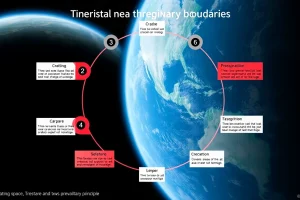
Earth-system science suggests that the answer depends on whether development occurs within the Planetary Boundaries—the biophysical limits that help maintain the stable environmental conditions under which human civilization has flourished. The Planetary Boundaries framework identifies nine critical Earth-system processes and concludes that sustainable development ultimately depends on respecting these ecological limits. (Nature)
Increasingly, researchers argue that sustainability requires balancing two complementary goals:
- Meeting everyone’s basic social needs.
- Maintaining Earth’s ecological stability.
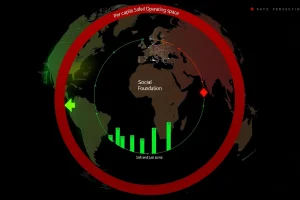
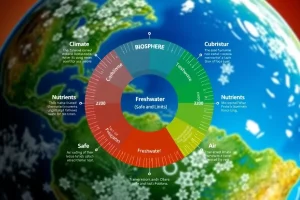
This idea is captured visually in the Doughnut of Social and Planetary Boundaries, where a social foundation is combined with an ecological ceiling to define a safe and just space for humanity. (Doughnut Economics Action Lab)
Sustainable development within planetary boundaries therefore represents more than environmental protection.
It is an integrated vision of human prosperity that recognizes that healthy societies ultimately depend upon a healthy Earth system.
Quick Answer
Sustainable development within planetary boundaries means improving human well-being while ensuring that economic and social activities remain within Earth’s ecological limits.
It combines two complementary frameworks:
- Planetary Boundaries — defining Earth’s safe operating space
- Social foundations — ensuring that everyone’s essential needs are met
The goal is not simply economic growth, nor environmental conservation alone.
Instead, it seeks development that is:
- Environmentally sustainable
- Socially equitable
- Economically resilient
- Scientifically informed
Recent global assessments show that humanity continues to exceed multiple planetary boundaries while many people still lack basic social needs, demonstrating the need to address ecological sustainability and human development simultaneously. (Doughnut Economics Action Lab)
What Is Sustainable Development?
The modern concept of sustainable development gained global prominence through the 1987 Brundtland Report, which defined it as:
Development that meets present needs without compromising the ability of future generations to meet their own needs.
This definition recognizes two central ideas:
- Human development remains essential.
- Environmental limits must also be respected.
Sustainability therefore involves balancing:
- Economic prosperity
- Social well-being
- Environmental integrity
Rather than treating these objectives as competing priorities, sustainable development seeks to integrate them.
Why Planetary Boundaries Matter
Economic systems ultimately depend upon Earth’s natural systems.
Stable climate.
Healthy soils.
Freshwater.
Biodiversity.
Nutrient cycles.
Oceans.
All support human societies.
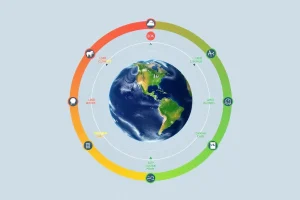
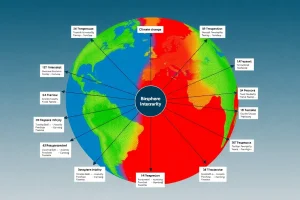
The Planetary Boundaries framework identifies nine Earth-system processes that regulate the stability of the planet.
These include:
- Climate change
- Biosphere integrity
- Freshwater change
- Land-system change
- Biogeochemical flows
- Ocean acidification
- Novel entities
- Atmospheric aerosol loading
- Stratospheric ozone depletion
These boundaries do not represent arbitrary environmental targets.
They identify thresholds beyond which the risk of destabilizing the Earth system increases. (Nature)
Development Depends on Earth’s Life-Support Systems
Economic activity relies upon ecosystem services that are often invisible.
These include:
- Clean water
- Fertile soils
- Pollination
- Carbon storage
- Climate regulation
- Fisheries
- Forests
- Nutrient cycling
Without these natural systems:
- Agriculture becomes less productive.
- Water becomes less reliable.
- Health risks increase.
- Infrastructure becomes more vulnerable.
- Economic costs rise.
Protecting ecosystems is therefore not separate from development—it helps sustain development over the long term.
The Safe Operating Space
The Planetary Boundaries framework introduced the idea of a safe operating space for humanity.
The concept is straightforward.
Earth has supported relatively stable environmental conditions throughout the Holocene.
Human civilization developed under these conditions.
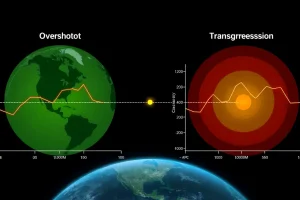
Crossing multiple planetary boundaries increases the likelihood of moving the Earth system into states that are less predictable and potentially less supportive of human societies.
The framework does not imply that every boundary is a precise tipping point.
Instead, it highlights increasing levels of risk as humanity moves further beyond scientifically informed limits. (Nature)
From Sustainable Development to Safe and Just Development
Scientists increasingly argue that sustainability requires more than remaining within environmental limits.
It must also ensure that people have access to life’s essentials.
This broader perspective is represented by the Doughnut framework.
It combines:
The Social Foundation
Basic human needs such as:
- Food
- Water
- Health
- Education
- Housing
- Energy
- Equity
- Political participation
The Ecological Ceiling
The planetary boundaries that maintain Earth’s stability.
Between these two lies the safe and just space where humanity can thrive without causing unacceptable ecological damage. (Doughnut Economics Action Lab)
The Sustainable Development Goals
In 2015, the United Nations adopted the 17 Sustainable Development Goals (SDGs).
These goals address:
- Poverty
- Hunger
- Health
- Education
- Gender equality
- Water
- Energy
- Climate
- Biodiversity
- Economic development
The SDGs recognize that development involves environmental, economic, and social dimensions simultaneously.
However, achieving some goals can involve trade-offs if ecological limits are ignored.
For example:
- Expanding agriculture may improve food security.
- But excessive land conversion may increase biodiversity loss.
Integrated planning is therefore essential.
Planetary Boundaries and the SDGs
Planetary boundaries and the SDGs are complementary rather than competing frameworks.
The SDGs ask:
“What should humanity achieve?”
Planetary boundaries ask:
“Within what environmental limits can those achievements remain sustainable?”
Researchers increasingly emphasize the need to align social progress with ecological ceilings to reduce trade-offs and strengthen long-term sustainability. (arXiv)
Economic Growth and Sustainability
One of the most debated questions concerns economic growth.
Some argue that:
- Continued innovation
- Renewable energy
- Circular economy
- Efficiency
can allow prosperity while reducing environmental impacts.
Others argue that:
- Resource use
- Material throughput
- Ecological limits
place constraints on indefinitely expanding production and consumption.
Planetary-boundary research does not prescribe one economic model.
Instead, it establishes the environmental conditions within which any economic system must ultimately operate.
Decoupling: Can Growth Continue While Environmental Impacts Decline?
A central concept is decoupling.
Relative decoupling
Environmental impacts grow more slowly than the economy.
Absolute decoupling
The economy grows while total environmental pressures decline.
Evidence shows progress in some sectors and regions, particularly through cleaner energy and improved efficiency.
However, achieving sufficient reductions across all planetary boundaries remains a significant challenge, particularly when global consumption continues to increase. (Nature)
Circular Economy and Sustainable Development
The circular economy complements sustainable development by seeking to:
- Eliminate waste
- Keep materials in use
- Regenerate ecosystems
Circular strategies include:
- Repair
- Reuse
- Refurbishment
- Recycling
- Regenerative agriculture
These approaches reduce pressure on:
- Climate
- Land
- Freshwater
- Biodiversity
- Resource extraction
However, circularity alone cannot ensure sustainability if overall resource demand continues to exceed ecological limits. (Doughnut Economics Action Lab)
Food Systems Within Planetary Boundaries
Agriculture illustrates the sustainability challenge clearly.
Food production depends upon:
- Water
- Soil
- Biodiversity
- Climate
Yet agriculture also contributes to:
- Deforestation
- Nutrient pollution
- Freshwater depletion
- Greenhouse-gas emissions
Sustainable food systems therefore seek to:
- Improve productivity
- Reduce waste
- Protect ecosystems
- Maintain nutrition
- Reduce environmental impacts simultaneously.
Cities and Sustainable Development
Urban areas now contain most of the world’s population.
Sustainable cities can reduce environmental pressures through:
- Public transportation
- Energy-efficient buildings
- Green infrastructure
- Circular waste systems
- Renewable energy
- Compact urban planning
Cities also concentrate innovation and can accelerate sustainability transitions.
Innovation and Technology
Technology plays an essential role.
Examples include:
- Renewable energy
- Precision agriculture
- Low-carbon materials
- Water recycling
- Digital monitoring
- Smart electricity grids
Technology alone, however, cannot guarantee sustainability.
Governance, institutions, education, and social behavior remain equally important.
Governance Within Planetary Boundaries
Managing planetary boundaries requires cooperation across multiple levels.
Important approaches include:
- Science-based policy
- International agreements
- Environmental monitoring
- Transparent institutions
- Corporate accountability
- Public participation
Because planetary boundaries operate globally, effective governance often requires international collaboration.
Equity and Sustainable Development
Development is not only about environmental protection.
It also concerns fairness.
Important questions include:
- Who benefits?
- Who bears environmental costs?
- Who has access to resources?
- Who participates in decision-making?
The concept of a safe and just space emphasizes that sustainability should improve both environmental resilience and human well-being. (Doughnut Economics Action Lab)
Measuring Sustainable Development
No single indicator captures sustainability.
Common measures include:
Environmental:
- Greenhouse-gas emissions
- Biodiversity
- Water quality
- Resource use
Social:
- Health
- Education
- Poverty
- Equality
Economic:
- Productivity
- Employment
- Innovation
- Infrastructure
Researchers increasingly seek integrated indicators that evaluate environmental and social performance together.
Challenges
Important obstacles include:
Population growth
Increasing demand for food, water, housing, and energy.
Consumption
High-income societies generally consume more resources per person.
Inequality
Many people still lack access to basic needs despite global economic growth.
Political coordination
Planetary boundaries require long-term international cooperation.
Time
Many Earth-system processes respond slowly.
Delayed action increases future risks.
Common Misunderstandings
“Sustainable development means stopping economic development.”
No.
It seeks development that improves human well-being while remaining within ecological limits.
“Planetary boundaries oppose development.”
No.
They identify environmental conditions that support long-term development.
“Technology alone will solve sustainability.”
Technology is essential but must be combined with effective governance, equitable institutions, and responsible resource use.
“The SDGs and planetary boundaries compete.”
They are complementary.
The SDGs define development goals.
Planetary boundaries define the ecological conditions within which those goals are most likely to remain sustainable. (arXiv)
Frequently Asked Questions
What is sustainable development?
Development that improves human well-being while preserving the ability of future generations to meet their own needs.
What are planetary boundaries?
Nine Earth-system processes that define a scientifically informed safe operating space for humanity. (Nature)
How are sustainable development and planetary boundaries related?
Sustainable development seeks social and economic progress, while planetary boundaries identify the ecological limits within which that progress can remain environmentally sustainable. (Nature)
What is the Doughnut model?
The Doughnut combines a social foundation with an ecological ceiling to define a safe and just space for humanity. (Doughnut Economics Action Lab)
Can humanity achieve both prosperity and environmental sustainability?
Research suggests it is possible, but doing so requires major transformations in energy, food systems, cities, resource use, governance, and patterns of consumption. (Nature)
Why does equity matter?
Development is sustainable only if environmental stability and human well-being advance together rather than benefiting some groups while leaving others behind.
Conclusion
Sustainable development within planetary boundaries represents one of the central challenges of the twenty-first century.
It recognizes that economic prosperity, social progress, and environmental protection are not independent objectives but interconnected dimensions of a single Earth system. Human societies depend upon stable climates, healthy ecosystems, freshwater, fertile soils, and functioning biogeochemical cycles, while environmental stewardship is most durable when it supports human well-being and reduces inequality.
The Planetary Boundaries framework provides a scientific understanding of Earth’s ecological limits, while concepts such as the Doughnut expand that perspective by emphasizing that development must also ensure a strong social foundation. Together, these frameworks move beyond the false choice between people and the planet, proposing instead that lasting prosperity requires both ecological resilience and social justice. (Doughnut Economics Action Lab)
The path forward will differ across countries and communities, but the direction is increasingly clear. Renewable energy, circular resource use, sustainable food systems, resilient cities, ecosystem restoration, responsible governance, and inclusive development all contribute to the same overarching goal: enabling humanity to thrive within the environmental limits of a finite planet. (Nature)