In brief
At a glance
Quick Facts
- Tipping point definition
- A critical threshold at which a small perturbation can qualitatively alter the state or development of a system.
- Planetary boundaries framework introduced
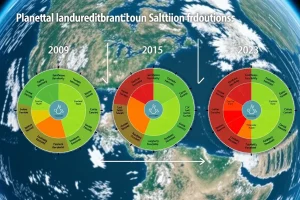
- In 2009 by Johan Rockström and colleagues, identifying nine Earth system processes with boundaries for a safe operating space.
- Boundaries crossed (2015 update)
- Four boundaries assessed as crossed: climate change, biosphere integrity, land-system change, and biogeochemical flows.
- Irreversibility
- Some tipping points, like ice sheet collapse, may be irreversible on human timescales; others, like Arctic sea ice, could be reversible.
- Cascading tipping points
- Crossing one tipping point can increase the likelihood of crossing others, creating a domino effect.
- Safe operating space
- The planetary boundaries framework aims to keep humanity within a zone where Earth system processes remain stable.
- Novel entities boundary
- Addresses synthetic chemicals and pollutants; a global boundary has not yet been quantified.
- Tipping elements
- Large-scale components of the Earth system that may pass a tipping point, such as the Greenland ice sheet or the Amazon rainforest.
Key Takeaways
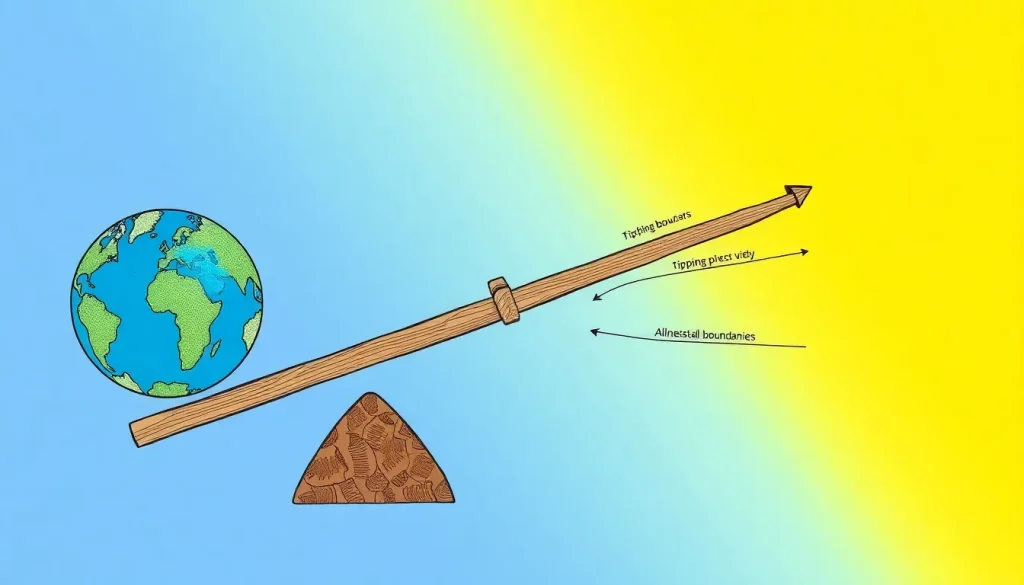
- Tipping points are critical thresholds where a small change can trigger a large, often irreversible shift in a system, while planetary boundaries define a safe operating space for humanity by setting limits on key Earth system processes.
- The planetary boundaries framework identifies nine processes that regulate the stability of the Earth system; crossing a boundary does not immediately cause a tipping point but sharply increases the risk of doing so.
- Tipping points can cascade: crossing one may trigger others, leading to a domino effect that could push the entire Earth system into a new, less hospitable state.
- Understanding the interplay between tipping points and planetary boundaries is crucial for global policy, as it highlights the need to stay well within safe limits to avoid catastrophic and potentially irreversible environmental changes.
What Is Tipping Point vs Planetary Boundary?
A tipping point is a threshold in a system where a small additional change can cause a rapid and often irreversible shift to a new state. The term is widely used in climate science and ecology to describe components of the Earth system—such as ice sheets, ocean currents, or ecosystems—that may respond abruptly once a critical level of forcing is exceeded. Once a tipping point is crossed, the system can reorganize into a fundamentally different configuration, and returning to the original state may be difficult or impossible even if the forcing is reduced. Classic examples include the collapse of the Greenland ice sheet, the dieback of the Amazon rainforest, or the shutdown of the Atlantic Meridional Overturning Circulation (AMOC).
A planetary boundary, on the other hand, is a concept introduced by a group of Earth system scientists led by Johan Rockström in 2009. It defines a safe operating space for humanity with respect to nine key Earth system processes that have maintained the stable environmental conditions of the Holocene—the past 11,700 years during which human civilization developed. Each boundary represents a limit for human-induced perturbations; staying within these boundaries is considered necessary to avoid triggering abrupt or irreversible environmental changes at a global scale. The planetary boundaries framework does not pinpoint exact tipping points but rather identifies a zone of uncertainty where the risk of crossing a threshold increases significantly. Thus, while tipping points describe the behavior of specific systems, planetary boundaries provide a holistic risk management tool for the entire Earth system.
Overview
The concepts of tipping points and planetary boundaries emerged from the recognition that human activities are now a dominant force shaping the Earth system, an era often called the Anthropocene. For most of the Holocene, Earth’s climate and ecosystems remained relatively stable, allowing agriculture, settlements, and complex societies to flourish. However, since the Industrial Revolution, human pressures—greenhouse gas emissions, land-use change, pollution, and resource extraction—have pushed many Earth system processes outside their historical range of variability. Scientists have responded by developing frameworks to understand, quantify, and communicate the risks of destabilizing the planet’s life-support systems.
Tipping points and planetary boundaries are complementary but distinct ideas. Tipping points focus on the nonlinear behavior of individual components of the Earth system, highlighting how gradual changes can lead to sudden, dramatic shifts. Planetary boundaries, in contrast, offer a top-down view of the entire Earth system, setting quantitative limits for human pressures to maintain a “safe operating space.” Together, they provide a powerful lens for assessing global environmental risks and guiding policy toward sustainability. The planetary boundaries framework explicitly acknowledges that crossing a boundary does not mean an immediate catastrophe, but it does mean that humanity is entering a danger zone where tipping points become more likely.
How It Works
Tipping points arise from positive feedback loops that amplify small changes. For example, as Arctic sea ice melts, the darker ocean surface absorbs more solar radiation, causing further warming and more ice melt—a self-reinforcing cycle. Once a critical threshold is passed, the feedback becomes strong enough to drive the system into a new state even without additional external forcing. This behavior is often described mathematically as a bifurcation, where a small change in a control parameter (such as global temperature) leads to a qualitative shift in the system’s state. Many tipping points also exhibit hysteresis, meaning that to reverse the change, the forcing must be reduced well below the level that triggered the shift.
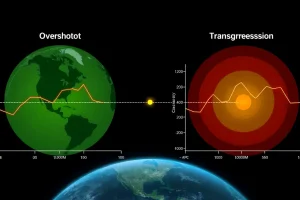
The planetary boundaries framework operates by identifying a control variable for each of the nine Earth system processes—for instance, atmospheric CO₂ concentration for climate change, or extinction rate for biosphere integrity. A boundary value is then set, often based on the Holocene range or the point at which the risk of triggering a tipping point becomes significant. Because of scientific uncertainty, each boundary includes a zone of uncertainty: below the boundary, the risk is low; within the zone, the risk increases; and beyond the zone, the risk is high. The framework is periodically updated as scientific understanding improves. Importantly, the boundaries are not independent; transgressing one can affect others, creating complex interactions that amplify overall risk.
Examples
Several large-scale tipping elements have been identified in the Earth system. Among the most studied are:
- Greenland Ice Sheet: Sustained warming beyond a threshold (estimated at 1–2°C above pre-industrial levels) could initiate irreversible melting, leading to several meters of sea-level rise over centuries to millennia.
- West Antarctic Ice Sheet: Marine ice sheet instability could cause a rapid collapse if grounding lines retreat past a critical point, contributing significantly to sea-level rise.
- Atlantic Meridional Overturning Circulation (AMOC): A slowdown or shutdown of this major ocean current system, driven by freshwater input from melting ice, would disrupt weather patterns, marine ecosystems, and global heat distribution.
- Amazon Rainforest: Deforestation and climate change could push the Amazon past a tipping point where it transitions from rainforest to savanna, releasing vast amounts of carbon and reducing regional rainfall.
- Permafrost Thaw: Warming of permafrost soils releases methane and CO₂, accelerating global warming in a feedback loop that could become self-sustaining.
- Coral Reefs: Ocean warming and acidification can cause widespread coral bleaching; beyond a certain frequency of heat stress, reefs may shift to algae-dominated ecosystems, losing biodiversity and coastal protection.
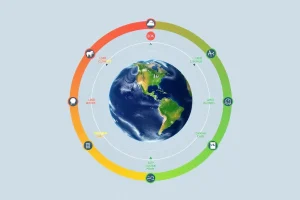
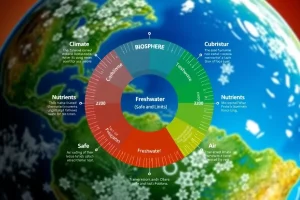
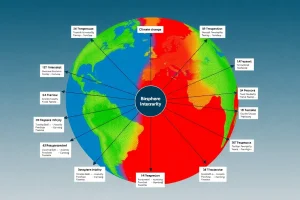
The nine planetary boundaries, as defined in the updated framework, are:
- Climate Change: Measured by atmospheric CO₂ concentration and radiative forcing. The boundary is set at 350 ppm CO₂ and +1.0 W/m²; current values exceed both.
- Biosphere Integrity: Measured by extinction rate and functional diversity. The boundary is set at an extinction rate of less than 10 extinctions per million species per year; current rates are far higher.
- Land-System Change: Measured by the area of forested land remaining. The boundary is set at 75% of original forest cover; global forest cover is below this threshold.
- Freshwater Use: Measured by consumptive blue water use. The boundary is set at 4,000 km³ per year; current use is approaching this limit regionally.
- Biogeochemical Flows: Measured by nitrogen and phosphorus cycles. Boundaries are set for industrial and agricultural inputs; both are significantly exceeded.
- Ocean Acidification: Measured by carbonate ion concentration. The boundary is set at 80% of pre-industrial aragonite saturation; current levels are near the boundary.
- Atmospheric Aerosol Loading: A global boundary has not yet been quantified, but regional impacts on monsoon systems are of concern.
- Stratospheric Ozone Depletion: Measured by ozone concentration. The boundary is set at a less than 5% reduction from pre-industrial levels; thanks to the Montreal Protocol, this boundary is not currently transgressed.
- Novel Entities: Includes synthetic chemicals, plastics, and other human-made pollutants. A global boundary has not yet been quantified, but the precautionary principle suggests it is being exceeded.
Importance and Impact
Understanding the difference between tipping points and planetary boundaries is essential for effective environmental governance. Tipping points represent specific, often irreversible dangers that can have catastrophic consequences for human societies and ecosystems. The planetary boundaries framework translates these risks into actionable limits, providing a science-based dashboard for policymakers, businesses, and civil society. By staying within the safe operating space, humanity can reduce the likelihood of crossing dangerous thresholds and maintain the Earth system in a Holocene-like state that has supported civilization for millennia.
The impact of transgressing planetary boundaries and triggering tipping points is profound. It could lead to sea-level rise measured in meters, disruption of food and water supplies, loss of biodiversity, and increased frequency of extreme weather events. These changes would undermine global economic stability, exacerbate geopolitical tensions, and threaten human well-being, particularly for vulnerable populations. The concepts thus serve as a call to action, emphasizing that incremental environmental degradation can accumulate to a point where the system flips, making prevention far more effective and less costly than attempting to reverse the damage.
Common Misconceptions
One common misconception is that tipping points are always global in scale. In reality, many tipping points are regional, such as the dieback of a specific forest or the collapse of a fishery, though they can have global repercussions. Another misunderstanding is that all tipping points are irreversible. Some, like Arctic sea ice loss, may be reversible if the forcing is reduced sufficiently, though the timescale for recovery can be long. The term “irreversible” often means irreversible on human timescales, not permanently.
Regarding planetary boundaries, a frequent error is to treat them as precise thresholds that, once crossed, immediately cause disaster. The framework explicitly includes a zone of uncertainty, and crossing a boundary indicates increasing risk, not an instant tipping point. Additionally, the boundaries are not fixed; they are updated as science advances. Some critics argue that the framework oversimplifies complex interactions, but its proponents view it as a useful heuristic for communicating risk and guiding policy. Finally, it is important to note that not all planetary boundaries are directly linked to a specific tipping point; some represent gradual degradation that still undermines Earth system resilience.
Connections to Other Systems
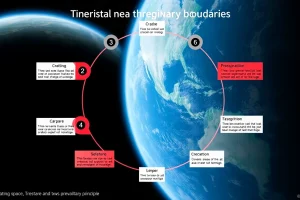
Tipping points and planetary boundaries are deeply interconnected. Crossing one planetary boundary can increase the pressure on others, creating a cascade of effects. For example, climate change (boundary 1) exacerbates biosphere integrity loss (boundary 2) through habitat destruction and species migration, while land-system change (boundary 3) contributes to both climate change and freshwater use (boundary 4). These interactions can amplify the risk of triggering multiple tipping points simultaneously. The concept of “tipping cascades” describes how one tipping point, such as Arctic sea ice loss, can alter atmospheric circulation and accelerate Greenland ice sheet melt, which in turn could slow the AMOC, affecting monsoon systems and the Amazon.
At the global scale, the Earth system itself may have a planetary threshold—a point beyond which the system shifts to a “Hothouse Earth” state, characterized by self-reinforcing feedbacks that keep warming even if human emissions are reduced. This scenario would involve the crossing of multiple tipping points and the transgression of most planetary boundaries. Avoiding such a trajectory requires not only staying within individual boundaries but also maintaining the overall resilience of the Earth system. This systems perspective underscores the need for integrated policies that address the root causes of environmental change across all sectors.
FAQ
What is a tipping point in the Earth system?
A tipping point is a critical threshold where a small change can trigger a large, often irreversible shift in a component of the Earth system, such as the collapse of an ice sheet or the dieback of a rainforest.
What are the nine planetary boundaries?
The nine planetary boundaries are climate change, biosphere integrity, land-system change, freshwater use, biogeochemical flows, ocean acidification, atmospheric aerosol loading, stratospheric ozone depletion, and novel entities. They define a safe operating space for humanity.
How do tipping points and planetary boundaries relate to each other?
Planetary boundaries set limits to avoid entering a high-risk zone where tipping points become more likely. Crossing a boundary does not immediately cause a tipping point, but it significantly increases the probability of triggering one or more tipping points.
References
- Rockström, J., et al. (2009). A safe operating space for humanity. Nature, 461, 472–475.
- Steffen, W., et al. (2015). Planetary boundaries: Guiding human development on a changing planet. Science, 347(6223), 1259855.
- Lenton, T. M., et al. (2008). Tipping elements in the Earth’s climate system. Proceedings of the National Academy of Sciences, 105(6), 1786–1793.
- IPCC (Intergovernmental Panel on Climate Change) reports, particularly the Special Report on Global Warming of 1.5°C and the Sixth Assessment Report.
- Stockholm Resilience Centre – Planetary Boundaries research.