In brief
At a glance
Quick Facts
- Journal / venue
- The Lancet Planetary Health
- Authors
- Chen G, Guo Y, Yue X, et al.
- Publication date
- September 2021
- Study type
- Global time-series analysis
- Peer-reviewed
- Yes
- DOI / link
- 10.1016/S2542-5196(21)00200-X
Study in one sentence
This global time-series study found that short-term exposure to fine particulate matter (PM2.5) from wildfires is associated with increased daily mortality from all causes, cardiovascular disease, and respiratory disease, with an estimated 33,510 annual deaths attributable to wildfire-related PM2.5 across 749 locations in 43 countries.
Publication and date
The study, titled “Mortality risk attributable to wildfire-related PM2.5 pollution: a global time series study in 749 locations,” was published in The Lancet Planetary Health in September 2021. The research was led by Gongbo Chen and colleagues from an international collaboration. The journal is peer-reviewed.
Research question
The researchers aimed to quantify the short-term association between wildfire-related PM2.5 and daily mortality (all-cause, cardiovascular, and respiratory) across a wide range of countries and regions, and to estimate the global burden of deaths attributable to wildfire smoke.
Method
The study was a multi-country, multi-city time-series analysis. The researchers collected daily data on all-cause, cardiovascular, and respiratory deaths from 749 locations in 43 countries, covering periods from 2000 to 2016. They used a chemical transport model (GEOS-Chem) and machine learning to estimate daily concentrations of wildfire-specific PM2.5 at each location, distinguishing smoke particles from other sources. The association between daily wildfire PM2.5 and mortality was examined using a two-stage approach: first, city-specific associations were estimated with quasi-Poisson regression models, adjusting for time trends, day of the week, temperature, and humidity. Then, the city-specific estimates were pooled in a random-effects meta-analysis. The attributable mortality burden was calculated by applying the pooled risk estimates to the observed wildfire PM2.5 days.
Main findings
Each 10 μg/m³ increase in wildfire-related PM2.5 over the current and previous day was associated with:
- a 1.9% (95% CI: 1.1–2.7) increase in all-cause mortality,
- a 1.7% (95% CI: 0.6–2.8) increase in cardiovascular mortality, and
- a 1.9% (95% CI: 0.5–3.3) increase in respiratory mortality.
These associations were robust across various sensitivity analyses. The estimated annual number of deaths attributable to wildfire PM2.5 across the 749 locations was 33,510 (95% CI: 20,600–46,080). The highest attributable mortality fractions were observed in Central America, Southeast Asia, and South America.
What the findings do not prove
The study demonstrates a statistical association between short-term exposure to wildfire-specific PM2.5 and increased daily mortality, but it does not prove that wildfire smoke is the sole or direct cause of these deaths. The attributable mortality estimates are based on modelled exposure and pooled risk estimates; they should not be interpreted as precise counts of individual deaths caused exclusively by wildfire smoke. The study also does not address long-term health effects of repeated or chronic exposure to wildfire smoke.
Limitations
The study has several limitations. Exposure assessment relied on model-derived estimates of wildfire PM2.5, which may contain errors, particularly in regions with sparse monitoring data. The analysis focused on short-term (lag 0–1 days) exposure and did not capture longer-term health impacts. The attributable mortality estimates assume a linear relationship between exposure and risk, and they do not account for potential differences in toxicity between wildfire smoke and other PM2.5 sources. The study locations were predominantly urban, so the findings may not fully represent rural populations. Additionally, the estimates of attributable deaths are based on the pooled risk from all locations and may not reflect local variations in population susceptibility or smoke composition.
How it compares with previous research
Previous studies had reported associations between wildfire smoke and respiratory hospitalizations and mortality, but most were limited to specific regions or fire events. This study is the largest and most geographically comprehensive to date, confirming that the health risks of wildfire PM2.5 are consistent across diverse populations and climates. The estimated mortality risk is comparable to that of total PM2.5 from other sources, supporting the view that wildfire smoke is a significant public health threat. The findings align with earlier regional studies in the United States, Australia, and Southern Europe, while extending the evidence to many low- and middle-income countries where data were previously lacking.
Why it matters
As climate change increases the frequency and intensity of wildfires globally, understanding the health impacts of wildfire smoke is critical for public health planning and policy. This study provides the most comprehensive evidence to date that wildfire-specific PM2.5 is associated with increased mortality worldwide. The results can inform air quality guidelines, early warning systems, and resource allocation during wildfire seasons. They also underscore the need for mitigation strategies to reduce wildfire risk and protect vulnerable populations from smoke exposure.
Link to the primary paper
Chen G, Guo Y, Yue X, et al. Mortality risk attributable to wildfire-related PM2.5 pollution: a global time series study in 749 locations. The Lancet Planetary Health. 2021;5(9):e579–e587. DOI: 10.1016/S2542-5196(21)00200-X.
FAQ
What are the main health effects of wildfire smoke?
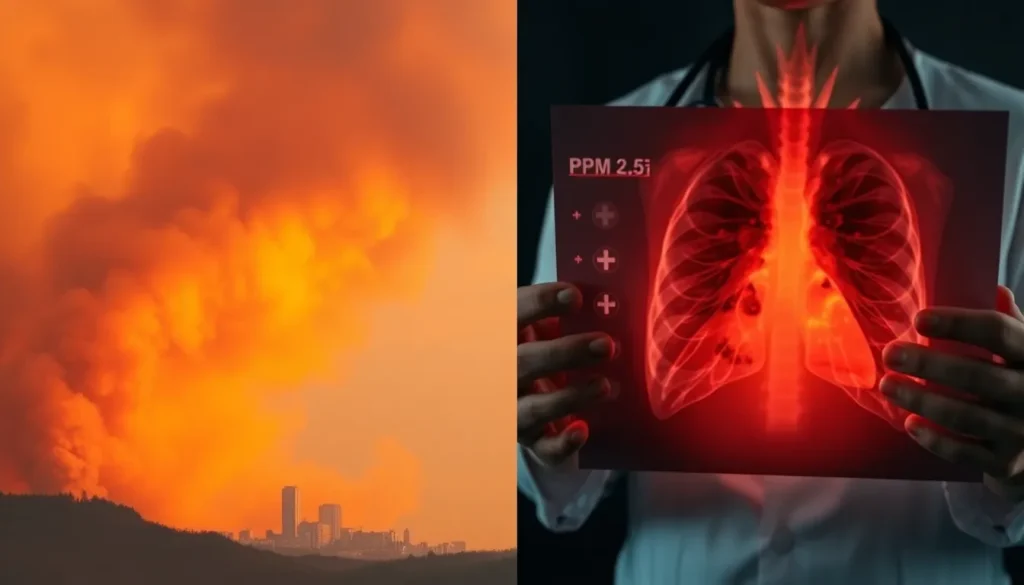
Wildfire smoke contains fine particulate matter (PM2.5) and other pollutants that can irritate the eyes, nose, and throat, and cause more serious effects like exacerbation of asthma, bronchitis, heart attacks, and stroke. Short-term exposure has been linked to increased hospital admissions and mortality from respiratory and cardiovascular causes.
How does wildfire PM2.5 differ from other PM2.5?
Wildfire PM2.5 is generated from burning vegetation and can contain a complex mixture of organic carbon, black carbon, and trace metals. Some studies suggest it may be more toxic than PM2.5 from urban sources due to its chemical composition and the high temperatures of combustion, but the evidence is still evolving.
Who is most vulnerable to wildfire smoke?
Children, the elderly, pregnant women, and people with pre-existing heart or lung conditions are at higher risk. Outdoor workers and those with limited access to clean indoor air are also more vulnerable.
References
- Chen G, Guo Y, Yue X, et al. Mortality risk attributable to wildfire-related PM2.5 pollution: a global time series study in 749 locations. Lancet Planet Health. 2021;5(9):e579–e587.
- Reid CE, Brauer M, Johnston FH, et al. Critical review of health impacts of wildfire smoke exposure. Environ Health Perspect. 2016;124(9):1334-1343.
- Liu JC, Pereira G, Uhl SA, Bravo MA, Bell ML. A systematic review of the physical health impacts from non-occupational exposure to wildfire smoke. Environ Res. 2015;136:120-132.
- Johnston FH, Henderson SB, Chen Y, et al. Estimated global mortality attributable to smoke from landscape fires. Environ Health Perspect. 2012;120(5):695-701.
- Cascio WE. Wildland fire smoke and human health. Sci Total Environ. 2018;624:586-595.