In brief
At a glance
Quick Facts
- Definition
- Human-made objects in Earth orbit that no longer serve a useful purpose, including defunct satellites, spent rocket stages, and fragmentation debris.
- Tracked objects
- More than 30,000 objects larger than 10 cm are catalogued by space surveillance networks.
- Estimated total debris
- Over 100 million particles larger than 1 mm are believed to be in orbit.
- Average collision speed in LEO
- About 10 km/s (36,000 km/h), meaning a 1 cm particle carries the energy of a large safe.
- Kessler syndrome threshold
- A theoretical point where debris density triggers a self-sustaining cascade of collisions, even without new launches.
- Notable debris event
- The 2009 Iridium-Cosmos collision created over 2,000 trackable fragments and highlighted the real risk of accidental hypervelocity impacts.
- International mitigation guideline
- The 25-year rule recommends that spacecraft in LEO be deorbited within 25 years of mission end.
- Smallest lethal untracked debris
- Objects between 1 cm and 10 cm are too small to track but large enough to destroy a satellite.
Key Takeaways
- Space debris consists of millions of human-made objects in Earth orbit that no longer serve a useful purpose, ranging from tiny paint flecks to entire spent rocket stages.
- It is an environmental problem because debris travels at extremely high speeds, making even small fragments capable of destroying or disabling active satellites and crewed spacecraft.
- The uncontrolled growth of debris could trigger the Kessler syndrome, a self-sustaining cascade of collisions that would make certain orbital regions too hazardous to use for generations.
- Mitigation measures, such as post-mission disposal and active debris removal, are essential to preserve the space environment for future scientific, commercial, and national security activities.
What Is Space Debris and Is It an Environmental Problem?
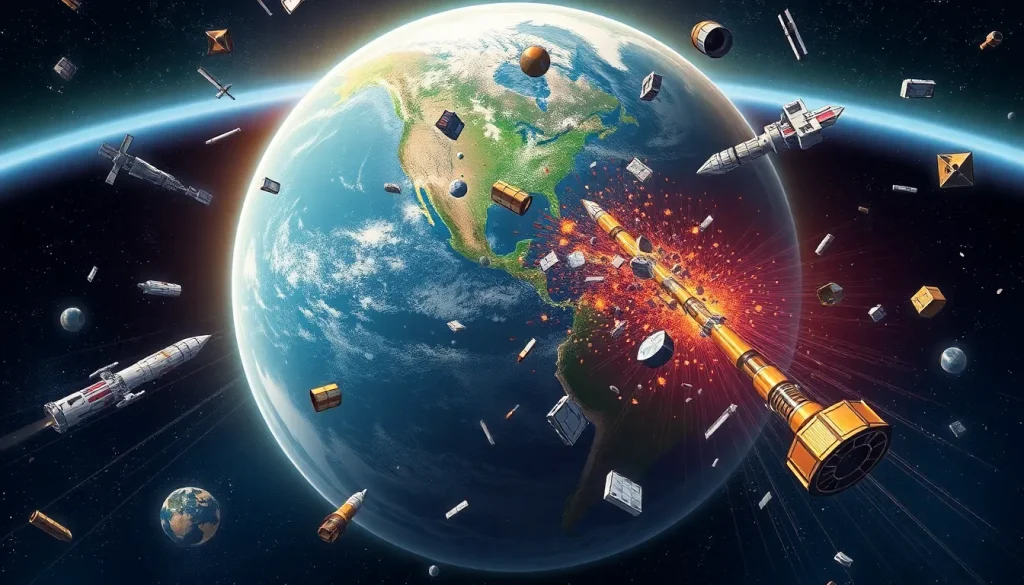
Space debris, also known as orbital debris, is any human-made object in Earth orbit that no longer serves a useful function. This includes defunct satellites, spent upper stages of launch vehicles, mission-related objects such as lens caps and deployment hardware, and fragments generated by explosions or collisions. The term encompasses objects of all sizes, from microscopic particles of solid rocket motor slag to large, intact spacecraft weighing several tons. Unlike natural meteoroids, space debris is entirely a product of human space activities and remains in orbit for years, decades, or even centuries, depending on its altitude.
Space debris is increasingly recognized as an environmental problem because it threatens the long-term sustainability of the orbital environment. The space around Earth is a finite resource, and the accumulation of debris raises the risk of collisions with operational satellites, which provide critical services such as communications, weather forecasting, navigation, and scientific research. A single collision can generate thousands of new fragments, each capable of causing further collisions, leading to a runaway chain reaction. This makes space debris not just a technical challenge but an environmental issue that demands international cooperation and responsible stewardship, much like pollution in Earth’s atmosphere or oceans.
Overview
The orbital debris population has grown steadily since the dawn of the space age in 1957. Today, space surveillance networks track more than 30,000 objects larger than 10 cm in diameter, but the total number of debris particles larger than 1 mm is estimated to exceed 100 million. These objects are concentrated in the most heavily used orbital regions: low Earth orbit (LEO), below 2,000 km altitude, and geostationary orbit (GEO), at approximately 36,000 km. In LEO, debris travels at velocities around 7–8 km/s, meaning that a 1 cm particle carries the kinetic energy of a large safe. At such speeds, even a fleck of paint can pit a spacecraft window or degrade sensitive surfaces.
The environmental dimension of space debris lies in its potential to degrade the orbital environment irreversibly. Unlike terrestrial pollution, which can often be cleaned up or diluted, orbital debris is extremely difficult and costly to remove. The lack of a natural cleansing mechanism in higher orbits means that debris can persist for millennia. As the number of satellites launched continues to rise, driven by commercial mega-constellations, the urgency of addressing space debris as an environmental problem grows. The international community has responded with guidelines and best practices, but compliance is voluntary, and enforcement remains a challenge.
History
The problem of space debris was recognized early in the space age. The first piece of orbital debris was the spent upper stage of the rocket that launched Sputnik 1 in 1957. Throughout the 1960s and 1970s, the United States and the Soviet Union conducted numerous launches, often leaving rocket bodies and defunct payloads in orbit. The first accidental hypervelocity collision between two catalogued objects occurred in 1991, when a Russian navigation satellite was struck by a fragment from a previous breakup. However, the event that brought widespread attention to the debris threat was the 2007 Chinese anti-satellite missile test, which deliberately destroyed a weather satellite and created over 3,000 trackable fragments.
Another milestone was the 2009 collision between the operational Iridium 33 communications satellite and the defunct Russian Cosmos 2251 satellite. This accidental crash produced more than 2,000 large fragments and demonstrated that the Kessler syndrome—a concept proposed by NASA scientist Donald J. Kessler in 1978—was not merely theoretical. Since then, the number of debris objects has continued to climb, fueled by occasional breakups, battery explosions, and the abandonment of satellites without proper disposal. The historical record shows that without active intervention, the debris population will grow even if all launches ceased today, due to collisions among existing objects.
How It Works
Space debris is generated through several mechanisms. The most common sources are:
- Launch and mission operations: Rocket stages, payload adapters, separation bolts, and protective covers are often discarded after use. Some missions also release multiple small objects, such as the needles from early communication experiments.
- Fragmentation events: Explosions of residual propellant in spent rocket stages or batteries in defunct satellites can shatter a spacecraft into thousands of pieces. Collisions between objects, whether accidental or intentional, also produce large debris clouds.
- Deterioration and erosion: Surfaces exposed to atomic oxygen, ultraviolet radiation, and thermal cycling can degrade, shedding paint flakes, insulation, and other materials. Solid rocket motors expel aluminum oxide slag particles that form a persistent debris population.
- Anti-satellite tests: The deliberate destruction of satellites using missiles creates massive amounts of long-lived debris, as demonstrated by tests in 2007, 2019, and 2021.
Once in orbit, debris follows the laws of orbital mechanics. Objects in LEO typically circle Earth every 90 minutes, and their orbits decay over time due to atmospheric drag, eventually burning up. However, at altitudes above about 600 km, the atmosphere is so thin that debris can remain for decades or centuries. In GEO, where there is virtually no atmospheric drag, debris will stay essentially forever unless actively removed. The risk of collision is not uniform; it is highest in the most congested altitude bands and near the poles, where many orbits cross. Tracking systems use radar and telescopes to catalog large debris, but the vast majority of lethal non-trackable debris—between 1 and 10 cm—remains invisible to current sensors, posing a constant threat.
Environmental and Human Impacts
The environmental impact of space debris is primarily the degradation of the orbital environment, which threatens the services that humanity relies on from space. Collisions with debris can disrupt satellite operations, leading to loss of communication, navigation, weather data, and scientific observations. For example, a debris strike on a weather satellite could impair hurricane tracking, while damage to a GPS satellite could affect everything from aviation to financial transactions. The economic cost of replacing a single large satellite can run into hundreds of millions of dollars, and insurance premiums for spacecraft already reflect the heightened risk.
Human spaceflight is also at risk. The International Space Station (ISS) regularly performs debris avoidance maneuvers—several times a year on average—to dodge tracked objects. A collision with a piece of debris larger than 1 cm could penetrate the station’s shielding, endangering the crew. In the worst-case scenario, a cascading debris event could make LEO impassable for human missions, effectively trapping humanity on Earth for generations. Beyond the immediate physical threat, debris also contributes to light pollution and interferes with astronomical observations. The growing number of satellites and debris streaks in telescope images hampers ground-based astronomy, and the re-entry of large objects can pose a risk to people and property on the ground, though such events are rare.
Solutions
Addressing the space debris problem requires a combination of mitigation, remediation, and international coordination. Mitigation measures aim to prevent the creation of new debris. Key practices include:
- Post-mission disposal: Satellites and rocket stages should be deorbited within 25 years after the end of their mission, either by controlled re-entry into the atmosphere or by moving to a graveyard orbit above GEO.
- Passivation: Removing residual energy sources—such as venting propellant and discharging batteries—at the end of a mission to prevent explosions.
- Design for demise: Building spacecraft components that completely burn up during atmospheric re-entry, reducing the risk of surviving fragments reaching the ground.
- Collision avoidance: Operators of maneuverable spacecraft use tracking data to perform avoidance maneuvers when a close approach is predicted.
Remediation, or active debris removal (ADR), involves capturing and deorbiting existing large debris objects. Proposed technologies include nets, harpoons, robotic arms, and drag sails. Several demonstration missions have been conducted, but no operational large-scale ADR system exists yet due to high costs and technical challenges. International guidelines, such as those from the Inter-Agency Space Debris Coordination Committee (IADC) and the United Nations Committee on the Peaceful Uses of Outer Space (COPUOS), provide a framework for responsible behavior, but compliance is voluntary. Some nations have incorporated these guidelines into national regulations, and there is growing momentum for a binding international treaty on space debris.
Common Misconceptions
Misconception: Space debris is just like litter on Earth and can be easily cleaned up. Unlike terrestrial litter, orbital debris travels at hypervelocities and is spread across vast volumes of space. Removing even a single large object requires a dedicated, expensive mission, and no technology can economically sweep up the millions of small fragments.
Misconception: The atmosphere will eventually clean up all debris. Atmospheric drag only affects objects in very low orbits. Above about 600 km, debris can persist for centuries, and in geostationary orbit, it will remain indefinitely. The natural cleansing process is too slow to prevent the growth of the debris population from ongoing activities.
Misconception: Space is so big that collisions are unlikely. While space is vast, the most useful orbits are narrow bands where satellites cluster. The probability of collision is low for any single satellite, but with thousands of objects in these regions, the cumulative risk is significant. The 2009 Iridium-Cosmos collision demonstrated that catastrophic impacts do occur.
Misconception: Only large objects are dangerous. Even a 1 cm particle can disable a satellite, and objects as small as 1 mm can damage critical components like solar panels or optics. The majority of debris that poses a lethal threat is too small to be tracked with current systems.
FAQ
What is space debris?
Space debris is any human-made object in Earth orbit that no longer serves a useful function, such as defunct satellites, spent rocket stages, and fragments from collisions or explosions.
How does space debris affect the environment?
Space debris degrades the orbital environment by increasing collision risk for active satellites, which can disrupt critical services like communications and weather forecasting. A cascading collision effect could render key orbits unusable for centuries.
Why is space debris a problem?
It threatens the safety of astronauts and spacecraft, raises the cost of space operations, and jeopardizes the long-term sustainability of space activities. Without mitigation, the debris population could grow uncontrollably, limiting future access to space.
References
- NASA Orbital Debris Program Office – https://orbitaldebris.jsc.nasa.gov/
- European Space Agency (ESA) Space Debris Office – https://www.esa.int/Space_Safety/Space_Debris
- Inter-Agency Space Debris Coordination Committee (IADC) – https://www.iadc-home.org/