In brief
At a glance
Quick Facts
- Definition
- Resource productivity is the ratio of GDP to domestic material consumption (DMC), measuring economic output per unit of material input.
- Primary Metric
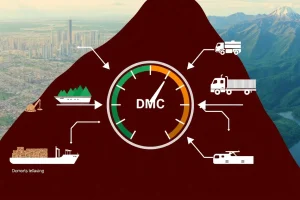
- Domestic Material Consumption (DMC) is the total material directly used by an economy, excluding indirect flows.
- Global Trend
- Global resource productivity has improved by about 1-2% per year, but total material use has more than tripled since 1970.
- Decoupling
- Relative decoupling occurs when GDP grows faster than material use; absolute decoupling requires material use to decline while GDP grows.
- Key Sectors
- Construction, food, and energy sectors account for the largest shares of material consumption globally.
- Measurement Unit
- Typically expressed in US dollars per kilogram or euros per tonne.
Key Takeaways
- Resource productivity measures how efficiently an economy converts natural resources into economic output, typically as GDP per unit of material consumption.
- It is a key indicator for tracking progress toward sustainable development and the circular economy.
- Improving resource productivity can reduce environmental pressures, lower costs, and enhance competitiveness.
- Despite efficiency gains, global material use continues to rise, highlighting the need for absolute decoupling and systemic change.
What Is Resource Productivity?
Resource productivity is an economic and environmental indicator that quantifies the efficiency with which an economy uses natural resources—such as minerals, metals, biomass, and fossil fuels—to generate economic value. It is most commonly defined as the ratio of gross domestic product (GDP) to domestic material consumption (DMC), expressed in monetary units per mass unit (e.g., US dollars per kilogram). In essence, it answers the question: “How much economic output do we get from each unit of material input?” A higher resource productivity indicates that an economy is creating more wealth with less material, reflecting greater efficiency and reduced environmental impact per unit of output.
The concept emerged from the broader field of resource economics and industrial ecology, where it serves as a headline indicator for monitoring the transition toward a more sustainable and circular economy. Resource productivity is closely related to resource efficiency, but while efficiency can refer to any measure of output per input, productivity specifically ties material use to economic performance. It is a central metric in policy frameworks such as the European Union’s Resource Efficiency Scoreboard and the OECD’s Green Growth Indicators. By tracking resource productivity over time, analysts can assess whether economic growth is becoming decoupled from resource consumption—a critical goal for achieving long-term environmental sustainability.
Overview
Resource productivity provides a macro-level view of how an economy uses materials. It is calculated using data from economy-wide material flow accounts (MFA), which track all material inputs into an economy, including domestic extraction and imports, minus exports. The resulting domestic material consumption (DMC) represents the total amount of materials directly used by an economy. Dividing GDP by DMC yields resource productivity. This indicator can be applied at national, regional, or global scales. Over the past few decades, many developed economies have seen gradual improvements in resource productivity, driven by technological innovation, structural change toward services, and policy measures. However, in absolute terms, global material consumption has continued to grow, driven by population growth and rising living standards in emerging economies. Thus, while relative decoupling (GDP growing faster than material use) is common, absolute decoupling (GDP growing while material use declines) remains rare.
How It Works
Resource productivity is measured through a systematic accounting framework. The first step is to compile material flow accounts, which categorize materials into four main groups: biomass (food, feed, wood), metal ores, non-metallic minerals (construction materials, industrial minerals), and fossil energy carriers (coal, oil, gas). These flows are measured in tonnes. Domestic extraction covers materials harvested or mined within a country; imports and exports are added and subtracted to calculate DMC. Alternatively, some analyses use raw material consumption (RMC), which accounts for the material footprint of final demand, including materials embodied in traded goods. Resource productivity is then computed as GDP (in constant prices) divided by DMC or RMC. The resulting figure can be tracked over time to reveal trends. For example, if GDP rises by 3% and DMC rises by 1%, resource productivity improves by about 2%. Policymakers use this metric to set targets and evaluate the effectiveness of resource efficiency policies.
Main Drivers
Several factors influence resource productivity. Technological innovation is a primary driver: advances in manufacturing, lightweight design, and digitalization can reduce the material intensity of products and processes. Structural economic change also plays a role; as economies shift from resource-intensive industries (like heavy manufacturing and construction) to services and knowledge-based sectors, material demand per unit of GDP tends to decline. Policy interventions, such as regulations on waste, extended producer responsibility, and incentives for recycling, can boost resource productivity by promoting circular use of materials. Additionally, price signals—when resource prices rise, businesses are motivated to use materials more efficiently. However, these drivers can be offset by the rebound effect, where efficiency gains lower costs and lead to increased consumption, partially eroding the productivity improvements.
Benefits, Limitations and Trade-offs
Improving resource productivity offers multiple benefits. Environmentally, it reduces the extraction of virgin materials, lowers energy use, and decreases waste and emissions, helping to preserve ecosystems and mitigate climate change. Economically, it can lower production costs, enhance competitiveness, and reduce dependency on imported raw materials, improving resource security. Socially, it can contribute to job creation in recycling and remanufacturing sectors. However, the metric has limitations. Resource productivity is an aggregate indicator that may mask shifts in material composition; for instance, a country could improve its productivity by outsourcing material-intensive production, merely displacing environmental pressures. It also does not capture the full lifecycle impacts of materials, such as toxicity or biodiversity loss. Moreover, focusing solely on productivity may encourage relative decoupling without addressing the need for absolute reductions in material use. Trade-offs exist between resource productivity and other goals, such as when lightweighting materials (e.g., plastics) reduces mass but increases complexity and recycling challenges.
Connections to Other Systems
Resource productivity is deeply interconnected with other sustainability concepts and frameworks. It is a core element of the circular economy, which aims to keep materials in use for as long as possible, thereby maximizing productivity and minimizing waste. The metric aligns with the Sustainable Development Goals (SDGs), particularly SDG 8 (Decent Work and Economic Growth) and SDG 12 (Responsible Consumption and Production), which call for improved resource efficiency. It also relates to climate policy, as material extraction and processing account for a significant share of global greenhouse gas emissions; enhancing resource productivity can thus contribute to climate mitigation. In economic systems, resource productivity is linked to productivity growth more broadly, influencing total factor productivity. At the international level, material flow accounts and resource productivity indicators are harmonized through frameworks like the System of Environmental-Economic Accounting (SEEA), enabling cross-country comparisons and global assessments.
FAQ
What is resource productivity?
Resource productivity measures how efficiently an economy uses natural resources to generate economic output, typically calculated as GDP divided by domestic material consumption (DMC).
How is resource productivity measured?
It is measured using material flow accounts that track all material inputs into an economy. GDP is then divided by the total material consumption to obtain a ratio, often expressed in dollars per kilogram.
Why does resource productivity matter?
It matters because improving resource productivity can reduce environmental pressures, lower costs, enhance resource security, and help decouple economic growth from resource depletion and pollution.
References
- Eurostat. (n.d.). Material flow accounts and resource productivity. Retrieved from https://ec.europa.eu/eurostat/web/environment/material-flows-and-resource-productivity
- OECD. (2015). Material Resources, Productivity and the Environment. OECD Green Growth Studies.
- United Nations Environment Programme. (2019). Global Resources Outlook 2019: Natural Resources for the Future We Want.
- European Commission. (2011). Roadmap to a Resource Efficient Europe. COM(2011) 571 final.