In brief
At a glance
Quick Facts
- Definition
- DMC measures the total amount of materials directly used by an economy, excluding hidden flows.
- Formula
- DMC = Domestic Extraction + Imports – Exports.
- Material categories
- Biomass, fossil fuels, metal ores, and non-metallic minerals.
- Primary purpose
- To monitor resource efficiency and decoupling of economic growth from material use.
- Global trend
- Global material consumption has more than tripled since 1970 and continues to rise.
- Per capita variation
- High-income countries often exceed 20 tonnes per person annually; low-income countries may be below 5 tonnes.
- Key limitation
- DMC does not account for upstream raw material extraction needed to produce imports.
- Related indicator
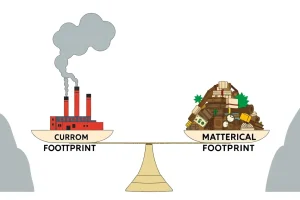
- Material Footprint (MF) includes global resource extraction associated with final demand.
Key Takeaways
- Domestic Material Consumption (DMC) measures the total amount of materials directly used by an economy, excluding hidden flows and upstream extraction abroad.
- DMC is calculated as domestic extraction plus imports minus exports, providing a standardized indicator for national material use.
- It is a key metric for tracking resource efficiency, decoupling, and progress toward a circular economy, but it does not capture the full environmental footprint of consumption.
- High-income countries often have higher per capita DMC, while rapidly industrializing nations show the fastest growth in material consumption.
What Is Domestic Material Consumption?
Domestic Material Consumption (DMC) is an environmental accounting indicator that quantifies the total amount of materials directly used by an economy in a given year. It includes all solid, liquid, and gaseous materials (except water and air) that are physically used in production and consumption activities within a country’s territory. DMC is a central metric in economy-wide material flow accounting (MFA), a framework standardized by Eurostat and the United Nations to track resource use and environmental pressures.
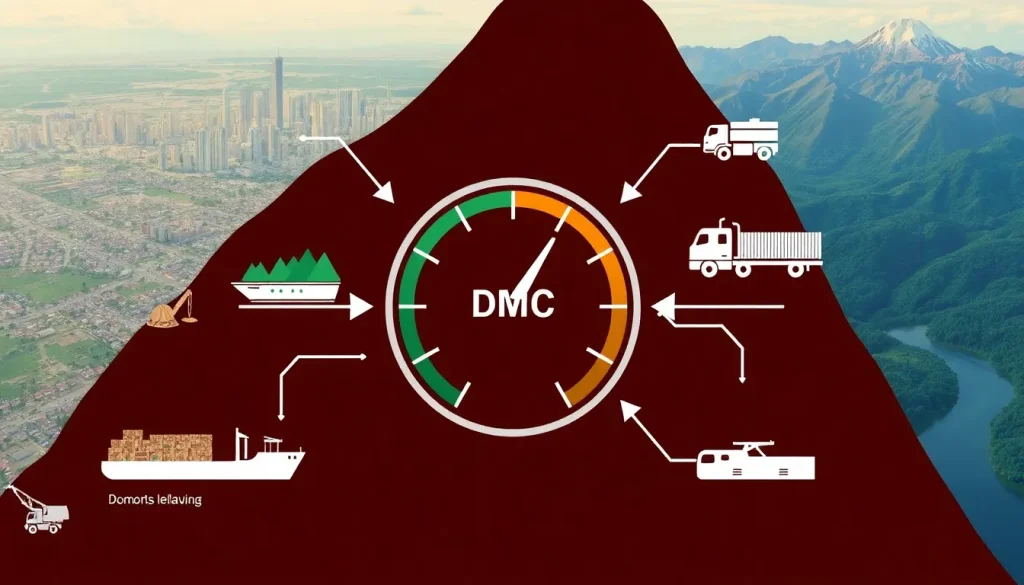
DMC is defined by a simple mass balance equation: DMC = Domestic Extraction (DE) + Imports – Exports. Domestic extraction covers all raw materials harvested from the natural environment within a country, such as biomass (crops, timber, fish), fossil fuels (coal, oil, gas), metal ores, and non-metallic minerals (sand, gravel, limestone). Imports and exports are measured in physical units (tonnes) and include all goods at the border, from raw materials to finished products. By subtracting exports, DMC reflects the materials that remain within the economy for consumption or capital formation, offering a snapshot of a nation’s direct material throughput.
Overview
DMC is part of a broader set of material flow indicators used to assess the physical dimension of economic activity. It is often reported alongside Domestic Extraction (DE), Physical Trade Balance (PTB), and Material Footprint (MF). While DMC measures apparent consumption of materials within a country, it does not account for the upstream material requirements of imported goods—the raw materials extracted abroad to produce those imports. This distinction is critical for understanding the full environmental impact of consumption, as DMC can underestimate the resource use of import-dependent economies.
DMC is widely used by statistical offices and international organizations to monitor resource productivity (GDP/DMC) and to track progress toward decoupling economic growth from material use. It is also an official indicator for Sustainable Development Goal 12 (Responsible Consumption and Production) and is employed in circular economy monitoring frameworks. Despite its limitations, DMC remains a practical and widely available metric for national-level material flow analysis.
How It Works
The calculation of DMC follows a standardized methodology based on economy-wide material flow accounts. The process begins with quantifying domestic extraction (DE) for four main material categories: biomass, metal ores, non-metallic minerals, and fossil energy carriers. Data are collected from national statistics, geological surveys, agricultural reports, and industry sources. Imports and exports are then added in physical units, typically tonnes, using trade statistics. The resulting DMC represents the total mass of materials that enter the national economy and are either consumed or added to physical stocks (e.g., buildings, infrastructure, durable goods).
It is important to note that DMC excludes “hidden flows” or “unused domestic extraction”—materials that are moved or disturbed during extraction but do not enter the economy (e.g., mining overburden, soil excavation). This makes DMC a consumption-oriented indicator rather than a comprehensive measure of total material requirements. For a more complete picture, analysts often turn to the Raw Material Consumption (RMC) or Material Footprint, which includes the upstream raw materials needed to produce traded goods.
Importance and Impact
DMC is a cornerstone indicator for assessing the sustainability of resource use. By tracking DMC over time, policymakers can evaluate whether economic growth is becoming more or less material-intensive. A declining DMC relative to GDP suggests relative decoupling, while an absolute reduction in DMC indicates absolute decoupling—a key goal for sustainable development. DMC also helps identify a country’s dependence on imported materials and its vulnerability to supply disruptions or price volatility.
At the global level, DMC data aggregated across countries reveals the total material footprint of human activities. This information is essential for understanding pressures on ecosystems, climate change (through embodied emissions in materials), and the limits of resource availability. International bodies like the UN Environment Programme use DMC to highlight the unsustainable trajectory of global material use, which has more than tripled since 1970 and is projected to double again by 2060 without policy intervention.
Regional Differences
DMC varies significantly across regions due to differences in economic structure, population size, and resource endowments. High-income countries typically have high per capita DMC, often exceeding 20 tonnes per person annually, driven by consumption-heavy lifestyles and large infrastructure stocks. In contrast, low-income countries may have per capita DMC below 5 tonnes, reflecting lower levels of industrialization and consumption. However, some resource-rich nations exhibit high DMC due to domestic extraction of materials that are processed and exported, even if final consumption is low.
Asia has become the dominant region in terms of total DMC, accounting for more than half of global material consumption, largely due to rapid industrialization in China and India. Europe and North America, while having high per capita rates, have seen more stable or slightly declining DMC in recent decades, partly due to a shift toward service-based economies and increased material efficiency. Africa and Latin America, despite being major exporters of raw materials, have relatively low DMC because much of their extraction is exported rather than consumed domestically.
Connections to Other Systems
DMC is closely linked to other environmental and economic indicators. It is a key component of material flow accounting, which also tracks Domestic Extraction (DE), Physical Trade Balance (PTB), and Total Material Requirement (TMR). DMC is often compared with GDP to calculate resource productivity, a measure of how efficiently an economy uses materials to generate wealth. Additionally, DMC is connected to waste generation and recycling rates, as materials that enter the economy eventually become waste or emissions, unless they are added to long-lived stocks.
DMC also intersects with climate policy, as the extraction, processing, and disposal of materials account for a significant share of global greenhouse gas emissions. Reducing DMC through circular economy strategies—such as reuse, recycling, and product life extension—can therefore contribute to climate mitigation. Furthermore, DMC is linked to biodiversity loss and land-use change, as the extraction of biomass, minerals, and fossil fuels often involves habitat destruction and ecosystem degradation.
Data Limitations and Uncertainties
While DMC is a widely used indicator, it has several limitations. First, it does not capture the upstream material requirements of imports, meaning that countries that have outsourced their manufacturing may appear to have lower material consumption than they actually do. This can lead to a misleading picture of decoupling. Second, DMC data quality varies across countries due to differences in statistical capacity, classification systems, and reporting practices. Biomass and non-metallic minerals data are often less reliable than those for metals and fossil fuels.
Additionally, DMC treats all materials equally by weight, ignoring differences in environmental impact. For example, one tonne of sand and one tonne of rare earth metals have vastly different ecological footprints, yet they are counted the same in DMC. To address this, analysts often disaggregate DMC by material category or complement it with indicators like the Material Footprint, which accounts for global resource extraction associated with final demand. Despite these limitations, DMC remains a practical and policy-relevant starting point for monitoring material use.
FAQ
What is Domestic Material Consumption?
Domestic Material Consumption (DMC) is an indicator that measures the total amount of materials directly used by an economy. It includes materials extracted domestically plus imports minus exports, covering biomass, fossil fuels, metal ores, and non-metallic minerals.
How is Domestic Material Consumption calculated?
DMC is calculated using the formula: DMC = Domestic Extraction (DE) + Imports – Exports. Domestic extraction is the amount of raw materials harvested within a country, while imports and exports are measured in physical units (tonnes) from trade statistics.
Why does Domestic Material Consumption matter?
DMC matters because it provides a standardized way to track resource use and environmental pressure. It helps policymakers assess whether economic growth is decoupling from material consumption, monitor progress toward sustainability goals, and identify dependencies on imported materials.
References
- Eurostat. (2018). Economy-wide material flow accounts handbook. Luxembourg: Publications Office of the European Union.
- OECD. (2021). Material resources, productivity and the environment. OECD Green Growth Studies. OECD Publishing.
- UNEP International Resource Panel. (2019). Global Resources Outlook 2019: Natural Resources for the Future We Want. Nairobi, Kenya.
- Krausmann, F., Wiedenhofer, D., Lauk, C., et al. (2017). Global socioeconomic material stocks rise 23-fold over the 20th century and require half of annual resource use. Proceedings of the National Academy of Sciences, 114(8), 1880-1885.