In brief
At a glance
Quick Facts
- Definition
- Raw Material Equivalent (RME) is the total amount of raw materials extracted from nature to produce a product, including unused extraction and upstream material losses.
- Key Indicator
- RME is used to calculate Raw Material Consumption (RMC), a consumption-based material flow indicator.
- Hidden Flows
- RME reveals hidden material flows that are not physically part of the final product, such as mining overburden and harvest residues.
- Scale
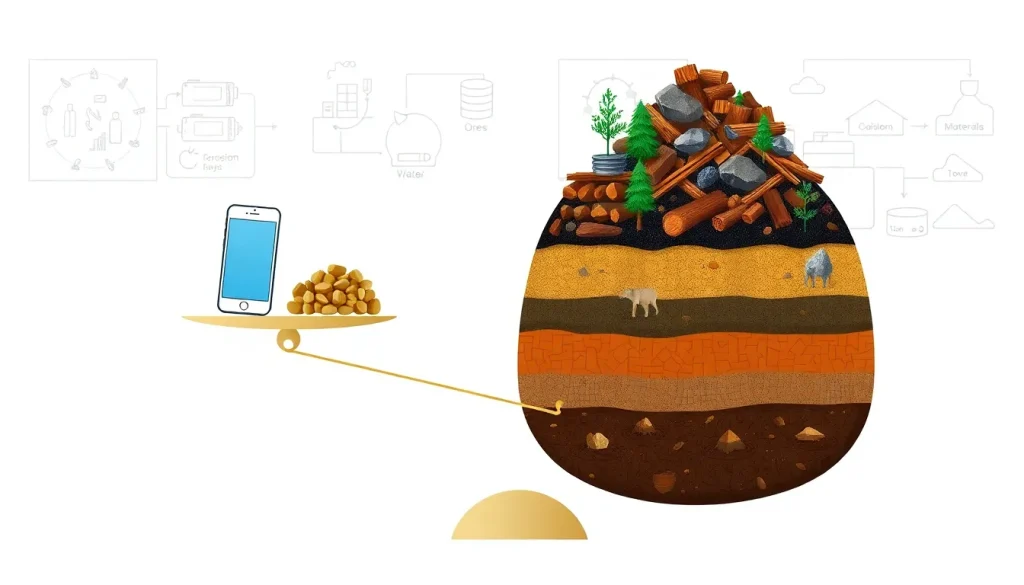
- The RME of a product can be 10 to 100 times its own weight, especially for electronics and metal-intensive goods.
- Policy Use
- The European Union and OECD use RME-based indicators to monitor resource efficiency and material footprints.
- Calculation Method
- RME is estimated using environmentally extended input-output analysis or life cycle inventory data.
- Global Trade
- RME adjusts for trade by attributing raw material extraction to the final consumer, not the producer.
- Limitation
- RME measures mass, not environmental impact; a tonne of sand and a tonne of rare earths have different consequences.
Key Takeaways
- Raw Material Equivalent (RME) measures the total amount of raw materials extracted from the environment to produce a final product, including all materials used and discarded along the supply chain.
- RME reveals the hidden material flows behind products, often showing that the actual resource use is many times greater than the product’s own weight.
- It is a key indicator for assessing resource efficiency, environmental pressure, and the sustainability of consumption and production patterns.
- RME accounts for unused extraction (overburden, by-products) and materials embodied in imports, providing a consumption-based perspective on resource use.
What Is Raw Material Equivalent Explained?
Raw Material Equivalent (RME) is a metric used in material flow accounting and environmental economics to express the total amount of raw materials extracted from the natural environment to produce a given product or service. Unlike direct material input, which only counts the mass of materials physically contained in a product, RME includes all materials that were moved or disturbed during extraction and processing, even if they do not end up in the final product. This includes unused extraction (such as mining overburden, harvest residues, and by-catch), as well as materials used in upstream production stages that are lost or discarded. RME thus provides a comprehensive, life-cycle-based measure of the resource intensity of goods and services.
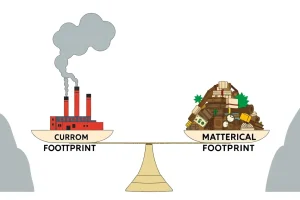
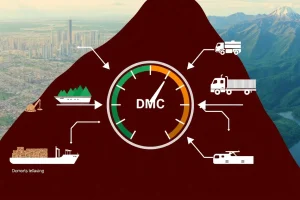
The concept is central to the field of material flow accounting and is used to calculate the Raw Material Consumption (RMC) of an economy. RMC adjusts domestic material consumption (DMC) by accounting for the raw material equivalents of traded goods. While DMC measures the direct material inputs used in an economy, RMC attributes the global raw material extraction to the final demand of that economy, regardless of where the extraction occurred. This makes RME a powerful tool for understanding the global resource implications of local consumption and for revealing the hidden material flows that are often overlooked in traditional economic and environmental statistics.
Overview
Raw Material Equivalent is a life-cycle-based indicator that captures the total material requirement along the entire production chain of a product. It is often expressed in tonnes and can be applied to individual products, sectors, or entire economies. The concept emerged from the field of material flow analysis (MFA) and is closely linked to the idea of the “ecological rucksack”—the hidden material flows that are not physically part of a product but were necessary for its creation. For example, the RME of a gold ring includes not only the few grams of gold it contains but also the tonnes of ore mined, processed, and discarded to extract that gold.
At the national level, RME is used to calculate the Raw Material Consumption (RMC) indicator, which is a consumption-based material flow indicator. RMC equals domestic extraction plus the RME of imports minus the RME of exports. This provides a more accurate picture of the material footprint of a country’s consumption than traditional production-based indicators. International organizations such as Eurostat and the OECD have adopted RME-based indicators to monitor progress toward sustainable resource use and to inform policies on resource efficiency and circular economy.
How It Works
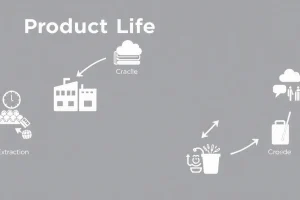
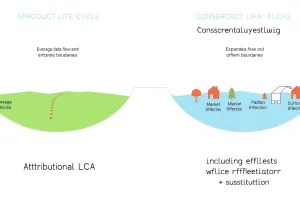
Calculating RME involves tracing the entire supply chain of a product back to the point of raw material extraction. This is typically done using environmentally extended input-output analysis or life cycle inventory methods. The process accounts for all materials that are extracted from nature, including those that become waste during processing, such as mining overburden, harvest residues, and unused extraction. For imported goods, RME estimates the amount of raw materials that were extracted in the exporting country to produce those goods, using coefficients that reflect the technology and efficiency of the exporting country or global averages.
The calculation can be broken down into several steps. First, the direct material inputs of a product are identified—these are the materials that physically end up in the product. Second, the unused domestic extraction associated with each material is estimated using extraction-to-use ratios. Third, the indirect flows of materials used in upstream production stages are added. Finally, for traded goods, the raw material equivalents are allocated to the final consumer rather than the producer. This approach ensures that the total global extraction of raw materials is fully attributed to the final demand of economies, providing a consumption-based perspective on resource use.
Importance and Impact
RME is important because it reveals the true scale of resource use driven by consumption, which is often hidden in global supply chains. By accounting for unused extraction and upstream material flows, RME provides a more complete picture of the environmental pressures associated with economic activities. This is critical for assessing sustainability, as the extraction and processing of raw materials are major sources of greenhouse gas emissions, biodiversity loss, water stress, and land-use change. RME helps policymakers and businesses identify hotspots of resource use and design strategies to reduce material footprints.
The impact of using RME as an indicator is significant for international resource policy. It shifts the focus from production-based to consumption-based accounting, highlighting the responsibility of consuming countries for global resource extraction. This can inform policies on sustainable consumption and production, circular economy, and supply chain management. For example, the European Union uses RME-derived indicators to monitor progress toward its resource efficiency goals and to assess the global material footprint of its economy. By revealing the full material requirements of products, RME also supports eco-design and informed consumer choices.
Examples
Consider a smartphone: its direct material composition might be around 100–200 grams, but the RME can be as high as 50–100 kilograms due to the extraction of metals, rare earth elements, and the energy carriers used in manufacturing. Similarly, a laptop computer weighing 2 kg can have an RME of over 1 tonne. These hidden flows are dominated by abiotic materials such as ores and fossil fuels. For agricultural products, the RME includes not only the harvested crop but also soil erosion, water used in irrigation, and biomass residues.
At the national level, the RME of imports can be several times higher than the direct weight of imported goods. For instance, the European Union’s RME of imports is significantly larger than the actual tonnage of imported products, reflecting the high material intensity of goods produced in other regions. This has implications for understanding the EU’s global resource footprint and for designing policies that address the outsourcing of environmental pressures. RME data also show that the material footprint of developed countries is often much higher than their domestic material consumption, underlining the hidden resource costs of affluent lifestyles.
Benefits, Limitations and Trade-offs
The primary benefit of RME is that it provides a comprehensive and consistent measure of resource use across products and countries, enabling fair comparisons and informed decision-making. It supports the development of indicators such as the Raw Material Consumption (RMC) and the material footprint, which are used in monitoring frameworks like the Sustainable Development Goals (SDG 12). RME also helps to identify opportunities for resource efficiency and circularity by highlighting where material losses occur in the supply chain.
However, RME has limitations. The calculation requires detailed data on material flows and production processes, which are often unavailable or uncertain, especially for complex global supply chains. As a result, RME estimates rely on models and assumptions, such as fixed coefficients for raw material equivalents per product, which may not reflect technological differences or temporal changes. There is also a trade-off between comprehensiveness and practicality: while RME captures hidden flows, it can be difficult to communicate to non-experts and may not directly correspond to specific environmental impacts, as it measures mass rather than toxicity or scarcity. Despite these challenges, RME remains a valuable tool for raising awareness and guiding policy on sustainable resource use.
Common Misconceptions
One common misconception is that RME is the same as the weight of a product. In reality, RME is often many times larger because it includes all materials extracted and disturbed during production, not just those that end up in the final good. Another misunderstanding is that RME directly measures environmental impact. While higher RME generally correlates with greater environmental pressure, the relationship is not linear: a tonne of sand and a tonne of rare earth metals have vastly different ecological and social consequences. RME is a mass-based indicator and should be complemented with other metrics for a full sustainability assessment.
Some also assume that RME is only relevant for heavy industries like mining or construction. In fact, all products have an RME, including services, which may have significant upstream material requirements (e.g., the servers and infrastructure behind digital services). Finally, there is a misconception that RME is a fixed property of a product. In reality, RME varies depending on the production technology, energy mix, and supply chain efficiency, meaning that improvements in these areas can reduce the RME of the same product over time.
FAQ
What is Raw Material Equivalent?
Raw Material Equivalent (RME) is a measure of the total amount of raw materials extracted from the environment to produce a product, including all materials used and discarded along the supply chain, such as mining waste and harvest residues.
How does Raw Material Equivalent work?
RME works by tracing the entire production chain of a product back to the point of extraction, using input-output models or life cycle data. It accounts for unused extraction and allocates global raw material extraction to the final consumer of goods.
Why does Raw Material Equivalent matter?
RME matters because it reveals the true resource intensity of products and economies, highlighting hidden environmental pressures. It supports sustainable consumption and production policies by providing a consumption-based perspective on resource use.
References
- Eurostat. (2013). Economy-wide Material Flow Accounts (EW-MFA). Compilation Guide. Luxembourg: Publications Office of the European Union.
- OECD. (2015). Material Resources, Productivity and the Environment. OECD Green Growth Studies. OECD Publishing, Paris.
- UNEP. (2019). Global Resources Outlook 2019: Natural Resources for the Future We Want. United Nations Environment Programme.