In brief
At a glance
Quick Facts
- Core Analogy
- Industrial systems are compared to biological organisms, with material and energy flows akin to metabolism.
- Key Metric
- Total Material Requirement (TMR) measures all materials extracted or moved to produce goods, including hidden flows.
- Scale of Application
- Can be applied to a single product, a company, a city, or the entire global economy.
- Related Field
- Industrial ecology uses industrial metabolism as a foundational concept to design sustainable industrial systems.
- Waste Generation
- A large portion of material inputs ends up as waste or emissions, highlighting linear throughput.
- Circular Economy Link
- Industrial metabolism analysis identifies opportunities to close material loops and reduce resource consumption.
Key Takeaways
- Industrial metabolism is a framework that views industrial systems as organisms, tracking the throughput of materials and energy from extraction to disposal.
- It quantifies all inputs, stocks, and outputs of a defined system, enabling the identification of inefficiencies and waste streams.
- The concept underpins industrial ecology and circular economy strategies by highlighting opportunities to close material loops and reduce resource consumption.
- Understanding industrial metabolism is essential for assessing environmental impacts, informing policy, and transitioning toward sustainable production and consumption.
What Is Industrial Metabolism?
Industrial metabolism is a concept that applies the biological metaphor of metabolism to industrial and economic systems. Just as a living organism takes in nutrients, transforms them into energy and tissue, and excretes waste, an industrial system consumes raw materials and energy, processes them into products and services, and generates emissions and waste. The term provides a holistic, systems-oriented way to analyze the material and energy flows that underpin all human economic activity, from the extraction of natural resources to the final disposal of goods.
This concept is a cornerstone of industrial ecology, a field that seeks to redesign industrial systems to mimic the cyclical, efficient material flows observed in natural ecosystems. By quantifying the total material and energy throughput of a factory, a city, a national economy, or the entire global economy, industrial metabolism reveals the environmental pressures associated with production and consumption. It moves beyond simple input-output accounting to consider the entire life cycle of materials, including hidden flows such as mining overburden, soil erosion, and unused extraction. The approach is inherently interdisciplinary, drawing on engineering, environmental science, economics, and systems thinking to provide a comprehensive picture of how human societies interact with the natural world through material and energy exchanges.
Overview
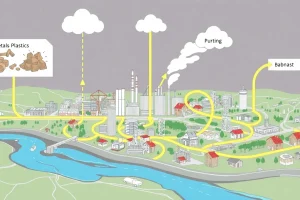
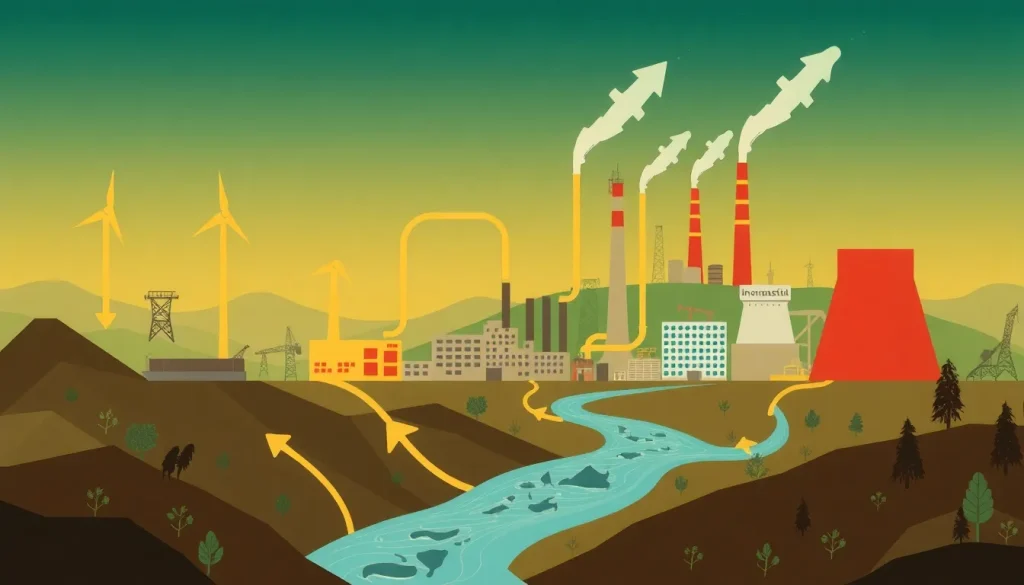
Industrial metabolism provides a structured way to map and measure the physical basis of an economy. It treats the industrial system as a metabolic organism that ingests raw materials (biomass, fossil fuels, minerals, metals) and energy, transforms them through manufacturing and construction into stocks (buildings, infrastructure, durable goods), and eventually releases wastes (emissions, effluents, solid waste) back into the environment. The approach distinguishes between direct material inputs—those that enter the economy for processing—and hidden or indirect flows, which are materials moved or disturbed but not used, such as mining overburden or soil erosion from agriculture.

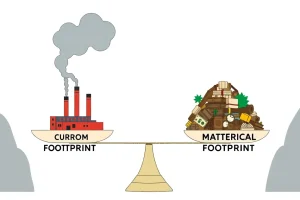
At its core, industrial metabolism relies on material flow analysis (MFA) and substance flow analysis (SFA) to track the movement of specific materials or substances through a defined system. These methods provide a systematic, quantitative basis for understanding resource use, waste generation, and the accumulation of materials in society. The results are often used to calculate indicators such as Total Material Requirement (TMR), Domestic Material Consumption (DMC), and Material Footprint, which help policymakers and businesses assess resource efficiency and environmental impact.
History
The intellectual roots of industrial metabolism trace back to the 1960s and 1970s, a period of growing environmental awareness. Economist Kenneth Boulding’s 1966 essay “The Economics of the Coming Spaceship Earth” argued for a shift from a “cowboy economy” (open, wasteful) to a “spaceman economy” (closed, cyclical), laying philosophical groundwork. In 1969, ecologist Eugene Odum proposed the analogy between natural and industrial ecosystems. The term “industrial metabolism” itself was popularized by physicist and economist Robert U. Ayres in a 1989 essay, where he systematically compared the materials cycles of industry to the metabolic processes of organisms.
The concept gained traction in the 1990s with the formal emergence of industrial ecology as a field. The publication of the Journal of Industrial Ecology in 1997 and seminal works such as Ayres and Simonis’s “Industrial Metabolism: Restructuring for Sustainable Development” (1994) solidified the framework. Since then, industrial metabolism has been adopted by international organizations, including the European Environment Agency and the United Nations Environment Programme, as a tool for monitoring resource use and guiding sustainable development policies. The development of standardized material flow accounting methods by Eurostat and the OECD further institutionalized the approach.
How It Works
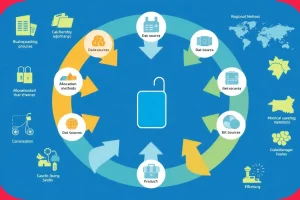
Industrial metabolism operates by defining a system boundary—such as a factory, a supply chain, a city, or a national economy—and then quantifying all material and energy flows that cross that boundary over a given period. The analysis typically follows a sequence of stages:
- Extraction: Raw materials (ores, fossil fuels, biomass) are removed from the natural environment, along with associated hidden flows like overburden and unused extraction.
- Production: Materials are processed, refined, and manufactured into intermediate and finished goods. Energy is consumed at each step.
- Consumption and Use: Products enter the use phase, where they may remain as in-use stocks (buildings, vehicles, appliances) for years or decades.
- Waste Management and Disposal: At end-of-life, materials are either recycled, incinerated, landfilled, or released as emissions to air, water, and soil.
The core tool is material flow analysis (MFA), which measures the mass of materials entering and leaving the system. Substance flow analysis (SFA) focuses on specific elements or compounds, such as carbon, nitrogen, or heavy metals. These methods produce a mass balance that must account for all inputs, outputs, and changes in stock. The results are often visualized as Sankey diagrams, showing the magnitude of flows. By comparing the metabolic profiles of different systems or tracking changes over time, analysts can identify inefficiencies, assess the potential for circularity, and evaluate the environmental burden of economic activity.
Importance and Impact
Industrial metabolism is important because it makes the physical dimension of economic activity visible and measurable. Traditional economic indicators like GDP focus on monetary transactions and often ignore the material and energy throughput that underpins them. By revealing the total resource requirements and waste generation of a system, industrial metabolism highlights the environmental pressures that are otherwise hidden. This is critical for addressing global challenges such as resource depletion, climate change, pollution, and biodiversity loss.
The impact of the concept is far-reaching. It provides the evidence base for policies aimed at decoupling economic growth from resource use and environmental degradation. For example, material flow accounts are used to monitor progress toward the Sustainable Development Goals (SDGs), particularly SDG 12 (Responsible Consumption and Production). At the corporate level, industrial metabolism thinking helps companies identify cost savings through material efficiency, waste reduction, and by-product synergy. It also underpins the circular economy, guiding the redesign of products and business models to keep materials in use for longer and regenerate natural systems.
Connections to Other Systems
Industrial metabolism is deeply interconnected with several related concepts and frameworks. It is a foundational element of industrial ecology, which uses the metabolic analogy to design industrial ecosystems where the waste of one process becomes the input for another. It also provides the quantitative backbone for life cycle assessment (LCA), a method that evaluates the environmental impacts of a product from cradle to grave. While LCA focuses on specific products and a range of environmental impact categories, industrial metabolism often deals with bulk material flows at larger scales.
The concept extends to urban metabolism, which applies the same principles to cities, analyzing the flows of water, energy, food, and materials into, through, and out of urban areas. At the macroeconomic level, industrial metabolism is linked to environmentally extended input-output analysis and material flow accounting systems maintained by national statistical offices. These connections enable a multi-scale understanding of how human activities interact with the environment, from a single factory to the global economy, and support integrated sustainability assessments.
Benefits, Limitations and Trade-offs
The primary benefit of the industrial metabolism approach is its holistic, systems-level perspective. It avoids shifting environmental burdens from one stage of the life cycle to another and reveals the full material footprint of consumption. This helps policymakers and businesses identify leverage points for improving resource efficiency and reducing waste. The quantitative nature of the analysis also supports target-setting and monitoring, making it a practical tool for sustainability management.
However, the approach has limitations. Data availability and quality can be a significant challenge, especially for hidden flows and informal economic activities. The focus on mass flows may overlook important qualitative differences, such as the toxicity of a small-volume substance or the ecological impact of land use change. There are also trade-offs: a narrow emphasis on reducing material throughput could conflict with other goals, such as energy efficiency or social equity. Furthermore, defining system boundaries and allocating impacts in complex global supply chains requires methodological choices that can influence results. Despite these challenges, industrial metabolism remains a powerful framework for understanding and managing the physical basis of human society.
FAQ
What is industrial metabolism?
Industrial metabolism is a concept that views industrial systems as organisms, analyzing the flows of materials and energy from extraction through production, consumption, and disposal. It quantifies the total throughput to understand environmental pressures.
How does industrial metabolism work?
It works by defining a system boundary and using material flow analysis to track all inputs (raw materials, energy), stocks (infrastructure, products in use), and outputs (emissions, waste). The mass balance reveals inefficiencies and opportunities for circularity.
Why does industrial metabolism matter?
It matters because it makes the physical basis of economic activity visible, helping to identify resource depletion, pollution, and waste. This evidence supports policies for sustainable development, resource efficiency, and the transition to a circular economy.
References
- Ayres, R. U. (1989). Industrial Metabolism. In J. H. Ausubel & H. E. Sladovich (Eds.), Technology and Environment. National Academy Press.
- Eurostat. (n.d.). Material flow accounts. Retrieved from https://ec.europa.eu/eurostat/web/environment/material-flows-and-resource-productivity
- Journal of Industrial Ecology. (n.d.). Wiley. Retrieved from https://onlinelibrary.wiley.com/journal/15309290