In brief
At a glance
Quick Facts
- Definition of Attributional LCA
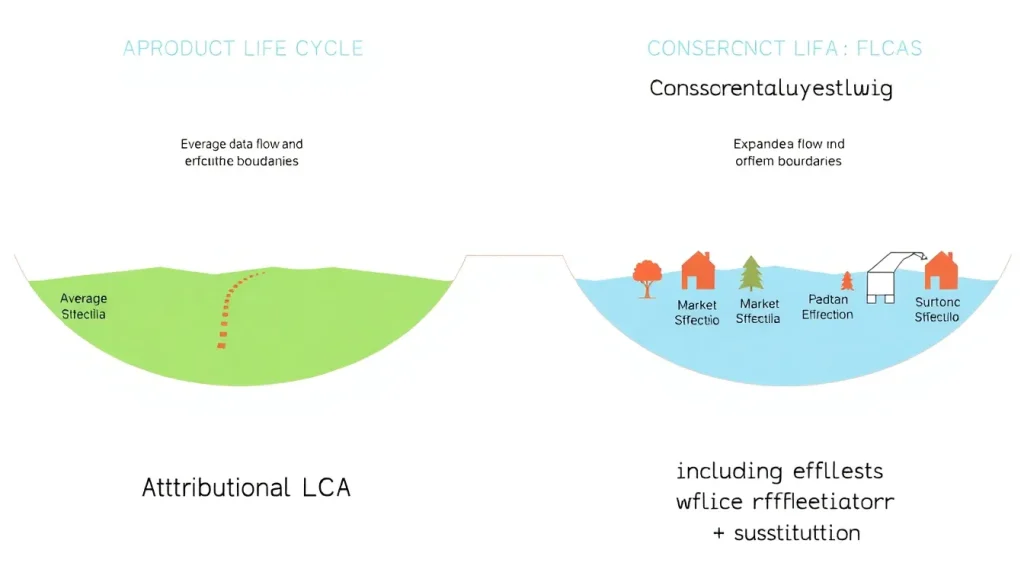
- A method that quantifies the environmental flows to and from a product system based on average data and a static system model.
- Definition of Consequential LCA
- A method that assesses the environmental consequences of a change in demand for a product, using marginal data and modeling market-mediated effects.
- Key Difference
- ALCA uses average data and describes the system as it is; CLCA uses marginal data and models how the system responds to changes.
- ISO Standards
- Both ALCA and CLCA are recognized under ISO 14040/14044, but the standards do not explicitly distinguish between them.
- Typical Applications
- ALCA is used for product carbon footprints and environmental product declarations; CLCA is used for policy analysis and strategic decision-making.
- System Boundary
- ALCA typically includes only direct physical flows, while CLCA expands boundaries to include indirect effects like market responses.
- Data Type
- ALCA relies on average or supplier-specific data; CLCA uses marginal data representing the technology affected by a change in demand.
- Co-product Handling
- ALCA often uses allocation to partition impacts among co-products; CLCA uses system expansion to avoid allocation.
- Uncertainty
- CLCA generally involves higher uncertainty due to modeling of future market responses and technological changes.
- Complementary Use
- Both methods can be used together to provide a comprehensive view: ALCA for current footprint, CLCA for decision support.
Key Takeaways
- Attributional life-cycle assessment (ALCA) quantifies the environmental flows associated with a product system based on average data and a static model, answering “What are the environmental impacts of this product?”
- Consequential life-cycle assessment (CLCA) evaluates how environmental flows change in response to a potential decision, using marginal data and modeling market-mediated effects to answer “What are the consequences of doing X instead of Y?”
- The fundamental distinction lies in the goal: ALCA is descriptive and retrospective, while CLCA is change-oriented and prospective, making them suitable for different applications.
- ALCA is commonly used for product declarations, benchmarking, and identifying hotspots, whereas CLCA supports policy analysis, strategic planning, and assessment of large-scale changes.
- Both approaches face challenges: ALCA may misrepresent system-wide effects of decisions, while CLCA involves greater uncertainty due to its reliance on economic models and future scenarios.
What Is Attributional vs Consequential Life-Cycle Assessment?
Attributional and consequential life-cycle assessment are two distinct modeling frameworks within the broader field of life-cycle assessment (LCA). LCA is a standardized methodology for evaluating the environmental impacts of a product, process, or service throughout its entire life cycle—from raw material extraction through production, use, and disposal. The attributional approach (ALCA) focuses on describing the environmentally relevant physical flows to and from a life cycle and its subsystems, using average data and a static system model. In contrast, the consequential approach (CLCA) aims to assess how these environmental flows would change as a result of a specific decision, such as a change in demand, by incorporating marginal data and modeling the causal relationships between the decision and its environmental consequences.
The distinction between these two approaches emerged in the late 1990s and early 2000s as LCA practitioners recognized that different study goals require different methodological choices. While ISO 14040 and 14044 standards provide a general framework for LCA, they do not explicitly prescribe either approach. Instead, the choice between attributional and consequential modeling is determined by the goal and scope of the study. Understanding this distinction is critical for anyone using LCA results, as the two approaches can yield different—sometimes contradictory—conclusions about the environmental preferability of a product or policy.
Overview
Life-cycle assessment is a tool for compiling and evaluating the inputs, outputs, and potential environmental impacts of a product system throughout its life cycle. The methodology is divided into four phases: goal and scope definition, inventory analysis, impact assessment, and interpretation. The goal and scope phase is where the fundamental choice between attributional and consequential modeling is made, as it determines the system boundaries, data requirements, and allocation methods.
Attributional LCA is the more traditional and widely used approach. It seeks to create a static model of a product system by linking unit processes with average data, often using cut-off criteria to exclude processes that contribute less than a certain percentage to the total impact. The system is typically modeled as it exists at a given point in time, and the results are normalized to a functional unit—a quantified description of the product’s function. This approach is well-suited for environmental product declarations, corporate sustainability reporting, and identifying environmental hotspots within a supply chain.
Consequential LCA, by contrast, is a dynamic approach that models how the environmental flows change when a decision alters the demand for a product. It uses marginal data, which represent the effects of a small change in output, and expands the system boundaries to include processes that are affected by market mechanisms. For example, if a study assesses the consequences of increasing biofuel production, a CLCA would consider not only the direct emissions from biofuel combustion but also the indirect land-use changes caused by diverting crops from food to fuel. This makes CLCA more complex but also more relevant for policy-making and strategic decisions where large-scale changes are expected.
How It Works
The methodological differences between ALCA and CLCA are rooted in the goal and scope definition phase. In ALCA, the system is modeled as a set of linked processes that together deliver the functional unit. The data used are typically average data—for example, the average electricity mix of a country or the average emissions from cement production. Co-product allocation, where a process yields multiple products, is handled by partitioning the environmental burdens based on physical or economic relationships (e.g., mass, energy content, or market value). The system boundaries are generally limited to the direct physical flows, and capital goods or infrastructure may be excluded if they are considered negligible.
In CLCA, the system is modeled to reflect the consequences of a change. The functional unit is often defined as a change in demand (e.g., an additional 1 MJ of fuel). The data used are marginal data, which identify the technology or process that is actually affected by the change. For instance, if electricity demand increases, the marginal supplier might be a natural gas power plant rather than the average grid mix. Co-product allocation is avoided through system expansion, where the system is credited for the avoided production of the co-product’s substitute. This often involves modeling market-mediated effects, such as price elasticities and substitution, which can significantly expand the system boundaries to include indirect effects like land-use change or rebound effects.
The inventory analysis phase differs accordingly. ALCA compiles an inventory of all environmental exchanges (emissions, resource use) associated with the product system, while CLCA compiles the net change in these exchanges resulting from the decision. The impact assessment phase then translates these inventory flows into environmental impact categories (e.g., global warming potential, acidification) using characterization factors. The interpretation phase must account for the different types of uncertainty: ALCA results are often more precise but may be less relevant for decision support, whereas CLCA results are more relevant but carry greater uncertainty due to the modeling of future market responses.
Importance and Impact
The choice between attributional and consequential LCA has profound implications for environmental decision-making. Using the wrong approach can lead to misleading conclusions and suboptimal policies. For example, an ALCA of biofuels might show lower greenhouse gas emissions compared to fossil fuels if it only considers direct emissions and uses average data. However, a CLCA that includes indirect land-use change might reveal that the overall climate impact is worse due to deforestation. This discrepancy has fueled debates in climate policy and renewable energy directives.
In corporate sustainability, ALCA is essential for product carbon footprints and environmental product declarations, which communicate the environmental performance of a product to consumers and stakeholders. These applications require a consistent, reproducible methodology that reflects the actual supply chain. CLCA, on the other hand, is critical for companies making strategic decisions about product portfolios, investments, or sourcing changes, as it helps anticipate the real-world environmental consequences of those decisions. Governments and international bodies rely on CLCA to design effective regulations, such as carbon taxes or biofuel mandates, that avoid unintended negative outcomes.
Benefits, Limitations and Trade-offs
Attributional LCA offers several benefits: it is relatively straightforward to conduct, uses readily available average data, and produces results that are easy to communicate and compare. It is well-established in standards and guidelines, making it the default choice for many practitioners. However, its limitations include a potential disconnect from real-world consequences. Because it does not account for market dynamics, it may suggest that a product is environmentally preferable when, in fact, its increased production would cause greater harm elsewhere. ALCA can also be sensitive to allocation choices, which can arbitrarily influence results.
Consequential LCA addresses these limitations by focusing on the actual environmental changes caused by a decision. It provides more relevant information for policy and strategic planning, and it avoids allocation problems through system expansion. However, CLCA is more complex and data-intensive, requiring economic models and assumptions about future market behavior. The results are often more uncertain and can vary significantly depending on the scenarios modeled. There is also a risk of “black box” modeling, where the underlying assumptions are opaque to decision-makers. In practice, many studies combine elements of both approaches, and the choice should be guided by the specific question being asked.
Common Misconceptions
One common misconception is that attributional LCA is always retrospective and consequential LCA is always prospective. While ALCA often describes an existing system and CLCA often models future changes, the temporal orientation is not the defining feature. An ALCA can be used to model a future product system based on projected average data, and a CLCA can be applied to historical decisions to understand what actually happened. The key difference is whether the study describes a system or models the consequences of a change.
Another misconception is that ISO 14040/14044 mandates one approach over the other. The standards require that the methodology be consistent with the goal and scope, but they do not explicitly distinguish between attributional and consequential LCA. This has led to confusion and inconsistent application. Additionally, some believe that CLCA is always superior because it is more “realistic.” In reality, both approaches have their place, and the choice depends on the decision context. Using CLCA for a simple product declaration would be unnecessarily complex and potentially misleading due to high uncertainty.
Examples
A classic example illustrating the difference is the assessment of biofuels. An attributional LCA of corn ethanol might show a reduction in greenhouse gas emissions compared to gasoline, based on average corn farming practices and ethanol production data. However, a consequential LCA would consider that diverting corn to ethanol production raises corn prices, leading farmers elsewhere to convert forests or grasslands to cropland, releasing large amounts of carbon. This indirect land-use change can result in a net increase in emissions, a finding that has influenced biofuel policies in several regions.
Another example is waste management. An ALCA comparing incineration with landfilling might allocate the environmental burdens of the waste treatment processes and credit the energy recovered from incineration. A CLCA would ask: if we increase incineration capacity, what changes? It would model the marginal energy source displaced by the electricity from incineration (e.g., coal or natural gas) and the avoided methane emissions from landfilling, while also considering the market for recovered materials. The results can differ significantly, affecting municipal waste strategy decisions.
FAQ
What is the main difference between attributional and consequential LCA?
The main difference is that attributional LCA describes the environmental flows of a product system using average data and a static model, while consequential LCA evaluates how those flows change in response to a decision, using marginal data and modeling market-mediated effects.
When should I use attributional LCA?
Use attributional LCA when you want to understand the environmental footprint of a specific product, compare products, or create an environmental product declaration. It is suitable for descriptive, accounting-type studies where the goal is to map the environmental burdens of a system as it is.
Why does the choice between ALCA and CLCA matter?
The choice matters because the two approaches can yield different, sometimes opposite, conclusions about the environmental preferability of a product or policy. Using the wrong approach can lead to ineffective or counterproductive decisions, such as promoting a biofuel that actually increases greenhouse gas emissions when indirect effects are considered.
References
- ISO 14040:2006 Environmental management — Life cycle assessment — Principles and framework
- ISO 14044:2006 Environmental management — Life cycle assessment — Requirements and guidelines
- UNEP/SETAC (2011) Global Guidance Principles for Life Cycle Assessment Databases
- Weidema, B. P. (2003) Market information in life cycle assessment
- Ekvall, T., & Weidema, B. P. (2004) System boundaries and input data in consequential life cycle inventory analysis