In brief
At a glance
Quick Facts
- Bleaching threshold
- Typically 1°C above the local summer maximum for several weeks.
- Degree Heating Weeks (DHW)
- A measure of accumulated heat stress; 4°C-weeks triggers bleaching, 8°C-weeks causes mortality.
- Global coral loss
- An estimated 50% of coral reefs have been lost in the past 30 years due to climate change and local stressors.
- Reef recovery time
- Even fast-growing corals require 10–15 years to recover from severe bleaching, assuming no repeat events.
- Economic value
- Coral reefs provide ecosystem services worth an estimated $2.7 trillion per year globally.
- Tipping point indicator
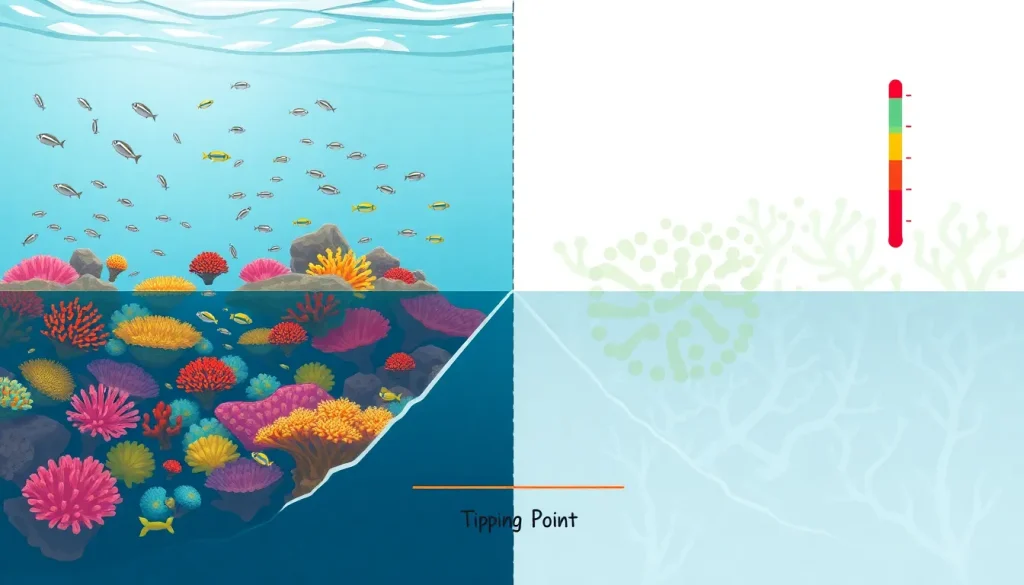
- A shift from coral dominance to macroalgae dominance is a key sign a reef has crossed a tipping point.
Key Takeaways
- Coral reef tipping points are critical thresholds beyond which reef ecosystems undergo rapid, often irreversible degradation, primarily driven by marine heat stress.
- Marine heat stress, measured in Degree Heating Weeks (DHW), causes coral bleaching when water temperatures exceed normal seasonal maxima for prolonged periods.
- Once a reef crosses a tipping point, it can shift from a coral-dominated state to an algae-dominated state, losing biodiversity, fisheries productivity, and coastal protection.
- Reducing global greenhouse gas emissions and managing local stressors are both essential to prevent reefs from crossing these tipping points and to support recovery.
What Is Coral Reef Tipping Points and Marine Heat Stress?
Coral reef tipping points refer to critical thresholds in environmental conditions—most notably sustained high water temperatures—beyond which a reef ecosystem shifts abruptly from a healthy, coral-dominated state to a degraded, algae-dominated state. This transition is often irreversible on human timescales, as the complex three-dimensional structure built by corals over centuries can collapse within a single season of extreme heat. Marine heat stress is the primary trigger for such tipping points, occurring when sea surface temperatures exceed the normal local summer maximum by 1–2°C for several weeks, causing corals to expel their symbiotic algae (zooxanthellae) and turn white—a phenomenon known as coral bleaching.
While bleached corals are not immediately dead, prolonged heat stress leads to starvation and mortality. The concept of a tipping point is central because reef ecosystems exhibit strong hysteresis: once the coral framework erodes and algae take over, simply returning temperatures to normal does not automatically restore the reef. Instead, recovery requires decades of favorable conditions and often active restoration. Understanding these thresholds is vital for predicting when and where reefs will collapse, and for designing effective management strategies in an era of rising ocean temperatures.
How It Works
The process begins with a marine heatwave—a period of unusually high sea surface temperature that persists for days to months. Corals live in a narrow thermal range; when water temperatures exceed the local long-term summer maximum by as little as 1°C, the symbiotic relationship between the coral animal and its zooxanthellae breaks down. The algae are expelled, causing the coral to lose its color and primary energy source. If heat stress is mild or brief, corals can recover. However, if the stress is severe or prolonged, the coral starves and dies.
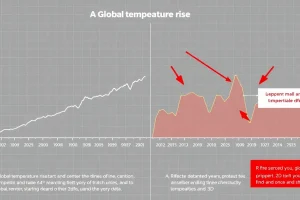
Scientists quantify heat stress using metrics like Degree Heating Weeks (DHW), which combine the magnitude and duration of temperature anomalies. A DHW of 4°C-weeks typically triggers significant bleaching, while values above 8°C-weeks often lead to widespread mortality. Once coral cover drops below a critical threshold—often around 10–20%—the reef can no longer maintain its structural complexity. The dead skeletons become overgrown by turf algae and macroalgae, which inhibit coral larvae from settling and recolonizing. This feedback loop locks the ecosystem into an algal-dominated state, representing a classic ecological tipping point.
Main Causes or Drivers
The primary driver of marine heat stress and coral reef tipping points is anthropogenic climate change, which has increased the frequency, intensity, and duration of marine heatwaves. As the ocean absorbs excess heat from greenhouse gas emissions, baseline sea temperatures rise, making it easier for natural variability (such as El Niño events) to push temperatures above bleaching thresholds. Ocean acidification, also driven by rising CO₂, compounds the problem by reducing calcification rates and weakening coral skeletons, making reefs more vulnerable to erosion after bleaching events.
Local stressors further lower the resilience of reefs and can accelerate the approach to tipping points. These include overfishing (which removes herbivorous fish that keep algae in check), nutrient pollution from agricultural runoff and sewage (which fuels algal growth), sedimentation from coastal development, and physical damage from storms or ship anchors. When these local pressures combine with global heat stress, the threshold for a tipping point is reached more quickly and recovery becomes even less likely.
Environmental and Human Impacts
When a coral reef crosses a tipping point, the consequences cascade through both marine and human systems. The loss of three-dimensional reef structure eliminates habitat for countless species, reducing biodiversity and fisheries productivity. Reefs that once supported vibrant fish populations become flattened, algae-covered rubble beds with far fewer ecological functions. This collapse can take only a few years, while natural recovery—if it occurs at all—may take decades to centuries.
For human communities, the impacts are severe. Coral reefs provide food and livelihoods for hundreds of millions of people, particularly in small island developing states and coastal regions of the tropics. Reefs also act as natural breakwaters, reducing wave energy and protecting shorelines from erosion and storm surges. When reefs degrade, these protective services diminish, increasing the vulnerability of coastal infrastructure and communities. The loss of tourism revenue and fisheries income can also destabilize local economies, creating feedback loops that increase pressure on already stressed marine resources.
Regional Differences
The vulnerability of coral reefs to heat stress and tipping points varies significantly by region. Reefs in the western Pacific and parts of the Indian Ocean have historically experienced more frequent thermal stress due to El Niño–Southern Oscillation (ENSO) events, but some have shown greater resilience or acclimatization. In contrast, reefs in the Caribbean have suffered catastrophic losses, with average coral cover declining by more than 50% since the 1970s, driven by repeated bleaching, disease, and local stressors. The Great Barrier Reef has experienced multiple mass bleaching events since 1998, with some northern sections losing over 90% of corals in a single event.
Regional differences in reef resilience are influenced by factors such as genetic diversity of corals, presence of heat-tolerant symbiont types, upwelling of cooler water, and the degree of local human pressure. For example, some reefs in the Red Sea and Persian Gulf survive at temperatures that would be lethal elsewhere, suggesting local adaptation. However, even these resilient reefs have thermal limits, and as marine heatwaves intensify, the window for survival narrows globally.
Solutions
Addressing coral reef tipping points requires action on both global and local scales. The most critical global solution is rapid reduction of greenhouse gas emissions to limit further ocean warming and acidification. Without this, local efforts can only delay, not prevent, widespread reef collapse. International agreements such as the Paris Agreement aim to keep global temperature rise well below 2°C, but even 1.5°C of warming is projected to cause significant reef loss.
At the local level, management strategies can enhance reef resilience and buy time. These include establishing marine protected areas (MPAs) that limit fishing and other extractive activities, improving water quality by reducing land-based pollution, and restoring herbivorous fish populations to control algae. Active interventions such as coral gardening, assisted evolution (selectively breeding heat-tolerant corals), and even shading or cloud brightening to reduce light stress are being explored. However, these technological solutions are not yet scalable and carry their own risks and uncertainties.
Common Misconceptions
A widespread misconception is that coral bleaching means immediate death. In reality, bleached corals are stressed but still alive; they can recover if heat stress subsides quickly. However, repeated or prolonged bleaching events often lead to mortality. Another misunderstanding is that coral reefs can simply migrate to cooler waters as oceans warm. While some range shifts are possible, the rate of climate change far outpaces the ability of most coral species to establish new reefs in suitable areas, especially given the slow growth of reef structures and the need for specific light and substrate conditions.
There is also a belief that local conservation alone can save reefs. While reducing local stressors is essential, it cannot compensate for the global-scale threat of rising temperatures. Even the most pristine, well-managed reefs bleach when exposed to sustained heat. Finally, some assume that coral restoration projects can fully rebuild lost reefs. Restoration can help at small scales, but it is not a substitute for preventing the loss of entire reef systems, which requires addressing climate change and other large-scale drivers.
FAQ
What is a coral reef tipping point?
A coral reef tipping point is a critical threshold where cumulative stress—especially from marine heatwaves—causes a rapid, often irreversible shift from a healthy, coral-dominated ecosystem to a degraded, algae-dominated state.
How does marine heat stress cause coral bleaching?
When water temperatures exceed normal summer highs for extended periods, corals expel their symbiotic algae, losing their color and main energy source. If heat stress persists, the corals starve and die.
Why do coral reef tipping points matter?
They matter because reef degradation leads to loss of biodiversity, fisheries collapse, reduced coastal protection, and economic hardship for millions of people who depend on reefs for food and income.
References
- Hughes, T. P., et al. (2018). Global warming transforms coral reef assemblages. Nature, 556(7702), 492–496.
- NOAA Coral Reef Watch. (n.d.). Methodology, Data, and Products. https://coralreefwatch.noaa.gov/
- IPCC. (2022). Climate Change 2022: Impacts, Adaptation and Vulnerability. Contribution of Working Group II to the Sixth Assessment Report.