In brief
At a glance
Quick Facts
- Reuse definition
- Using a product again for the same purpose without significant processing.
- Refurbishment definition
- Restoring a used product to a functional state, often including cosmetic repairs and testing.
- Remanufacturing definition
- A standardized industrial process that returns a used product to a like-new condition with a warranty.
- Waste hierarchy position
- Reuse is preferred over refurbishment, which is preferred over remanufacturing, but all are above recycling.
- Typical product examples
- Reuse: glass bottles; Refurbishment: smartphones; Remanufacturing: automotive parts.
- Energy savings
- Remanufacturing can save up to 85% of the energy required to produce a new product, depending on the product.
- Warranty
- Remanufactured products typically come with a warranty equivalent to that of a new product.
- Economic impact
- The remanufacturing industry supports jobs in skilled labor and engineering.
Key Takeaways
- Reuse, refurbishment, and remanufacturing are distinct product-life-extension strategies that differ in the level of processing, performance expectations, and warranty provided.
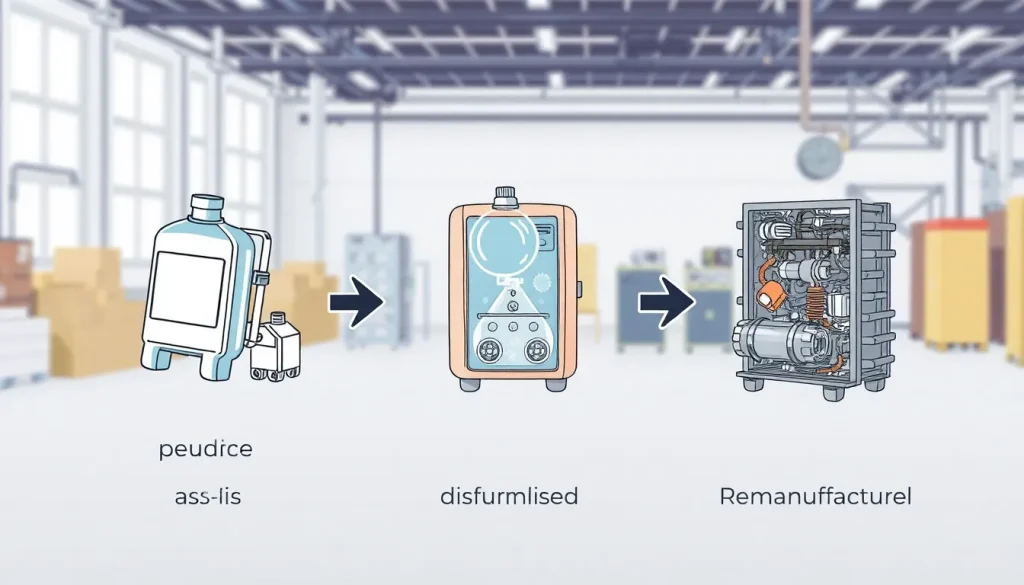
- Reuse involves using a product again without significant alteration; refurbishment restores a used product to a functional state with some repairs; remanufacturing returns a product to a like-new condition through a comprehensive industrial process.
- These strategies are ranked in the waste hierarchy above recycling and disposal, offering greater environmental benefits by preserving the energy and materials embedded in products.
- Remanufacturing, in particular, can deliver products that meet original specifications and come with warranties comparable to new items, making it a viable option for both consumers and industries.
What Is Reuse vs Refurbishment vs Remanufacturing?
Reuse, refurbishment, and remanufacturing are three distinct approaches to extending the useful life of products, each involving a different level of intervention and restoration. Reuse refers to the act of using a product again for its original purpose without significant processing or alteration. Refurbishment involves restoring a used product to a functional state, often including cosmetic repairs, cleaning, and replacement of minor components. Remanufacturing is a more comprehensive industrial process that returns a used product to a like-new condition, with performance and warranty equivalent to that of a new product.
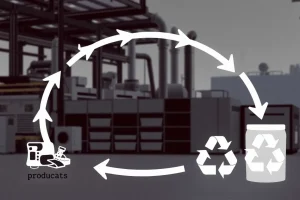
These strategies are central to the concept of a circular economy, where the aim is to keep products and materials in use for as long as possible, thereby reducing waste and the consumption of virgin resources. They are positioned above recycling in the waste hierarchy because they preserve the form and function of the product, avoiding the energy-intensive processes of breaking down and reprocessing materials. Understanding the differences between these approaches is essential for businesses, policymakers, and consumers seeking to make more sustainable choices.
Overview
Reuse, refurbishment, and remanufacturing are often confused, but they represent distinct levels of product recovery. Reuse is the simplest form: a product is used again for the same purpose, either by the original owner or after changing hands, with minimal or no processing. Examples include refilling a glass bottle, donating clothing, or reselling a used book. The product may be cleaned or inspected, but its form and function remain unchanged. Reuse is the most direct way to extend a product’s life and is widely practiced in both formal and informal economies.

Refurbishment goes a step further by restoring a used product to a satisfactory working condition. This typically involves disassembly, cleaning, repair, and replacement of worn or defective parts, followed by testing. Refurbished products are often sold at a discount and may not meet the exact specifications of a new item, but they are fully functional. Common refurbished goods include smartphones, laptops, and medical equipment. The process can be performed by the original manufacturer, authorized service providers, or third-party refurbishers, and it often includes cosmetic improvements to enhance resale value.
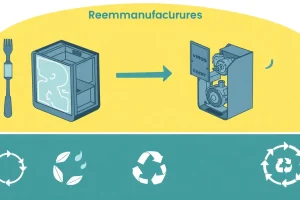
Remanufacturing is the most extensive process. It involves completely disassembling a used product, inspecting and cleaning all components, replacing or repairing worn parts to original specifications, and reassembling the product to a like-new condition. The remanufactured product is then tested to meet the same performance standards as a new product and is typically sold with a warranty. This process is common in the automotive, aerospace, and heavy machinery industries, where high-value components such as engines, transmissions, and hydraulic systems are remanufactured. Remanufacturing requires a reverse supply chain to collect used cores and sophisticated quality control to ensure reliability.
How It Works
Each of these strategies follows a distinct operational process. Reuse is the most straightforward: a product is collected, possibly cleaned or inspected, and then redistributed or resold. For example, reusable packaging systems involve returning empty containers to a central facility for washing and refilling. The key is that the product’s original form and function are maintained without significant intervention. Reuse systems often rely on deposit-return schemes or shared ownership models to ensure products are returned and recirculated.
Refurbishment typically involves several steps: inspection and testing to identify faults, disassembly to access components, cleaning, repair or replacement of defective parts, reassembly, and final testing. The goal is to restore the product to a fully functional state, though cosmetic imperfections may remain. Refurbishment is often carried out by the original manufacturer, third-party service providers, or specialized refurbishment companies. The process may also include software updates and data wiping for electronic devices. Quality standards for refurbishment vary widely, and there is no universal certification, so buyers should verify the refurbisher’s reputation and warranty terms.
Remanufacturing is a more rigorous, standardized industrial process. It begins with the complete disassembly of the product, known as the core. Each component is thoroughly cleaned, inspected, and tested. Worn or obsolete parts are replaced with new or reconditioned ones that meet original equipment manufacturer (OEM) specifications. The product is then reassembled and tested to ensure it performs as new. Remanufactured products are often indistinguishable from new ones and come with a warranty. The process requires sophisticated reverse logistics and quality control systems. In many industries, remanufacturing is governed by standards such as ISO 9001 to ensure consistent quality.
Importance and Impact
These strategies play a critical role in reducing environmental impact and promoting resource efficiency. By extending the life of products, they decrease the demand for raw materials, energy, and water required to manufacture new goods. This, in turn, reduces greenhouse gas emissions, pollution, and waste generation. Reuse, refurbishment, and remanufacturing are key components of a circular economy, which aims to decouple economic growth from resource consumption. They help close material loops and reduce the pressure on landfills and incinerators.
Economically, these activities can create local jobs in repair, refurbishment, and remanufacturing sectors, which are often more labor-intensive than automated manufacturing. They also provide consumers and businesses with lower-cost alternatives to new products, increasing affordability and access. For manufacturers, remanufacturing can be a profitable business model, as it recovers the value of used products and components while building customer loyalty through service offerings. In some sectors, remanufacturing has become a significant part of the economy, supporting skilled labor and engineering expertise.
From a policy perspective, many governments encourage these practices through extended producer responsibility (EPR) schemes, tax incentives, and public procurement policies that favor remanufactured or refurbished goods. International standards and certification programs help build trust in remanufactured products, facilitating trade and market growth.
Benefits, Limitations and Trade-offs
Benefits: All three strategies conserve resources and reduce waste. Reuse requires minimal energy and processing, making it the most environmentally friendly option. Refurbishment extends product life at a lower cost than new production, while remanufacturing can deliver like-new quality with significant energy savings—often 50–85% less energy than manufacturing from virgin materials. They also support local economies and can create skilled jobs. For consumers, these options provide access to functional products at reduced prices, and for businesses, they can open new revenue streams and enhance brand reputation for sustainability.
Limitations: Reuse is limited to products that are durable and safe for repeated use; single-use items or those with hygiene concerns may not be suitable. Refurbishment may result in products with shorter remaining lifespans or cosmetic flaws, which can affect consumer perception. Remanufacturing requires a steady supply of used cores, sophisticated reverse logistics, and significant upfront investment in facilities and quality control. Not all products are designed for remanufacturing, and some components may be too worn to restore. Additionally, the market for remanufactured goods can be hindered by a lack of consumer awareness or trust.
Trade-offs: There is often a trade-off between the depth of restoration and the cost. Reuse is cheapest but offers no performance upgrade. Refurbishment balances cost and functionality. Remanufacturing provides the highest quality but at a higher cost, though still typically less than new. Additionally, the environmental benefits depend on the efficiency of the processes and the energy mix used; if refurbishment or remanufacturing relies on fossil fuels, the net benefit may be reduced. Design decisions made during product development—such as ease of disassembly and component durability—greatly influence the feasibility and cost-effectiveness of these strategies.
Common Misconceptions
FAQ
What is the difference between reuse, refurbishment, and remanufacturing?
Reuse means using a product again without significant changes. Refurbishment restores a used product to working order, often with cosmetic fixes. Remanufacturing is an industrial process that returns a product to like-new condition with a warranty.
How does remanufacturing work?
Remanufacturing involves completely disassembling a used product, cleaning and inspecting all parts, replacing worn components to meet original specifications, reassembling, and testing to ensure it performs as new.
Why do these strategies matter for sustainability?
They extend product life, reducing the need for raw materials, energy, and waste disposal. This lowers environmental impact and supports a circular economy by keeping products in use longer.
References
- Ellen MacArthur Foundation, 'Circular Economy Introduction'
- ISO 9001:2015 Quality management systems — Requirements
- United Nations Environment Programme, 'Waste Management Hierarchy'