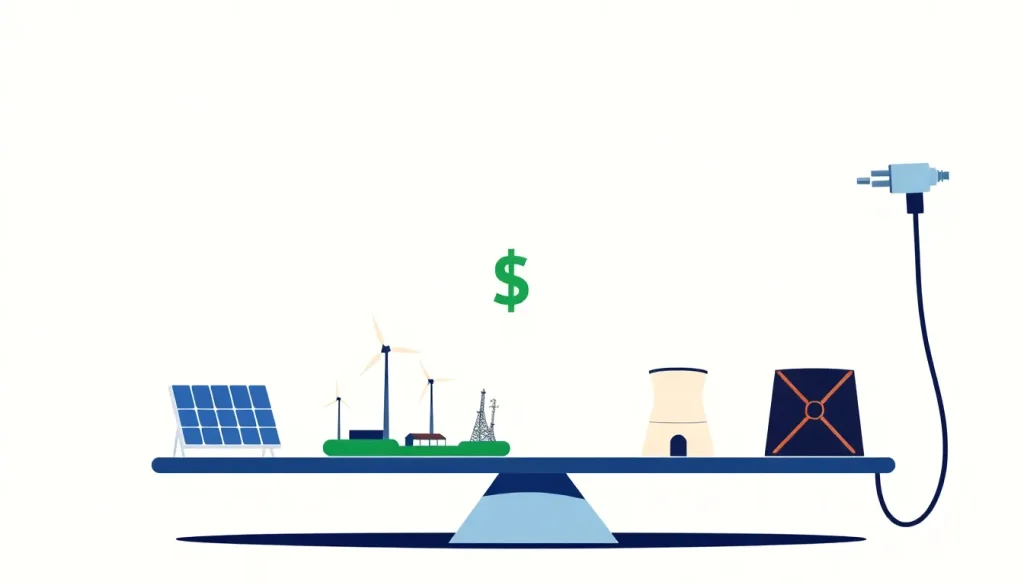
In brief
At a glance
Quick Facts
- Full Name
- Levelized Cost of Energy (LCOE)
- Definition
- The average net present cost of electricity generation over a plant's lifetime, per unit of energy produced.
- Typical Unit
- Currency per megawatt-hour ($/MWh) or per kilowatt-hour (¢/kWh).
- Key Inputs
- Capital costs, fuel costs, operations and maintenance, capacity factor, discount rate, and plant lifetime.
- Primary Use
- Comparing the economic competitiveness of different electricity generation technologies.
- Does Not Include
- Grid integration costs, environmental externalities, transmission, or the time-varying value of electricity.
- Influential Factor
- The discount rate significantly affects LCOE, especially for capital-intensive technologies.
- Trend
- LCOE of solar PV and onshore wind has declined substantially, often making them the cheapest new generation sources.
Key Takeaways
- Levelized Cost of Energy (LCOE) is the average net present cost of electricity generation over the lifetime of a power plant, expressed per unit of energy produced.
- LCOE allows for a consistent comparison of different generation technologies by accounting for capital costs, fuel costs, operations and maintenance, and financing.
- While LCOE is a valuable screening tool, it does not capture system-level costs such as grid integration, intermittency, or environmental externalities.
- LCOE values vary significantly by technology, location, and over time, with renewable sources like wind and solar often showing declining LCOE trends due to technological improvements and economies of scale.
What Is Levelized Cost of Energy Explained?
Levelized Cost of Energy (LCOE) is an economic metric used to assess and compare the lifetime cost of generating electricity from different power plants. It represents the per-unit cost (typically expressed in currency per megawatt-hour, such as $/MWh) of building and operating a generating plant over an assumed financial life and duty cycle. In essence, LCOE is the minimum price at which electricity must be sold for the project to break even, considering the time value of money.
LCOE is a fundamental tool in energy economics and policy. It provides a standardized way to compare the cost-competitiveness of diverse generation technologies—such as coal, natural gas, nuclear, wind, solar, and hydropower—on a level playing field. By incorporating all major cost components (capital investment, fuel, operations and maintenance, and financing) and discounting them to a common base year, LCOE enables analysts, investors, and regulators to evaluate which technologies can deliver electricity at the lowest cost over the long term. However, it is important to recognize that LCOE is a simplified metric and does not capture all factors relevant to energy system planning, such as dispatchability, grid integration costs, or environmental impacts.
How It Works
The calculation of LCOE is based on the principle of net present value (NPV). It equates the sum of discounted lifetime costs (including initial investment, fuel, operations and maintenance, and decommissioning) with the sum of discounted lifetime energy output. The formula is:
LCOE = (Sum of Discounted Costs over Lifetime) / (Sum of Discounted Electricity Generated over Lifetime)
More precisely, the costs and energy outputs for each year t are discounted back to the present using a discount rate r. The general formula is:
LCOE = [ Σ (I_t + M_t + F_t) / (1 + r)^t ] / [ Σ (E_t / (1 + r)^t ) ]
where I_t is investment expenditures in year t, M_t is operations and maintenance expenditures, F_t is fuel expenditures, E_t is electricity generation, and r is the discount rate. The discount rate reflects the opportunity cost of capital and can significantly influence the LCOE. A higher discount rate increases the present value of near-term costs relative to future costs, which tends to favor technologies with low upfront capital but higher operating costs (such as natural gas plants) over capital-intensive technologies with low operating costs (such as wind or nuclear).
Key inputs to the LCOE calculation include the overnight capital cost, capacity factor, fuel costs, fixed and variable O&M costs, plant lifetime, and the discount rate. Because these parameters can vary widely by location, technology maturity, and market conditions, LCOE estimates are often presented as ranges or scenarios rather than single values.
Why It Matters
LCOE is a critical metric for energy planning and investment decisions. It provides a transparent, technology-neutral basis for comparing the economic attractiveness of different generation options. Utilities and independent power producers use LCOE to decide which types of plants to build or retire. Policymakers rely on LCOE to design support mechanisms, such as feed-in tariffs or auctions, and to evaluate the cost-effectiveness of renewable energy mandates. Financial institutions use LCOE to assess the viability of project financing.
Moreover, LCOE has played a central role in the global energy transition. As the LCOE of renewable technologies—particularly solar photovoltaics and onshore wind—has declined dramatically, these sources have become cost-competitive with, and often cheaper than, fossil fuel-based generation in many regions. This shift has reshaped energy markets and accelerated the deployment of clean energy. However, LCOE alone does not determine the value of electricity to the grid; other metrics, such as the levelized avoided cost of electricity (LACE), are increasingly used alongside LCOE to provide a more complete picture.
Benefits, Limitations and Trade-offs
The primary benefit of LCOE is its simplicity and comparability. It condenses complex financial and technical data into a single number, making it easy to rank technologies. It is transparent, widely understood, and can be calculated using publicly available data. LCOE also facilitates sensitivity analysis, allowing analysts to test how changes in key assumptions (such as fuel prices or discount rates) affect cost rankings.
However, LCOE has significant limitations. It does not account for the variability or dispatchability of generation sources; a solar plant with a low LCOE may still require backup or storage to ensure reliability, adding system-level costs not captured in the plant-level LCOE. It also ignores transmission and distribution costs, environmental externalities (such as carbon emissions or air pollution), and the value of electricity at different times of day. Furthermore, LCOE comparisons assume that all technologies provide the same quality of power, which is not the case. As a result, LCOE is best used as a screening tool rather than a definitive measure of overall cost-effectiveness.
Common Misconceptions
One common misconception is that LCOE represents the actual price at which electricity is sold. In reality, LCOE is a break-even cost; market prices may be higher or lower depending on supply, demand, and market structure. Another misunderstanding is that the technology with the lowest LCOE is always the best choice for a grid. Because LCOE does not capture the value of electricity at different times or the costs of integrating variable sources, a system optimized solely on LCOE could be unreliable or more expensive overall.
Additionally, some assume that LCOE is a fixed, objective number. In practice, LCOE estimates are highly sensitive to assumptions about discount rates, fuel price forecasts, capacity factors, and plant lifetimes. Different analysts may produce different LCOE values for the same technology based on their input assumptions. Finally, LCOE is sometimes misinterpreted as the total cost of delivered electricity, but it excludes transmission, distribution, and end-use costs.
Examples
To illustrate how LCOE works, consider a simplified comparison between a natural gas combined-cycle plant and an onshore wind farm. The gas plant has a relatively low upfront capital cost but significant ongoing fuel costs and moderate O&M costs. The wind farm has a high upfront capital cost but zero fuel costs and lower O&M costs. Using a discount rate of 7%, the LCOE for the gas plant might be calculated at $50/MWh, while the wind farm might come in at $40/MWh, making wind the more cost-effective option on a levelized basis. However, if the discount rate is increased to 10%, the higher upfront cost of wind is penalized more heavily, and the LCOE of wind could rise above that of gas, altering the ranking.
Another example is the dramatic decline in solar PV LCOE. In many sunny regions, utility-scale solar PV has achieved an LCOE below $30/MWh, making it one of the cheapest sources of new electricity generation. This has been driven by falling module prices, improved efficiency, and lower installation costs. In contrast, new coal plants often have LCOEs above $60/MWh, and even existing coal plants can struggle to compete with new renewables on a levelized cost basis when fuel and maintenance costs are considered.
What the Evidence Shows
Numerous studies by organizations such as the International Energy Agency (IEA), the U.S. Energy Information Administration (EIA), and Lazard have tracked LCOE trends over time. The evidence consistently shows that the LCOE of renewable energy technologies, particularly solar PV and onshore wind, has fallen sharply, while the LCOE of fossil fuel technologies has remained relatively stable or increased in some cases due to fuel price volatility and environmental regulations. For example, the global weighted-average LCOE of utility-scale solar PV declined by around 85% between 2010 and 2020, according to the International Renewable Energy Agency (IRENA).
However, the evidence also highlights the importance of regional context. LCOE values for the same technology can vary by a factor of two or more depending on local solar irradiance, wind speeds, labor costs, and financing conditions. In regions with abundant renewable resources and favorable policy environments, renewables are often the least-cost option. In other areas, natural gas or even coal may still have a lower LCOE, especially when considering existing infrastructure. The data also underscore that LCOE is not static; technological learning, supply chain developments, and policy changes continue to reshape the cost landscape.
FAQ
What is Levelized Cost of Energy (LCOE)?
LCOE is the average net present cost of generating electricity over the lifetime of a power plant, expressed per unit of energy produced. It allows for a consistent comparison of different generation technologies.
How is LCOE calculated?
LCOE is calculated by dividing the sum of all discounted costs (capital, fuel, operations and maintenance) over the plant's lifetime by the sum of discounted energy output. The formula uses a discount rate to account for the time value of money.
Why does LCOE matter?
LCOE matters because it provides a standardized metric for comparing the economic competitiveness of energy sources. It informs investment decisions, policy design, and energy planning, and has been instrumental in tracking the declining costs of renewable energy.
References
- U.S. Energy Information Administration (EIA), Levelized Cost of New Generation Resources, Annual Energy Outlook.
- International Energy Agency (IEA), Projected Costs of Generating Electricity.
- Lazard, Levelized Cost of Energy Analysis.
- International Renewable Energy Agency (IRENA), Renewable Power Generation Costs.