In brief
At a glance
Quick Facts
- Verdict
- Mixed
- Problem addressed
- Aviation's non-CO2 climate impacts, including contrails and NOx
- Evidence strength
- Moderate
- Potential scale
- Global
- Relative cost
- Moderate
- Time to impact
- Years
Quick verdict
Mitigating aviation’s non-CO2 climate impacts is a promising but still-emerging field. Operational measures like contrail avoidance could deliver rapid, low-cost reductions in short-term warming, but their real-world effectiveness and scalability are not yet proven. Technological solutions such as sustainable aviation fuels and hydrogen propulsion offer longer-term potential but face significant economic and infrastructure barriers. A comprehensive strategy must integrate non-CO2 mitigation with continued efforts to reduce CO2 emissions, while acknowledging the high scientific uncertainty surrounding non-CO2 effects.
Problem addressed
Aviation contributes to climate change not only through carbon dioxide (CO2) but also through a range of non-CO2 emissions and atmospheric effects. These include nitrogen oxides (NOx), water vapor, soot (black carbon), sulfate aerosols, and the formation of persistent contrails and contrail-induced cirrus clouds. While CO2 has a long atmospheric lifetime and accumulates over time, many non-CO2 effects are short-lived but exert a strong warming influence. According to scientific assessments, the total effective radiative forcing (ERF) from aviation is approximately 1.5 to 2 times that of CO2 alone, with contrail cirrus and NOx-induced ozone changes being the largest non-CO2 contributors. However, these estimates carry high uncertainty. The problem is that current climate policies and mitigation efforts focus almost exclusively on CO2, leaving a substantial portion of aviation’s climate impact unaddressed. Without targeted action, the growth in air traffic could amplify these non-CO2 effects, undermining progress toward climate goals.
How the solution works
Mitigation strategies for non-CO2 aviation emissions fall into three broad categories: operational changes, technological improvements, and fuel switching.

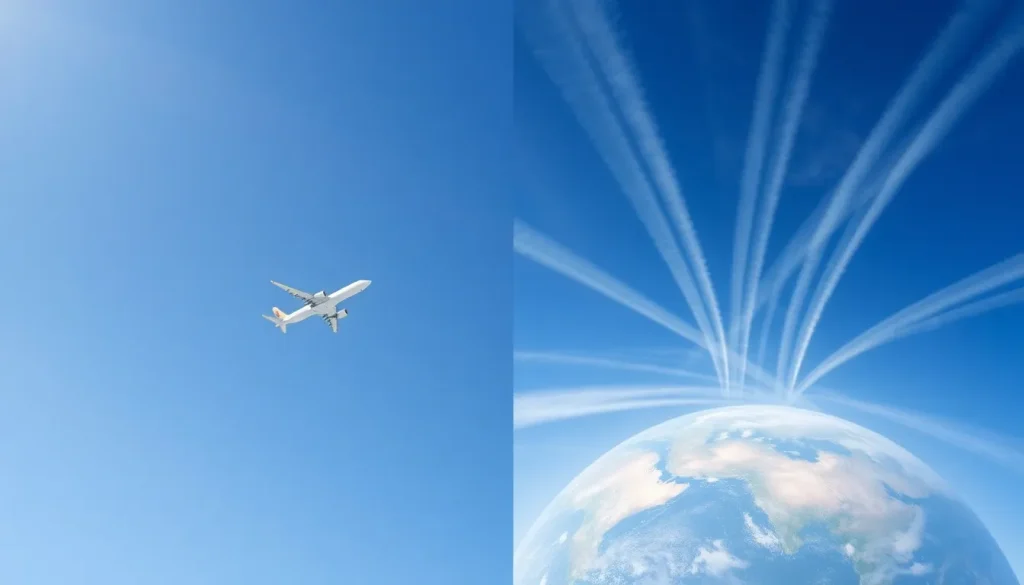
- Contrail avoidance: Persistent contrails form when aircraft fly through ice-supersaturated regions of the atmosphere. By adjusting flight paths—typically small changes in altitude—pilots can avoid these regions, preventing contrail formation. This requires accurate humidity forecasting and real-time decision support tools. Since only a small fraction of flights create the majority of warming contrails, targeted rerouting could significantly reduce contrail radiative forcing with minimal additional fuel burn.
- Fuel composition changes: Reducing the aromatic content and sulfur impurities in jet fuel lowers soot emissions, which serve as nuclei for ice crystal formation in contrails. Sustainable aviation fuels (SAF) produced from biomass or synthetic processes generally have lower aromatic content and can reduce soot particle emissions by 50–70% compared to conventional Jet A-1. Hydrogen combustion eliminates CO2 and soot entirely but produces more water vapor, which could enhance contrail formation under certain conditions.
- Engine and airframe technology: Lean-burn combustors and advanced engine designs can reduce NOx emissions. However, NOx has a complex climate impact: it leads to short-term ozone formation (warming) but also longer-term methane destruction (cooling). The net effect is uncertain and varies with altitude and background atmospheric chemistry. Improvements in overall fuel efficiency reduce all emissions proportionally.
Evidence strength
The evidence for the climate impact of non-CO2 aviation emissions is robust in terms of physical understanding, but the quantification of individual effects and the efficacy of mitigation measures remain uncertain. The IPCC Special Report on Aviation (1999) and subsequent assessments (Lee et al., 2021) provide a scientific consensus on the mechanisms, but the error bars are large. For example, the ERF from contrail cirrus is estimated at 57.4 mW/m² (range 17–98 mW/m²), making it the largest non-CO2 forcing but with a factor-of-five uncertainty. Evidence for contrail avoidance comes primarily from modeling studies and a limited number of field trials. The DLR/NASA ecoDemonstrator flights in 2021 demonstrated that contrail avoidance is technically feasible using forecast-based rerouting, but the climate benefit was not directly measured. The impact of SAF on contrails is supported by both ground tests and a few in-flight measurements, but the long-term net effect depends on scaling SAF production and the specific fuel pathways. Overall, the evidence base is moderate: the problem is well-defined, but solution effectiveness is largely based on models and small-scale experiments rather than large-scale, real-world validation.
Potential scale
The potential scale of non-CO2 mitigation is global, as aviation operations span the planet. Contrail avoidance could theoretically reduce aviation’s total effective radiative forcing by 20–50% if implemented on a large scale, with some studies suggesting even higher potential. However, the actual achievable reduction depends on the accuracy of humidity forecasts, air traffic management capacity, and the willingness to accept small increases in fuel burn (and CO2) for rerouting. SAF adoption could reduce soot emissions and contrail properties across the entire fleet if blended at high percentages, but current SAF production is less than 1% of total jet fuel demand. Scaling SAF to meaningful levels (e.g., 50% by 2050) faces feedstock, cost, and certification barriers. Hydrogen propulsion is limited to new aircraft designs and would require decades to penetrate the fleet. Thus, while the theoretical global potential is large, practical scalability is constrained by technological, economic, and infrastructural factors.
Cost considerations
Costs vary widely by solution. Contrail avoidance is considered the most cost-effective near-term option, with estimated costs of €1–5 per tonne of CO2-equivalent avoided, primarily due to slight increases in fuel consumption from rerouting. However, these estimates are based on models and may not account for full operational complexities. SAF blends that reduce soot are currently 2–5 times more expensive than conventional jet fuel, and dedicated contrail-reducing fuel formulations would add further cost. Hydrogen aircraft would require entirely new infrastructure and aircraft, with lifecycle costs uncertain but likely higher than conventional aircraft for decades. NOx reduction technologies add engine complexity and cost. Overall, non-CO2 mitigation is generally more expensive per tonne of CO2-equivalent than many ground-based mitigation options but could be justified by the urgency of reducing short-term warming. Cost-effectiveness comparisons are complicated by the different metrics used (e.g., GWP vs. GTP) and the short-lived nature of the effects.
Implementation time
Contrail avoidance could be implemented within a few years, as it relies on existing aircraft and air traffic management systems, provided that accurate humidity forecasting and decision-support tools are developed and integrated. Pilot trials are already underway, and operational procedures could be refined incrementally. SAF adoption is a longer-term endeavor: even with aggressive policy support, it will take decades to build production capacity and achieve significant fleet-wide blending. Hydrogen-powered aircraft are not expected to enter commercial service before the mid-2030s at the earliest, and fleet turnover will take several more decades. NOx reduction technologies are being introduced gradually with new engine models. Thus, the time to impact ranges from immediate (for operational measures) to decades (for technological shifts).
Environmental benefits
The primary environmental benefit is a reduction in short-term global warming. Because non-CO2 effects, especially contrails, have a strong warming impact but short atmospheric lifetimes (hours to days), mitigating them yields a rapid climate response. This is in contrast to CO2 reductions, which take decades to manifest due to the long lifetime of CO2. Quantitatively, avoiding a single warming contrail can offset the warming from several tonnes of CO2 over a 20-year time horizon. Reducing soot also improves local air quality around airports, though this benefit is minor compared to climate effects. SAF use can reduce lifecycle CO2 emissions in addition to non-CO2 benefits, providing a dual dividend. However, the environmental benefit is uncertain and depends on accurate quantification of avoided forcing.
Social and economic co-benefits
Non-CO2 mitigation could help the aviation industry maintain its social license to operate by demonstrating proactive climate responsibility. Contrail avoidance may have minimal direct economic co-benefits, but it could spur innovation in weather forecasting and air traffic management, with potential spillover benefits for flight efficiency and safety. SAF production can create jobs in rural areas and contribute to energy security, though these benefits are shared with general SAF deployment. Reduced soot emissions improve air quality, which has public health benefits for communities near airports. However, these co-benefits are relatively small compared to the primary climate motivation.
Risks and unintended consequences
The main risk is that focusing on non-CO2 mitigation could distract from the urgent need to reduce CO2 emissions, which accumulate and have a long-term impact. There is also a risk of over-reliance on uncertain science: if contrail avoidance is less effective than models predict, resources may be wasted. Operational rerouting could increase fuel burn and CO2 emissions, creating a trade-off that must be carefully managed. In some cases, avoiding a contrail might inadvertently create a cooling contrail (which has a net negative forcing), though this is less common. For SAF, the land-use change and sustainability concerns associated with biofuels apply, potentially causing indirect emissions or biodiversity loss. Hydrogen propulsion’s water vapor emissions could enhance contrail formation, potentially offsetting some benefits. Finally, policy measures like mandatory contrail avoidance could face industry resistance and require complex international coordination.
Where it works best
Contrail avoidance is most effective in regions with frequent ice-supersaturated conditions, such as the North Atlantic flight corridor, northern Europe, and parts of North America during winter. These regions have high air traffic density and meteorological conditions conducive to persistent contrails. SAF soot reduction works universally, as it depends on fuel properties, not geography. NOx reduction is more beneficial at cruise altitudes where ozone formation dominates, but the net effect is latitude-dependent. Operational measures are best suited for airlines with modern fleets and access to sophisticated flight planning tools. In general, the solution works best when integrated into a comprehensive environmental management system that balances CO2 and non-CO2 objectives.
Where it may not work
Contrail avoidance may be impractical in regions with dense air traffic and limited airspace capacity, such as busy terminal areas, where altitude flexibility is constrained. In tropical regions, persistent contrails are less frequent, so the benefit is smaller. SAF soot reduction is limited if the fuel is used in older engine types that do not benefit as much from reduced aromatics. Hydrogen aircraft will initially be limited to short- and medium-haul routes due to storage volume constraints, leaving long-haul emissions unaddressed. In general, the solution is a poor fit for operators with older aircraft, limited capital, or those operating in regions without the necessary meteorological infrastructure.
Comparison with alternatives
Alternatives to non-CO2 mitigation include focusing solely on CO2 reduction through efficiency, SAF, and carbon offsets, or using atmospheric carbon dioxide removal (CDR) to compensate for all aviation forcing. Compared to CO2-only strategies, non-CO2 mitigation addresses a larger fraction of near-term warming but with higher uncertainty. Carbon offsets (e.g., reforestation) do not address non-CO2 effects at all. CDR is expensive and not yet scalable. Another alternative is demand reduction (e.g., fewer flights), which reduces all emissions simultaneously but faces strong socioeconomic barriers. Non-CO2 mitigation is complementary to these approaches, not a substitute. It is most valuable as part of a portfolio that includes aggressive CO2 reductions, because even if non-CO2 measures are imperfect, they can buy time for CO2 reductions to take effect.
Case studies
DLR/NASA ecoDemonstrator (2021): A Boeing 737-800 conducted test flights over Europe to evaluate contrail avoidance using humidity forecasts. The aircraft successfully avoided ice-supersaturated regions, preventing contrail formation. The trial demonstrated technical feasibility, but the climate benefit was not quantified in real time. Follow-on studies are analyzing the net forcing change.
COVID-19 pandemic (2020): The drastic reduction in air traffic led to a measurable decrease in contrail coverage, providing a natural experiment. Studies found that the reduction in contrail radiative forcing was significant, confirming the link between aviation activity and short-term warming. However, the simultaneous drop in CO2 emissions complicates attribution.
SAF contrail studies (various): In-flight measurements behind an A320 burning a 50% blend of HEFA-SAF showed a 50–70% reduction in soot particle number emissions compared to conventional fuel. This translated to smaller ice crystal sizes in contrails, potentially reducing their warming effect. However, the long-term climate impact of such changes is still being modeled.
Final assessment
Mitigating aviation’s non-CO2 climate impacts is a scientifically sound and potentially high-impact strategy, but it remains in an early stage of development. Contrail avoidance stands out as a low-cost, rapidly deployable measure that could significantly reduce short-term warming, provided that forecasting accuracy and operational integration improve. Sustainable aviation fuels offer a dual benefit for CO2 and non-CO2 but are constrained by cost and scalability. The high uncertainty in quantifying non-CO2 effects and the risk of unintended consequences mean that a precautionary, adaptive approach is warranted. Policymakers should support research and pilot programs while ensuring that non-CO2 mitigation does not detract from the imperative to cut CO2 emissions. For airlines and governments, the most prudent path is to invest in contrail avoidance trials, incentivize SAF with low aromatic content, and integrate non-CO2 metrics into climate accounting frameworks. The solution is most worth pursuing in regions with high contrail frequency and for operators with the technical capability to implement it, as part of a broader climate strategy.
FAQ
What are the main non-CO2 emissions from aviation?
The main non-CO2 climate effects from aviation are persistent contrails and contrail-induced cirrus clouds, nitrogen oxides (NOx) which alter ozone and methane, water vapor, soot (black carbon), and sulfate aerosols. Contrails and NOx are the largest contributors to aviation's non-CO2 radiative forcing.
How effective is contrail avoidance?
Modeling studies suggest that contrail avoidance could reduce aviation's total effective radiative forcing by 20–50%, but real-world effectiveness is not yet proven. It requires accurate humidity forecasting and may involve small increases in fuel burn. Field trials have demonstrated technical feasibility, but the net climate benefit is still being evaluated.
Can sustainable aviation fuels reduce non-CO2 effects?
Yes, sustainable aviation fuels (SAF) with low aromatic content can reduce soot particle emissions by 50–70%, which in turn reduces the number of ice crystals in contrails and may lessen their warming effect. However, the overall climate benefit depends on the fuel's lifecycle and the scale of adoption, which is currently very limited.
References
- Lee, D. S., et al. (2021). The contribution of global aviation to anthropogenic climate forcing for 2000 to 2018. Atmospheric Environment, 244, 117834.
- IPCC (1999). Aviation and the Global Atmosphere. Cambridge University Press.
- Teoh, R., et al. (2020). Mitigating the climate forcing of aircraft contrails by small-scale diversions and technology adoption. Environmental Science & Technology, 54(5), 2941–2950.
- DLR (2021). ecoDemonstrator: Contrail avoidance flights. German Aerospace Center.
- Bock, L., & Burkhardt, U. (2019). Contrail cirrus radiative forcing for future air traffic. Atmospheric Chemistry and Physics, 19(12), 8163–8174.