In brief
At a glance
Quick Facts
- Verdict
- Mixed
- Problem addressed
- Carbon emissions and congestion from short-haul air travel
- Evidence strength
- Moderate
- Potential scale
- Regional
- Relative cost
- High
- Time to impact
- Decades
Quick verdict
High-speed rail (HSR) is a proven, lower-carbon alternative to air travel for intercity corridors of roughly 200–800 km, where it can match or beat door-to-door travel times while emitting a fraction of the greenhouse gases per passenger. However, its viability depends heavily on population density, existing infrastructure, and the carbon intensity of the electricity grid. HSR requires massive upfront investment and decades to plan and build, making it a long-term, high-cost solution that is not universally applicable. In the right contexts, it can significantly reduce aviation’s environmental footprint and enhance regional connectivity, but it is not a one-to-one replacement for all air travel.
Problem addressed
Aviation is one of the fastest-growing sources of greenhouse gas emissions, and short-haul flights (typically under 1,000 km) are disproportionately polluting per passenger-kilometer due to the high fuel consumption during take-off and landing. Air travel also generates noise, local air pollution, and contrails that contribute to climate forcing. While technological improvements and sustainable aviation fuels are being developed, their scalability and timeline remain uncertain. High-speed rail is proposed as a way to shift passengers from short-haul flights to a more energy-efficient, electrified mode, thereby reducing the environmental impact of intercity travel. Additionally, HSR can alleviate airport congestion and provide more reliable city-center-to-city-center connections.
How the solution works
High-speed rail operates on dedicated tracks designed for speeds typically between 250 and 350 km/h, using electric traction. By connecting city centers directly, HSR eliminates the need for lengthy airport transfers and check-in procedures, making total journey times competitive with flying for distances up to about 800 km. The trains are powered by electricity, which can be generated from low-carbon sources, and they benefit from economies of scale: a single train can carry hundreds of passengers, resulting in lower energy use per seat-kilometer compared to aircraft. Regenerative braking and aerodynamic design further improve efficiency. The infrastructure includes purpose-built lines, advanced signalling, and often tunnels and viaducts to maintain high speeds and avoid grade crossings.
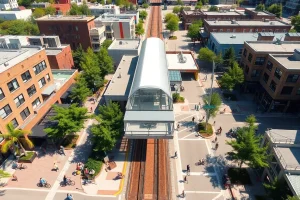
HSR trains are typically powered by overhead catenary wires, drawing electricity from the grid. Modern trainsets, such as the Japanese Shinkansen or French TGV, use distributed traction and lightweight materials to achieve high speeds with low energy consumption. Advanced signalling systems like ETCS (European Train Control System) allow for safe operation at high frequencies. The dedicated tracks are built to precise standards, with gentle curves and gradients, and often include extensive tunnelling in mountainous areas. Stations are usually located in city centers, integrating with local transit, which is a key advantage over airports that are often on the periphery.
Evidence strength
The evidence for HSR’s ability to shift passengers from air to rail is strong, based on decades of operational data from countries like Japan, France, Spain, and China. Studies consistently show that where HSR is introduced on routes under about 800 km, air travel demand declines significantly—often by 50% or more—and some short-haul air routes are discontinued entirely. For example, after the introduction of the TGV in France, domestic air traffic on the Paris–Lyon route dropped sharply. However, the net environmental benefit is more contested: life-cycle assessments must account for the substantial emissions from constructing HSR infrastructure (concrete, steel, tunnelling), which can take years of operation to offset. The evidence on induced demand is mixed; some studies suggest that HSR generates new trips, partially eroding the per-passenger emission savings. A 2020 meta-analysis of 30 studies found that HSR reduces air travel demand by an average of 5–10% per year on affected routes, with larger effects over time. However, the net CO₂ reduction is less clear: one study estimated that the Paris–Lyon TGV line took 12 years to offset its construction emissions, while another suggested that China’s HSR expansion may have increased overall transport emissions due to induced demand and coal-powered electricity. The variability underscores the importance of context. Overall, the evidence base is moderate to strong for modal shift, but weaker for net climate benefit, which depends on local factors.
Potential scale
HSR has the potential to serve dense intercity corridors regionally or continentally. In Europe and East Asia, networks already span thousands of kilometers, carrying hundreds of millions of passengers annually. The International Energy Agency estimates that global HSR activity could triple by 2050 under a sustainable development scenario. However, scaling is limited by geography: HSR requires high population density and relatively flat terrain to be cost-effective. It is not suitable for low-density regions, extremely long distances (over 1,500 km), or routes with major natural barriers like oceans. Thus, its maximum potential is regional rather than global, and it will likely complement rather than replace long-haul aviation.
Cost considerations
HSR is among the most expensive transport infrastructure to build, with costs ranging from roughly $20 million to over $100 million per kilometer, depending on terrain, land acquisition, and labour costs. Operating costs are lower per passenger-kilometer than air travel once built, but the high upfront investment requires strong government support and often decades to recoup. Ticket prices can be competitive with airfares, but may require subsidies or high ridership to cover costs. In contrast, air travel infrastructure (airports, air traffic control) is also expensive but largely already built, and aircraft have lower per-unit capital costs. The cost-effectiveness of HSR is highly sensitive to ridership forecasts, which have sometimes been overestimated, leading to financial underperformance.
Operating costs for HSR include energy, maintenance, and labour. Energy costs are lower than jet fuel per seat-kilometer, but maintenance of dedicated infrastructure is expensive. Some HSR lines, like the French TGV, generate operating profits, while others require ongoing subsidies. The economic case often relies on wider economic benefits, such as agglomeration effects, which are difficult to quantify.
Implementation time
Planning, financing, and constructing a new HSR line typically takes 10–20 years or more, depending on the length, regulatory environment, and public acceptance. Even upgrading existing lines for higher speeds can take several years. Once operational, the environmental benefits begin immediately, but the full payback of construction emissions may take a decade or longer of operation. In contrast, new aircraft can be deployed within a few years, and air routes can be established quickly. Thus, HSR is a long-term solution that requires sustained political and financial commitment.
Environmental benefits
When powered by low-carbon electricity, HSR can emit as little as 5–15 g CO₂ per passenger-kilometer, compared to 150–300 g for short-haul flights. Even on a moderately carbon-intensive grid, HSR typically outperforms air travel. It also produces no direct air pollution at the point of use, reduces noise compared to airports (though train noise can be a local issue), and uses less land per unit of transport capacity than highways. However, the construction phase generates significant emissions—one study estimated that building a new HSR line can emit 100–300 tonnes of CO₂ per meter, which must be offset by operational savings. The net climate benefit is positive over the lifecycle, but the magnitude depends on ridership and the speed of grid decarbonization.
Social and economic co-benefits
HSR can enhance regional economic integration by bringing cities closer together, stimulating business travel, tourism, and labour mobility. It can reduce road congestion and traffic accidents by shifting travellers from cars. Stations often become catalysts for urban regeneration. HSR also provides a more comfortable and productive travel experience, with space to work and fewer delays than air travel. For communities, it can improve access to services and opportunities. However, these benefits are not automatic; they require complementary policies and may primarily benefit larger cities at the expense of smaller ones.
Risks and unintended consequences
The most significant risk is cost overruns and ridership shortfalls, which can leave governments with stranded assets and large debts. HSR construction can cause environmental damage, including habitat fragmentation, and may face public opposition due to noise, visual intrusion, and land acquisition. There is also a risk of induced demand: faster connections may encourage more travel, partially offsetting emission savings. Additionally, HSR could draw passengers from conventional rail and bus services, potentially reducing the viability of those lower-cost options. If the electricity grid remains fossil-fuel dependent, the operational emissions advantage shrinks. Finally, focusing on HSR may divert investment from other sustainable transport modes, such as improving urban transit or cycling infrastructure. There is also a risk of ‘white elephant’ projects, where HSR lines are built for political prestige rather than sound transport planning, leading to underutilization and financial losses. The construction phase can disrupt communities and ecosystems, and if not managed well, can lead to corruption and inefficiency.
Where it works best
HSR is most effective in corridors with high population density, strong economic ties, and distances of 200–800 km between major cities. Flat or gently rolling terrain reduces construction costs. A pre-existing culture of rail travel and integrated public transport networks at both ends enhance ridership. Examples include the Tokyo–Osaka corridor in Japan, Paris–Lyon in France, and Beijing–Shanghai in China. In these contexts, HSR can capture a large share of the air-rail market and operate profitably.
Where it may not work
HSR is a poor fit for low-density regions, extremely long distances (over 1,500 km), or routes with severe geographic obstacles such as mountain ranges or seas. It is also less suitable where the electricity grid is heavily coal-dependent, as the emissions advantage over flying narrows. In countries with weak governance or unstable funding, the long implementation time and high costs make HSR projects highly risky. For example, the California HSR project has faced significant delays and cost escalations, partly due to political and legal challenges. In such contexts, improving conventional rail or investing in sustainable aviation may be more practical.
Comparison with alternatives
HSR competes not only with air travel but also with cars, buses, and conventional rail. The table below summarizes key metrics for a typical 500 km journey.
| Metric | High-Speed Rail | Air Travel | Car | Bus |
|---|---|---|---|---|
| Door-to-door time | ~2.5–3 hours | ~3–4 hours (incl. airport transfers) | ~4–5 hours | ~5–6 hours |
| CO₂ per passenger | 5–50 kg (depending on grid) | 100–200 kg | 80–150 kg (solo driver) | 20–50 kg |
| Cost to user | Moderate | Low to moderate (budget airlines) | Moderate to high (fuel, tolls) | Low |
| Infrastructure cost | Very high | High (airports, ATC) | Moderate (roads exist) | Low (uses roads) |
| Reliability | High | Moderate (weather, delays) | Variable | Variable |
Compared to air travel, HSR offers a more sustainable and often more convenient option for medium distances, but it cannot match the speed of air travel over long distances or the flexibility of cars for door-to-door trips. Buses and conventional rail are cheaper but slower. The optimal solution often involves a multimodal system where each mode serves its niche.
Case studies
Japan’s Shinkansen: Launched in 1964, the Tokaido Shinkansen between Tokyo and Osaka (515 km) carries over 150 million passengers annually. It has virtually eliminated air travel on that route and operates with high punctuality and safety. The network has expanded nationwide, demonstrating long-term viability.
France’s TGV: The Paris–Lyon line (1981) reduced travel time to 2 hours, causing a sharp decline in air traffic. The TGV network now connects major French cities and extends to neighbouring countries. It is considered a financial success, with construction costs largely recouped.
China’s HSR network: The world’s largest, built rapidly since 2008, now exceeds 40,000 km. It has dramatically reduced domestic air travel on many routes, though some lines suffer from low ridership and high debt. The network’s environmental benefit is tempered by China’s coal-heavy grid, but as the grid decarbonizes, the advantage grows.
California HSR (USA): A cautionary tale. Planned to connect Los Angeles and San Francisco, the project has faced massive cost overruns, delays, and political opposition. Originally estimated at $33 billion, costs have ballooned to over $100 billion, and the completion date is uncertain. It illustrates the challenges of implementing HSR in a low-density, car-centric, litigious environment.
Final assessment
High-speed rail is a mature, proven technology that can significantly reduce the environmental impact of intercity travel when deployed in suitable corridors. It offers substantial co-benefits in terms of connectivity, economic development, and user experience. However, it is not a universal solution: its high cost, long lead times, and dependence on density and clean electricity mean it must be carefully targeted. For distances of 200–800 km between major cities, HSR can effectively replace short-haul flights and should be a priority in decarbonization strategies. For longer distances or less dense regions, other approaches—such as sustainable aviation fuels, improved aircraft efficiency, or demand management—will be necessary. Policymakers should weigh the full lifecycle costs and benefits, and consider HSR as part of an integrated, multimodal transport system rather than a standalone fix.
FAQ
Is high-speed rail always more environmentally friendly than flying?
Not always. It depends on the electricity source, occupancy, and infrastructure construction emissions. On routes with high ridership and clean electricity, HSR has significantly lower emissions per passenger-km, but on low-ridership routes or those powered by coal, the advantage may be small or even negative.
Why is high-speed rail so expensive to build?
HSR requires dedicated, often elevated or tunnelled tracks, advanced signalling, and new stations. Land acquisition, environmental reviews, and safety standards add to costs. Costs vary widely by country and terrain.
Can high-speed rail replace all air travel?
No. HSR is most competitive for distances of about 200–800 km. For longer distances, air travel remains faster and more practical. HSR also requires high population density and strong city-center connections to attract enough passengers.
References
- International Energy Agency (IEA), 'The Future of Rail', 2019
- European Environment Agency, 'Transport and Environment Reporting Mechanism'
- UIC High-Speed Rail Database
- California High-Speed Rail Authority reports
- Academic literature on life-cycle assessment of transport modes