In brief
At a glance
Quick Facts
- Global food waste share of production
- About one-third of all food produced for human consumption is lost or wasted.
- Contribution to greenhouse gas emissions
- Food waste accounts for approximately 8-10% of total global greenhouse gas emissions.
- Methane potency
- Methane from food waste in landfills has a warming potential over 25 times that of CO2 over 100 years.
- Land area used for wasted food
- Nearly 1.4 billion hectares of land—about 30% of the world's agricultural land—is used to grow food that is never eaten.
- Water footprint
- Wasted food represents about a quarter of all water used in agriculture globally.
- Top climate solution ranking
- Reducing food waste is ranked among the top solutions for mitigating climate change by Project Drawdown.
- Economic cost
- The annual economic cost of food waste is estimated at hundreds of billions of dollars, including environmental externalities.
Key Takeaways
- Approximately one-third of all food produced globally is lost or wasted, representing a massive misuse of land, water, and energy resources.
- When food decomposes in landfills, it generates methane, a greenhouse gas with a warming potential over 25 times that of carbon dioxide over 100 years.
- The land used to grow wasted food covers nearly 1.4 billion hectares, an area larger than China, contributing to deforestation and biodiversity loss.
- Reducing food waste is one of the most effective strategies to combat climate change, potentially lowering global greenhouse gas emissions by up to 8%.
- Food waste occurs at all stages of the supply chain, with consumer waste dominating in high-income countries and post-harvest losses prevalent in low-income regions.
What Is How Food Waste Affects Climate and Land Use?
Food waste refers to the discarding or non-consumptive use of food that was intended for human consumption. This includes edible items thrown away by households, retailers, and food service providers, as well as losses during production, processing, and distribution. The connection between food waste and climate change lies primarily in the greenhouse gases emitted throughout the food lifecycle—from the energy used in farming, transportation, and refrigeration to the methane released when food decomposes in landfills. Additionally, the land used to grow food that is never eaten represents a significant and unnecessary environmental burden, as forests and other natural habitats are cleared for agriculture that does not ultimately nourish people.
When food is wasted, all the resources embedded in its production are also squandered. This includes the land, water, fertilizers, and labor used to grow, harvest, process, and transport it. The climate impact of food waste is therefore twofold: direct emissions from waste management (especially methane from landfills) and indirect emissions from the entire supply chain that produced the wasted food. Addressing food waste is increasingly recognized as a key leverage point for reducing humanity’s environmental footprint and achieving climate goals.
How It Works
The environmental impact of food waste unfolds across the entire food supply chain. At the agricultural stage, land is cleared and cultivated, often involving deforestation, which releases stored carbon and reduces the Earth’s capacity to absorb CO2. The production of fertilizers and pesticides, operation of farm machinery, and irrigation all consume energy and emit greenhouse gases. When food is lost or wasted at any subsequent stage—harvest, storage, processing, distribution, retail, or consumption—all these upstream emissions are effectively generated for no nutritional benefit.
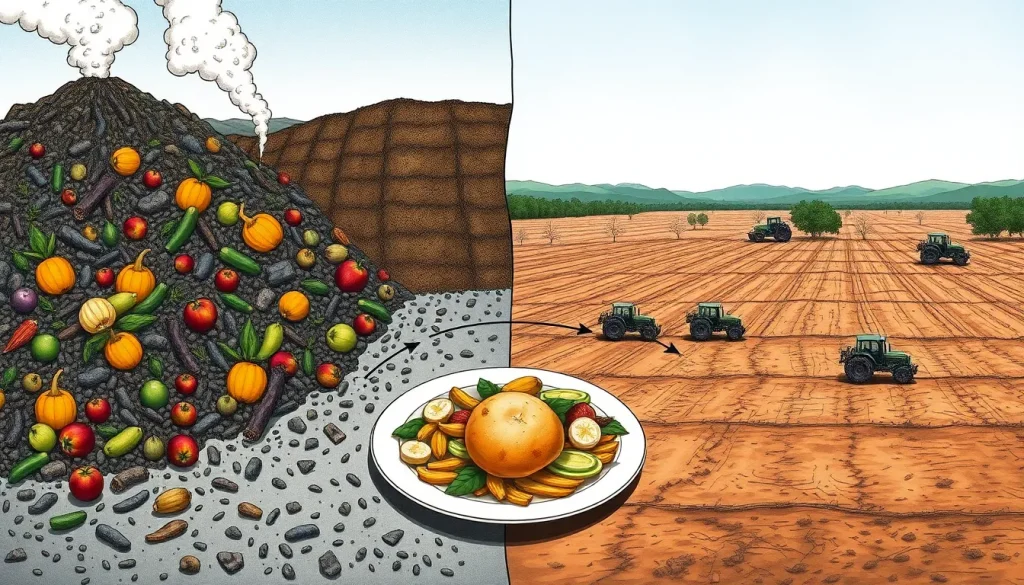
Once food reaches a landfill, the decomposition process becomes a direct source of climate pollution. In the oxygen-deprived environment of a landfill, organic matter breaks down anaerobically, producing methane (CH4). Methane is a short-lived but powerful greenhouse gas, with a global warming potential 28 to 36 times that of CO2 over a 100-year period, according to the Intergovernmental Panel on Climate Change (IPCC). Landfills are among the largest human-related sources of methane. Even when landfill gas is captured for energy, a significant portion escapes. Composting or anaerobic digestion of food waste can reduce these emissions by diverting organic material from landfills and producing useful soil amendments or biogas.
Land use is affected because the global food system occupies about half of all habitable land. When food is wasted, the land used to produce it—whether for crops or grazing—is effectively wasted as well. This “phantom land” could otherwise be left as natural habitat, used for reforestation, or employed to grow food for those in need. The pressure to expand agricultural land drives deforestation, particularly in tropical regions, which not only releases carbon but also destroys biodiversity and disrupts water cycles.
Environmental and Human Impacts
The environmental consequences of food waste extend beyond climate and land. Water resources are heavily impacted: agriculture accounts for about 70% of global freshwater withdrawals, and wasted food embodies a quarter of all water used in agriculture. The production of wasted food also contributes to soil degradation, eutrophication from fertilizer runoff, and pesticide pollution. Biodiversity suffers as natural habitats are converted to farmland that produces food never eaten. The cumulative effect is a significant and avoidable strain on planetary boundaries.
Human impacts are equally profound. Food waste exacerbates food insecurity by reducing the availability of food and driving up prices. The resources wasted could feed millions of undernourished people. Moreover, the economic cost of food waste is enormous, running into hundreds of billions of dollars annually when considering the value of the food itself and the environmental externalities. Communities near landfills often bear the brunt of pollution and health risks, making food waste an environmental justice issue as well.
Main Causes or Drivers
Food waste arises from a complex interplay of factors that vary by region and stage of the supply chain. In developing countries, most losses occur early in the chain due to inadequate harvesting techniques, poor storage facilities, lack of refrigeration, and insufficient infrastructure for transportation and processing. These post-harvest losses are often driven by financial and technical limitations.
In developed countries, waste is concentrated at the retail and consumer levels. Supermarkets enforce strict cosmetic standards for produce, rejecting items that are misshapen or blemished. Overstocking, oversized portions, and marketing practices encourage over-purchase. At home, consumers often discard food due to confusion over date labels (“sell by,” “use by,” “best before”), poor meal planning, and a culture of abundance that devalues food. All-you-can-eat buffets and large plate sizes in restaurants further contribute. Systemic issues such as inefficient supply chains, lack of coordination between actors, and policies that incentivize overproduction also play a role.
Solutions
Addressing food waste requires a hierarchy of actions: prevention, redistribution, and recycling. Prevention is the most effective approach, as it avoids all associated environmental impacts. This includes improving supply chain efficiency, standardizing date labels, educating consumers on meal planning and storage, and changing retail practices to accept imperfect produce. Redistribution involves donating surplus edible food to food banks and charities, which addresses both waste and hunger.
When food cannot be eaten, recycling through composting or anaerobic digestion recovers nutrients and energy while avoiding landfill methane. Policy interventions are critical: governments can set waste reduction targets, ban organic waste from landfills, invest in infrastructure, and support research. Businesses can adopt waste tracking systems, optimize inventory, and redesign packaging. Public awareness campaigns can shift social norms around food. International cooperation, such as the UN Sustainable Development Goal 12.3 to halve per capita food waste by 2030, provides a framework for action.
Why It Matters
Food waste is a cross-cutting issue that intersects climate, land, water, biodiversity, and social equity. Its sheer scale—roughly one-third of all food—makes it a critical leverage point for environmental sustainability. The IPCC has identified reducing food waste as a key strategy for mitigating climate change, with co-benefits for food security and land conservation. Project Drawdown ranks reduced food waste as one of the top solutions for lowering greenhouse gas emissions.
Addressing food waste also aligns with broader goals of a circular economy, where resources are used efficiently and waste is minimized. It offers a rare opportunity to achieve significant environmental gains without requiring new technologies or sacrifices in human well-being. Instead, it calls for better management, behavioral change, and systemic improvements that can save money, feed people, and protect the planet.
Regional Differences
The nature and scale of food waste differ markedly between high-income and low-income countries. In sub-Saharan Africa and South Asia, food losses are predominantly post-harvest, caused by limited access to modern storage, cooling, and transport. In contrast, in Europe and North America, more than half of food waste occurs at the consumption stage, driven by consumer behavior and retail standards. Middle-income countries often face a mix of both challenges as their food systems modernize.
These regional differences have implications for solutions. In developing regions, investments in infrastructure, cold chains, and farmer training can dramatically reduce losses. In wealthier nations, policy and education campaigns targeting households and retailers are more impactful. Climate also plays a role: warmer regions experience faster spoilage, making cold storage even more critical. Understanding these nuances is essential for designing effective, context-specific interventions.
FAQ
What is food waste?
Food waste is the discarding of edible food at any stage of the supply chain, from farm to fork, including food that is lost during production, processing, retail, and consumption.
How does food waste contribute to climate change?
Food waste contributes to climate change by generating greenhouse gases throughout its lifecycle: emissions from farming, transport, and refrigeration, plus methane released when food decomposes in landfills. The embedded resources also represent unnecessary emissions.
Why does reducing food waste matter for land use?
Reducing food waste lessens the demand for agricultural land, helping to prevent deforestation and habitat loss. It allows land to be used more efficiently or returned to nature, preserving biodiversity and carbon sinks.
References
- Food and Agriculture Organization of the United Nations (FAO) - 'Food Wastage Footprint: Impacts on Natural Resources'
- Intergovernmental Panel on Climate Change (IPCC) - Special Report on Climate Change and Land
- Project Drawdown - Reduced Food Waste solution
- UN Environment Programme (UNEP) - Food Waste Index Report