In brief
At a glance
Quick Facts
- Verdict
- Mixed: Systemic change is more impactful, but individual action is necessary
- Problem addressed
- Relative effectiveness of individual vs systemic actions in solving societal problems
- Evidence strength
- Moderate
- Potential scale
- Global
- Relative cost
- Varies: individual actions low cost, systemic changes high cost
- Time to impact
- Varies: individual actions immediate, systemic changes take years
Quick verdict
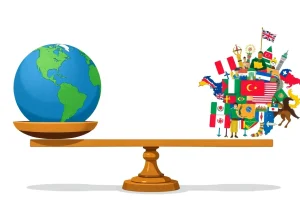
The debate between individual action and systemic change is not about choosing one over the other, but understanding their interdependence. Evidence from environmental science, sociology, and political economy indicates that systemic changes—such as policy reforms, economic incentives, and institutional shifts—are far more effective at achieving large-scale, lasting impact. However, individual actions are crucial for driving cultural shifts, creating political will, and enabling systemic change. A dual approach that leverages individual behavior to catalyze systemic transformation is the most promising path forward.
Problem addressed
Many of the world’s most pressing problems—climate change, inequality, public health crises—are rooted in complex systems. A persistent question is where to focus effort: on changing individual behaviors (e.g., reducing personal carbon footprints, ethical consumption) or on transforming the systems that shape those behaviors (e.g., government policies, corporate practices). This debate influences resource allocation, advocacy strategies, and public engagement. Misplaced emphasis can lead to ineffective solutions, blame shifting, and delayed action on root causes.
How the solution works
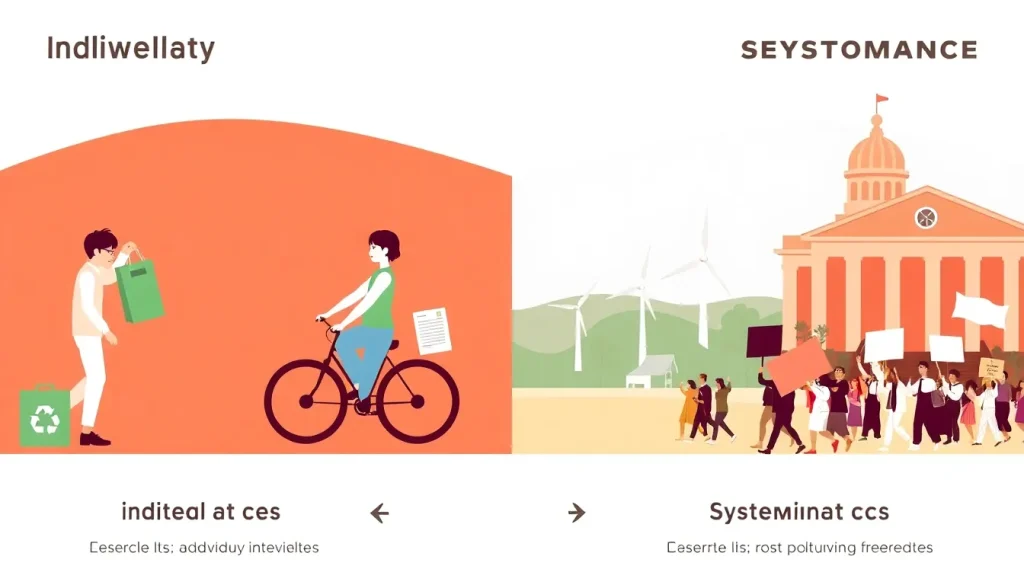
The “solution” is not a single intervention but a framework for understanding how change happens. Individual action refers to personal choices: diet, transportation, energy use, voting, and consumption. Systemic change involves altering the rules, incentives, and structures that govern society—through legislation, regulation, market mechanisms, and institutional reform. The two interact: individual actions can signal demand for systemic change (e.g., consumer shifts prompting corporate sustainability), create social norms (e.g., recycling becoming routine), and build movements that pressure policymakers. Conversely, systemic changes make sustainable individual choices easier and more accessible (e.g., public transit investment reduces car dependence).
Evidence strength
The evidence base is moderate and draws from multiple disciplines. Research consistently shows that systemic interventions have larger and more durable effects. For example, the IPCC’s Sixth Assessment Report emphasizes that economy-wide policies like carbon pricing and renewable energy mandates are essential for meeting climate targets, while individual behavior change alone is insufficient. A 2017 study by Wynes and Nicholas found that even if all individuals adopted commonly recommended actions (e.g., recycling, changing lightbulbs), emissions reductions would fall far short of what is needed. Conversely, political science research demonstrates that collective action—voting, protests, advocacy—can lead to policy shifts. However, quantifying the exact impact of individual actions on systemic change is challenging, and evidence on the effectiveness of lifestyle campaigns is mixed, with some studies showing limited spillover into political engagement.
Potential scale
Systemic changes have the potential for global impact. A single policy, such as a carbon tax or a ban on single-use plastics, can affect millions of people and entire industries. Individual actions, by contrast, are inherently limited in scale unless aggregated through collective movements. For instance, one person adopting a plant-based diet has a negligible effect on global emissions, but widespread dietary shifts driven by cultural change and supported by agricultural policy could be significant. The scale of individual action is thus contingent on its ability to influence systems.
Cost considerations
Individual actions often have low or no direct financial cost (e.g., reducing meat consumption, using public transport) but may require time, effort, or upfront investment (e.g., buying an electric vehicle). Systemic changes can be costly to implement—subsidies, infrastructure, enforcement—but their cost-effectiveness is generally high when measured per unit of impact. For example, the cost per ton of CO2 reduced through building codes is often lower than relying on voluntary individual retrofits. However, systemic changes can face political opposition due to perceived economic burdens, and costs may be unevenly distributed without careful design.
Implementation time
Individual actions can be adopted immediately, with some effects (e.g., reduced energy use) appearing right away. Systemic changes typically require years to decades to design, legislate, and implement, and their effects may take even longer to materialize. For instance, shifting a national energy grid to renewables involves long planning horizons, while an individual can switch to a green energy provider in days. This time lag underscores the need for both: immediate individual steps to build momentum and long-term systemic strategies for lasting change.
Environmental benefits
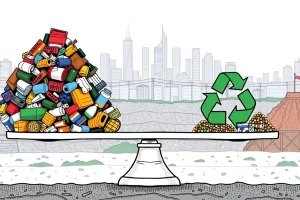
Systemic changes offer the largest environmental benefits. Policies like the Clean Air Act or the European Union’s Emissions Trading System have demonstrably reduced pollution at scale. Individual actions contribute but are often marginal in comparison. For example, the cumulative effect of personal recycling is dwarfed by the impact of extended producer responsibility laws that redesign packaging systems. However, individual actions in aggregate can reduce pressure on ecosystems, and they play a role in areas where systemic change is absent or slow.
Social and economic co-benefits
Both approaches can yield co-benefits. Individual actions like cycling or walking improve personal health; community gardens enhance social cohesion. Systemic changes can address root causes of inequality—for instance, progressive climate policies can include job retraining for fossil fuel workers. Well-designed systemic interventions often have broader co-benefits: public transit investment reduces congestion and air pollution while improving access to employment. However, if systemic changes are not equitable, they can exacerbate disparities (e.g., carbon taxes that disproportionately affect low-income households without compensatory measures).
Risks and unintended consequences
An overemphasis on individual action can lead to “responsibilization,” where the burden of solving systemic problems is shifted onto individuals, deflecting attention from corporate and governmental accountability. This can foster guilt and inaction rather than empowerment. There is also a risk of “moral licensing,” where individuals who take one positive action feel entitled to engage in harmful behaviors elsewhere. Systemic changes carry risks of unintended consequences: for example, biofuel mandates intended to reduce emissions have led to deforestation and food price spikes. Poorly designed policies can create loopholes or perverse incentives. Both approaches require careful design to avoid rebound effects, where efficiency gains are offset by increased consumption.
Where it works best
Individual actions are most effective when they are part of a collective movement that pressures for systemic change. They work best in contexts with high public awareness and where personal choices are visible and can influence social norms (e.g., reducing plastic use). Systemic changes work best in societies with strong institutions, rule of law, and public support. They are particularly effective when they target leverage points in a system—such as changing subsidies or regulations that have cascading effects. A combination is ideal: individual actions can pilot innovative solutions and demonstrate feasibility, while systemic changes can scale them.
Where it may not work
Relying solely on individual action is unlikely to work for problems that require coordinated, large-scale responses, such as climate change or biodiversity loss. In contexts of deep structural inequality, individual actions may be inaccessible to many (e.g., buying organic food or electric cars). Systemic changes may fail in environments with weak governance, corruption, or powerful vested interests that block reform. In such cases, grassroots individual and collective action may be the only available lever, but its impact will be limited without eventual institutional change.
Comparison with alternatives
The main alternative to a combined approach is focusing exclusively on one side. A purely individual-focused strategy (e.g., voluntary green consumerism) has been shown to be insufficient for meeting climate goals and can delay necessary policy action. A purely systemic approach that ignores individual behavior risks public backlash and may fail to achieve cultural buy-in. Other alternatives include technological solutionism (relying on future innovations) or degrowth movements that advocate for systemic economic transformation. Evidence suggests that a portfolio of strategies—individual, collective, technological, and policy-driven—is most robust.
Case studies
Anti-apartheid movement: Individual boycotts of South African goods and cultural isolation combined with international sanctions and divestment campaigns (systemic pressure) led to the end of apartheid. This illustrates how individual actions can amplify systemic change.
Germany’s Energiewende: Germany’s transition to renewable energy was driven by both individual adoption of solar panels (supported by feed-in tariffs) and systemic policies like the Renewable Energy Act. The policy created the conditions for individual action to scale, resulting in over 40% of electricity from renewables by 2020.
Voluntary carbon offsets: Many companies and individuals purchase offsets to compensate for emissions. Studies have found that voluntary offset markets have limited effectiveness due to issues of additionality and permanence, and they can serve as a distraction from necessary systemic emission reductions. This case highlights the limits of individual market-based actions without robust regulation.
Final assessment
The evidence strongly suggests that systemic change is the primary driver of large-scale, lasting progress on complex societal problems. However, individual actions are not irrelevant; they are the seeds of cultural and political transformation. The most effective approach integrates both: individuals acting not only as consumers but as citizens—voting, organizing, and advocating for the systemic changes that make sustainable choices the default. For policymakers and advocates, the priority should be on structural reforms, while encouraging individual actions that build momentum and demonstrate public demand. The debate should shift from “either/or” to “how can individual actions best catalyze systemic change?”
FAQ
Is individual action pointless?
No, individual actions are not pointless. While they have limited direct impact on large-scale problems, they can drive cultural shifts, influence policy through collective action, and serve as a moral foundation. However, relying solely on individual actions without pursuing systemic change is insufficient to solve major societal issues.
What is the most effective individual action for climate change?
According to research by Wynes and Nicholas (2017), the most effective individual actions for reducing greenhouse gas emissions are having one fewer child, living car-free, avoiding air travel, and adopting a plant-based diet. However, these actions are most impactful when combined with advocacy for systemic changes like renewable energy policies.
How can individuals contribute to systemic change?
Individuals can contribute to systemic change by voting for policies that address root causes, participating in collective action such as protests or community organizing, supporting advocacy groups, and using their purchasing power to influence corporate behavior. Education and raising awareness also play a role in shifting social norms.
References
- IPCC, 2022: Climate Change 2022: Mitigation of Climate Change. Working Group III contribution to the Sixth Assessment Report.
- Maniates, M. (2001). Individualization: Plant a tree, buy a bike, save the world? Global Environmental Politics, 1(3), 31-52.
- Wynes, S., & Nicholas, K. A. (2017). The climate mitigation gap: education and government recommendations miss the most effective individual actions. Environmental Research Letters, 12(7), 074024.
- Berners-Lee, M. (2010). How Bad Are Bananas? The carbon footprint of everything. Profile Books.
- Project Drawdown (2020). The Drawdown Review: Climate Solutions for a New Decade.