In brief
Modern economies have largely been built on a simple model:
Take → Make → Use → Dispose.
Raw materials are extracted from nature, transformed into products, used for a period of time, and ultimately discarded as waste.
This linear economy has enabled enormous improvements in living standards, industrial production, and global trade. It has also contributed to unprecedented levels of resource extraction, waste generation, biodiversity loss, greenhouse-gas emissions, and pollution.
As humanity pushes beyond several planetary boundaries, scientists, businesses, and policymakers have increasingly asked whether economic prosperity can be achieved without continually increasing the consumption of finite resources.
One proposed answer is the circular economy.
Rather than treating products as disposable, the circular economy seeks to eliminate waste by design, keep materials circulating at their highest possible value, and regenerate natural systems. It aims to redesign production and consumption so that economic activity becomes more compatible with Earth’s ecological limits. (Ellen MacArthur Foundation)
The circular economy has become one of the most influential sustainability concepts of the twenty-first century. Governments, multinational companies, cities, and international organizations increasingly incorporate circular strategies into climate, waste, and resource policies.
Yet the concept also has important limitations.
While circular approaches can substantially reduce resource use and environmental impacts, they cannot completely eliminate the physical limits imposed by thermodynamics, material degradation, and continued economic growth.
Understanding both the promise and the constraints of the circular economy is therefore essential for making informed sustainability decisions. (ScienceDirect)
Quick Answer
A circular economy is an economic system designed to eliminate waste, keep products and materials in use for as long as possible, and regenerate natural systems.
According to the Ellen MacArthur Foundation, it is built around three design principles:
- Eliminate waste and pollution
- Circulate products and materials at their highest value
- Regenerate nature (Ellen MacArthur Foundation)
Unlike the traditional linear economy, a circular economy emphasizes:
- Repair
- Reuse
- Refurbishment
- Remanufacturing
- Recycling
- Composting
- Product redesign
- Renewable materials
Evidence suggests that circular strategies can reduce greenhouse-gas emissions, resource extraction, waste, and pollution. However, they are not a complete solution to sustainability challenges and must be combined with renewable energy, ecosystem protection, efficient resource use, and responsible consumption. (Ellen MacArthur Foundation)
What Is the Circular Economy?
The circular economy is a systems approach to production and consumption.
Instead of asking:
“How do we manage waste?”
it asks:
“How do we design systems so waste is never created in the first place?”
This represents a major conceptual shift.
Waste is viewed not as an inevitable outcome, but as a design failure.
Products should therefore be created so that materials remain valuable throughout multiple life cycles.
From Linear to Circular
Linear Economy
The traditional model follows this sequence:
- Extract resources
- Manufacture products
- Sell products
- Use products
- Dispose of products
Resource extraction continually increases while waste accumulates.
Circular Economy
The circular model seeks to maintain material value through strategies such as:
- Better design
- Longer product life
- Maintenance
- Repair
- Reuse
- Sharing
- Refurbishment
- Remanufacturing
- Recycling
Rather than ending as waste, materials ideally remain within productive use for as long as possible. (Ellen MacArthur Foundation)
The Three Core Principles
The Ellen MacArthur Foundation identifies three fundamental principles.
1. Eliminate Waste and Pollution
The most effective waste is waste that is never created.
This begins during product design.
Examples include:
- Designing durable products
- Reducing unnecessary packaging
- Avoiding hazardous chemicals
- Improving manufacturing efficiency
2. Circulate Products and Materials
Products should remain useful for as long as possible.
Strategies include:
- Repair
- Reuse
- Leasing
- Sharing
- Refurbishment
- Remanufacturing
- Recycling
The objective is to preserve the highest possible value of products and materials.
3. Regenerate Nature
The circular economy extends beyond materials.
It also seeks to restore natural systems through approaches such as:
- Regenerative agriculture
- Healthy soils
- Forest restoration
- Renewable biological materials
Natural ecosystems become active partners in economic systems rather than resources to be continuously depleted. (Ellen MacArthur Foundation)
Why the Circular Economy Matters
Humanity currently consumes enormous quantities of materials.
These include:
- Metals
- Fossil fuels
- Timber
- Minerals
- Sand
- Biomass
Material extraction drives many environmental pressures including:
- Climate change
- Deforestation
- Biodiversity loss
- Freshwater depletion
- Pollution
- Waste generation
A circular economy seeks to reduce these pressures by using existing materials more effectively.
Circular Strategies
Different strategies preserve different levels of value.
Generally, the higher the product remains in its original form, the greater the resource savings.
Refuse
Avoid unnecessary products altogether.
Reduce
Use fewer materials.
Improve efficiency.
Reuse
Use products repeatedly without major modification.
Repair
Fix damaged products instead of replacing them.
Refurbish
Restore products to good working condition.
Remanufacture
Disassemble products and rebuild them using recovered components.
Recycle
Recover raw materials for new production.
Although important, recycling is generally less resource-efficient than repair or reuse because additional energy and processing are required.
Circular Design
Most environmental impacts are determined during product design.
Circular design emphasizes:
- Durability
- Repairability
- Modularity
- Standardized components
- Material recovery
- Reduced toxicity
- Easy disassembly
Design therefore becomes one of the most powerful tools for reducing waste.
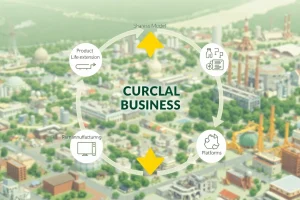
Circular Business Models
The circular economy also changes business strategies.
Examples include:
Product-as-a-Service
Customers purchase the service rather than ownership.
Examples include:
- Equipment leasing
- Mobility services
- Industrial machinery contracts
Sharing Economy
Products are shared among multiple users.
Examples include:
- Car sharing
- Tool libraries
- Bicycle sharing
Refurbishment Services
Companies restore products for resale.
Examples include:
- Smartphones
- Computers
- Industrial equipment
Take-Back Programs
Manufacturers recover products after use to reclaim valuable materials.
The Circular Economy and Climate Change
Climate discussions often focus on energy.
Renewable electricity is essential.
However, many emissions arise from producing materials such as:
- Steel
- Cement
- Plastics
- Food
The Ellen MacArthur Foundation estimates that transitioning to renewable energy addresses only part of global emissions. Circular strategies targeting products, materials, and food systems can help reduce emissions associated with industry, agriculture, and land use. (Ellen MacArthur Foundation)
Circular Economy and Planetary Boundaries
Circular principles can help reduce pressure on multiple planetary boundaries.
Climate Change
Less material extraction and longer product lifetimes reduce emissions.
Biosphere Integrity
Lower demand for raw materials can reduce habitat destruction.
Land-System Change
Improved resource efficiency reduces pressure for agricultural and industrial expansion.
Freshwater Change
Efficient production often lowers water consumption.
Novel Entities
Designing safer materials reduces pollution from hazardous chemicals.
However, the circular economy alone cannot restore planetary boundaries if overall resource demand continues to grow rapidly. (Ellen MacArthur Foundation)
Evidence for Circular Benefits
Research identifies several demonstrated benefits.
Reduced Resource Extraction
Keeping products in use longer reduces demand for virgin materials.
Lower Waste
Repair, reuse, and recycling reduce landfill disposal.
Lower Greenhouse-Gas Emissions
Circular production often requires less energy than manufacturing from newly extracted materials.
Economic Opportunities
Circular systems can stimulate:
- Innovation
- Repair industries
- Remanufacturing
- Recycling technologies
- Service-based business models
Greater Supply Security
Recovering materials reduces dependence on newly extracted resources and vulnerable supply chains.
These benefits are increasingly documented across sectors such as construction, electronics, packaging, and manufacturing. (Ellen MacArthur Foundation)
The Limits of Recycling
Recycling is valuable.
But recycling alone does not create a circular economy.
Reasons include:
- Material quality often declines during recycling.
- Energy is still required.
- Collection systems are imperfect.
- Some materials cannot be economically recycled.
- Products are often too complex to separate efficiently.
This explains why circular strategies prioritize reduce, reuse, repair, and remanufacture before recycling.
Scientific Limitations
Despite its popularity, researchers emphasize several important limitations.
Thermodynamics
Materials cannot be recycled indefinitely without losses.
Every processing cycle requires energy.
Some material quality inevitably declines.
System Boundaries
A product may appear circular locally while shifting environmental impacts elsewhere.
For example:
- Recycling may require significant transportation.
- New infrastructure consumes resources.
- Secondary markets may stimulate additional consumption.
Rebound Effects
Efficiency improvements sometimes lower costs.
Lower costs may encourage greater overall consumption.
This phenomenon can offset some environmental gains.
Infinite Growth
A circular economy cannot eliminate all resource extraction if total production and consumption continue increasing indefinitely.
Absolute material limits still exist.
Researchers therefore argue that circularity should be viewed as an important sustainability strategy rather than a complete solution. (ScienceDirect)
Circular Economy vs Recycling
These concepts are often confused.
| Recycling | Circular Economy |
|---|---|
| Focuses on waste | Focuses on system redesign |
| End-of-life solution | Whole life-cycle approach |
| Material recovery | Waste prevention first |
| One strategy | Many complementary strategies |
Recycling is one component of circularity—not the entire concept.
Measuring Circularity
Assessing circular performance is challenging.
Possible indicators include:
- Material recovery rates
- Product lifespan
- Repair rates
- Recycled content
- Resource productivity
- Waste generation
- Material intensity
Researchers continue developing standardized circularity indicators because no single metric captures every aspect of circular performance. (arXiv)
Circular Economy and the Anthropocene
The Anthropocene recognizes humanity as a planetary force.
The circular economy attempts to redesign that influence.
Instead of continually expanding resource extraction, it seeks to align economic systems more closely with ecological processes.
Its long-term objective is not simply producing less waste.
It is redesigning production so that economic prosperity becomes increasingly compatible with Earth’s life-support systems.
Common Misunderstandings
“The circular economy is just recycling.”
No.
Recycling is only one of many circular strategies.
“Circular products have zero environmental impact.”
No.
Every product requires energy and materials.
Circularity reduces impacts but does not eliminate them.
“Technology alone creates a circular economy.”
Technology helps.
Successful circular systems also require:
- Better design
- Business innovation
- Consumer participation
- Policy
- Infrastructure
“A circular economy solves every environmental problem.”
No.
Climate change, biodiversity loss, and other planetary challenges also require renewable energy, ecosystem conservation, efficient resource use, and broader sustainability policies. (ScienceDirect)
Frequently Asked Questions
What is a circular economy?
A circular economy is an economic system that eliminates waste, keeps materials circulating at their highest value, and regenerates nature. (Ellen MacArthur Foundation)
What are the three principles?
Eliminate waste and pollution, circulate products and materials, and regenerate nature. (Ellen MacArthur Foundation)
Is recycling enough?
No. Repair, reuse, refurbishment, and remanufacturing usually preserve more value and require fewer resources than recycling alone.
Does the circular economy reduce climate change?
Yes, it can reduce emissions associated with materials, manufacturing, agriculture, and waste, complementing renewable energy and energy efficiency. (Ellen MacArthur Foundation)
What are the biggest limitations?
Material degradation, thermodynamic constraints, rebound effects, incomplete recycling systems, and continued growth in resource demand all limit how circular an economy can become. (ScienceDirect)
Can a circular economy support planetary boundaries?
Circular strategies can substantially reduce pressure on multiple planetary boundaries, but they must be combined with broader environmental policies and sustainable consumption patterns. (Ellen MacArthur Foundation)
Conclusion
The circular economy represents one of the most influential attempts to rethink how modern societies produce, consume, and manage resources.
Instead of treating waste as inevitable, it begins with the premise that products and systems can be designed to prevent waste, keep materials in circulation, and regenerate natural systems. This approach has demonstrated potential to reduce resource extraction, lower greenhouse-gas emissions, stimulate innovation, and lessen pressure on biodiversity, freshwater, and other planetary boundaries. (Ellen MacArthur Foundation)
At the same time, scientific research reminds us that circularity is not a universal solution. Physical laws limit perfect material recovery, recycling cannot continue indefinitely without losses, and efficiency gains can be offset if total consumption continues to grow. A truly sustainable future therefore requires circular design alongside renewable energy, ecosystem restoration, responsible governance, and resource-efficient lifestyles. (ScienceDirect)
Ultimately, the circular economy is best understood not as a destination where waste disappears completely, but as a practical framework for redesigning economic systems so that they operate more effectively within the ecological limits of a finite planet.