In brief
Environmental change is often described in terms of temperatures, carbon dioxide, biodiversity loss, pollution, or declining freshwater.
But behind every graph lies another question:
Who experiences these changes first?
A flood does not affect every neighborhood equally.
A drought does not threaten every farmer to the same degree.
Air pollution is rarely distributed evenly across cities.
Communities living closest to hazardous industries often experience higher exposure to pollution, while many Indigenous peoples face disproportionate risks from ecosystem degradation despite contributing relatively little to global environmental change.
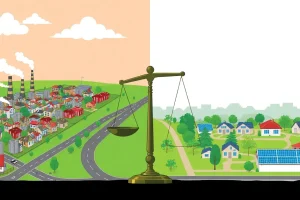
These patterns illustrate the central concern of environmental justice.
Environmental justice asks whether the environmental benefits and burdens of modern society are shared fairly. It recognizes that environmental problems are not only scientific or ecological—they are also social, economic, political, and ethical.
As climate change, biodiversity loss, freshwater depletion, pollution, and other planetary pressures intensify, questions of justice become increasingly important.
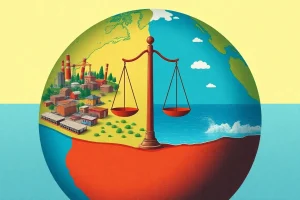
The Planetary Boundaries framework defines the safe operating space for humanity by identifying the biophysical limits that support Earth-system stability. Environmental justice asks a complementary question:
Who bears the risks when those boundaries are crossed?
Recent international assessments increasingly emphasize that environmental degradation and inequality reinforce one another. The United Nations Development Programme (UNDP) describes today’s “triple planetary crisis”—climate change, biodiversity loss, and pollution—as both an environmental and a human-rights challenge because its impacts fall disproportionately on vulnerable and marginalized populations. (UNDP)
Understanding environmental justice therefore means understanding not only how the Earth system changes, but also how those changes affect different people across space, generations, and societies.
Quick Answer
Environmental justice is the principle that all people should enjoy equal protection from environmental harm and equal access to environmental benefits, regardless of income, race, ethnicity, gender, nationality, or other social characteristics.
It includes:
- Fair distribution of environmental risks
- Fair distribution of environmental benefits
- Equal participation in environmental decision-making
- Recognition of affected communities
- Protection of environmental rights
Environmental justice recognizes that environmental degradation often affects those who contributed least to creating it. Climate change, biodiversity loss, pollution, and resource depletion frequently impose greater burdens on low-income communities, Indigenous peoples, children, older adults, and countries with fewer resources for adaptation. (UNDP)
What Is Environmental Justice?
Environmental justice emerged from the recognition that environmental problems are rarely distributed equally.
Historically, some communities have experienced greater exposure to:
- Air pollution
- Contaminated water
- Hazardous waste
- Industrial emissions
- Flood risks
- Heat exposure
- Resource extraction
At the same time, these communities often possess fewer financial, political, or institutional resources to reduce those risks.
Environmental justice therefore seeks fairness in both environmental outcomes and environmental governance.
The Three Dimensions of Environmental Justice
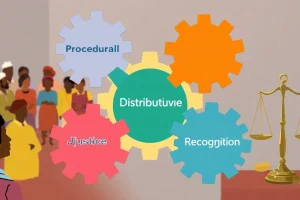
Researchers commonly describe environmental justice through three complementary dimensions.
1. Distributive Justice
Distributive justice concerns who receives environmental benefits and who bears environmental burdens.
Questions include:
- Who breathes polluted air?
- Who loses farmland to drought?
- Who benefits from natural resources?
- Who bears the costs of environmental degradation?
2. Procedural Justice
Procedural justice focuses on how environmental decisions are made.
It asks whether people have:
- Access to information
- Meaningful participation
- Legal protection
- Transparent decision-making
- Access to courts and remedies
Communities affected by environmental decisions should have opportunities to influence those decisions.
3. Recognition Justice
Recognition justice emphasizes respect for different cultures, identities, knowledge systems, and lived experiences.
It recognizes that some groups have historically been overlooked or excluded, including:
- Indigenous peoples
- Local communities
- Minority populations
- Women
- Future generations
Justice therefore involves acknowledging whose voices count in environmental governance.
Environmental Justice and Human Rights
Environmental justice is increasingly understood as a human-rights issue.
The United Nations recognizes that human rights and environmental protection are deeply interconnected.
A healthy environment supports rights to:
- Life
- Health
- Food
- Water
- Housing
- Culture
- Livelihoods
In 2022, the United Nations General Assembly recognized the right to a clean, healthy, and sustainable environment, reinforcing the growing relationship between environmental protection and human rights. (UNEP – UN Environment Programme)
Planetary Boundaries and Justice
The Planetary Boundaries framework identifies the biophysical limits that help maintain Earth-system stability.
These include:
- Climate change
- Biosphere integrity
- Freshwater change
- Land-system change
- Biogeochemical flows
- Ocean acidification
- Novel entities
- Atmospheric aerosol loading
- Stratospheric ozone depletion
These boundaries describe what is environmentally safe.
They do not, by themselves, determine what is socially fair.
A stable Earth system remains essential because crossing planetary boundaries increases the likelihood of widespread environmental harm. Yet the distribution of that harm is highly uneven. (DOI)
From “Safe” to “Safe and Just”
Recent Earth-system research argues that sustainability requires considering both:
- Safety — maintaining Earth’s life-support systems
- Justice — protecting people from significant harm
This perspective has been described as creating a safe and just space for humanity.
Under this framework:
Environmental limits remain essential.
But so do:
- Equity
- Human well-being
- Fair access to resources
- Protection from environmental harm
The goal is not only to remain within planetary boundaries but also to ensure that environmental policies reduce rather than reinforce inequality. (UNDP)
Climate Justice
Perhaps the best-known example is climate justice.
Climate justice recognizes that:
- Countries contributed differently to historical emissions.
- Communities differ greatly in vulnerability.
- Wealth strongly influences adaptation capacity.
Many low-income countries have contributed relatively little to cumulative greenhouse-gas emissions while facing some of the greatest risks from:
- Heatwaves
- Floods
- Sea-level rise
- Crop failures
- Water insecurity
Climate justice therefore asks not only:
“How do we reduce emissions?”
but also:
“How should responsibilities and resources be shared fairly?”
The IPCC increasingly frames adaptation and mitigation within principles of equity and justice. (IPCC)
Biodiversity and Indigenous Peoples
Environmental justice also concerns biodiversity.
Many Indigenous peoples manage ecosystems containing exceptionally high levels of biodiversity.
Their territories often support:
- Forests
- Wetlands
- Grasslands
- Rivers
- Coastal ecosystems
At the same time, these communities frequently face pressures from:
- Mining
- Logging
- Infrastructure
- Agricultural expansion
Recognizing Indigenous rights is therefore increasingly viewed as both a justice issue and a biodiversity conservation strategy.
Pollution and Environmental Inequality
Pollution rarely affects everyone equally.
Communities located near:
- Industrial facilities
- Highways
- Waste disposal sites
- Mining operations
often experience greater environmental exposure.
Potential consequences include:
- Reduced air quality
- Water contamination
- Soil degradation
- Higher environmental health risks
The exact distribution differs across countries, but unequal exposure to environmental hazards remains a recurring feature of environmental injustice.
Water Justice
Freshwater illustrates another justice challenge.
Access to safe water varies widely between and within countries.
Environmental change may increase:
- Drought
- Flooding
- Water scarcity
- Water contamination
Communities with limited infrastructure or financial resources generally have fewer options for adapting.
Water justice therefore concerns both:
- Environmental sustainability
- Fair access
Food Justice
Food systems also involve justice.
Questions include:
- Who has access to nutritious food?
- Who produces food?
- Who experiences hunger?
- Who bears environmental costs?
Food insecurity often results from interactions among:
- Poverty
- Conflict
- Climate change
- Land degradation
- Inequality
Building sustainable food systems therefore requires both ecological resilience and social equity.
Intergenerational Justice
Environmental justice extends across time.
Future generations cannot participate in today’s decisions.
Yet today’s actions influence:
- Climate
- Biodiversity
- Freshwater
- Soil fertility
- Resource availability
Intergenerational justice argues that current societies have responsibilities toward people who will live decades or centuries from now.
This principle is central to the concept of sustainable development.
Global Justice
Environmental change is also international.
Some countries consume far more resources than others.
Some produce more emissions.
Others experience greater environmental risks despite contributing relatively little to global degradation.
Global environmental justice therefore considers:
- Historical responsibility
- Financial capacity
- Technology transfer
- Adaptation support
- International cooperation
These questions frequently arise during negotiations on climate finance, biodiversity conservation, and sustainable development.
Environmental Justice and the Triple Planetary Crisis
The United Nations increasingly describes humanity as facing a triple planetary crisis:
- Climate change
- Biodiversity loss
- Pollution
These crises reinforce existing social inequalities.
People with fewer economic and political resources often experience greater exposure, greater vulnerability, and fewer opportunities for recovery. Addressing environmental justice therefore requires both reducing environmental pressures and addressing structural inequalities. (UNDP)
Environmental Rights
Environmental justice increasingly includes the concept of environmental rights.
These include:
Substantive Rights
Such as rights to:
- Health
- Water
- Food
- Housing
- A healthy environment
Procedural Rights
Such as:
- Access to environmental information
- Public participation
- Access to justice
- Transparent governance
These rights help communities protect themselves from environmental harm. (UNEP – UN Environment Programme)
Building More Just Environmental Policies
Researchers and international organizations identify several principles.
Inclusive Decision-Making
Communities should participate in decisions affecting their environment.
Transparency
Environmental information should be publicly available.
Accountability
Governments and organizations should be accountable for environmental impacts.
Fair Transition
Policies addressing climate and sustainability should also consider employment, affordability, and community well-being.
This idea is often called a just transition.
Strengthening Institutions
Effective legal systems help protect environmental rights and resolve environmental conflicts fairly. (UNDP)
Common Misunderstandings
“Environmental justice is only about pollution.”
No.
It includes climate change, biodiversity, freshwater, food systems, land use, and access to environmental decision-making.
“Environmental justice opposes environmental protection.”
No.
Its goal is to ensure that environmental protection is both effective and fair.
“Justice and sustainability are separate issues.”
Increasingly, international organizations view them as interconnected.
Environmental sustainability and human well-being reinforce one another. (UNEP – UN Environment Programme)
“Everyone experiences environmental change equally.”
Environmental risks vary widely depending on geography, income, governance, infrastructure, and social vulnerability.
Frequently Asked Questions
What is environmental justice?
Environmental justice seeks fair distribution of environmental benefits and burdens, equal participation in environmental decision-making, and protection of environmental rights for all people. (UNDP)
What is climate justice?
Climate justice applies environmental-justice principles to climate change, emphasizing fairness in responsibilities, impacts, and adaptation.
How is environmental justice related to planetary boundaries?
Planetary boundaries define Earth’s safe operating space, while environmental justice asks how environmental risks and benefits are distributed across societies. Together they support the idea of a safe and just future. (DOI)
Why are vulnerable communities often more affected?
Many have fewer resources for adaptation, greater exposure to environmental hazards, and less influence over environmental decision-making. (UNDP)
What is the right to a healthy environment?
It is the internationally recognized human right to live in a clean, healthy, and sustainable environment, acknowledged by the United Nations General Assembly in 2022. (UNEP – UN Environment Programme)
Can environmental justice improve sustainability?
Yes. Policies that reduce inequality, strengthen participation, and protect environmental rights can improve both social resilience and long-term environmental outcomes. (UNEP – UN Environment Programme)
Conclusion
Environmental justice reminds us that environmental change is never experienced equally.
The crossing of planetary boundaries affects real people living in specific places, under different social, economic, and political conditions. While Earth-system science helps define the biophysical limits within which humanity can safely operate, environmental justice asks how the costs and benefits of living within—or exceeding—those limits are shared.
Today’s environmental crises are increasingly understood as inseparable from questions of inequality, governance, and human rights. Climate change, biodiversity loss, freshwater stress, and pollution often reinforce existing social vulnerabilities, while unequal access to resources and decision-making can make adaptation more difficult. For this reason, international organizations increasingly frame environmental protection and human rights as mutually reinforcing goals. (UNDP)
Ultimately, creating a sustainable future requires more than keeping the Earth system stable. It also requires ensuring that environmental policies are inclusive, transparent, and equitable. A world that remains within planetary boundaries while leaving large groups of people exposed to preventable harm cannot be considered fully sustainable. The long-term challenge is therefore not only to remain within Earth’s ecological limits, but to do so in ways that enable all people—today and in the future—to thrive. (UNEP – UN Environment Programme)