In brief
At a glance
Quick Facts
- Core Dimensions
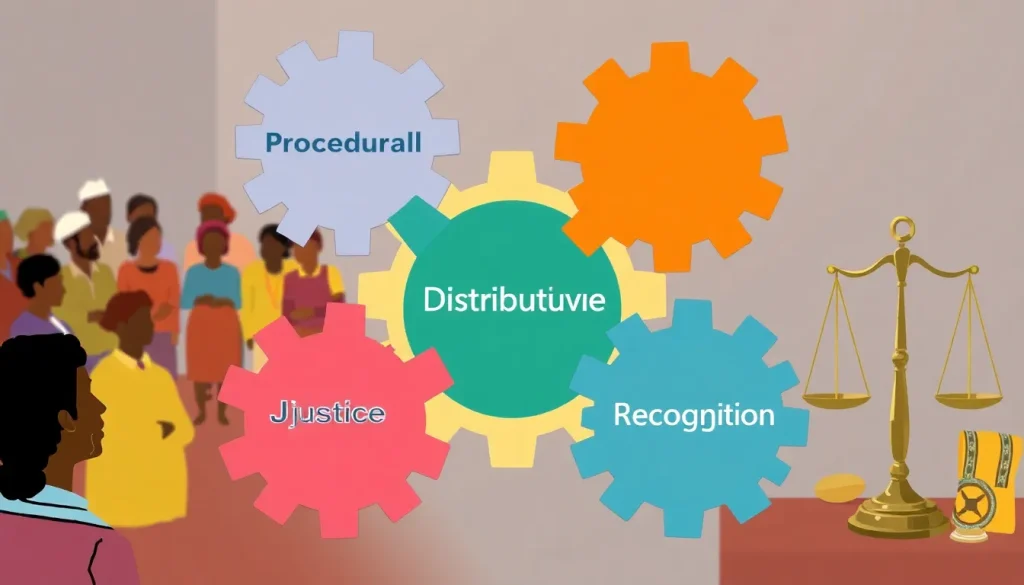
- Procedural (fair process), Distributive (fair outcomes), Recognition (fair respect and identity).
- Key Thinkers
- John Rawls (distributive), Nancy Fraser (recognition), Tom Tyler (procedural).
- Application Areas
- Environmental policy, organizational management, legal systems, urban planning, international development.
- Procedural Justice Elements
- Participation, transparency, neutrality, accountability, and correctability.
- Distributive Justice Principles
- Equality, equity, need, contribution, and priority to the least advantaged.
- Recognition Justice Focus
- Cultural respect, identity acknowledgment, challenging stereotypes, and valuing diverse knowledge systems.
- Interdependence
- Failures in one dimension often undermine the others; true fairness requires addressing all three.
- Historical Roots
- Distributive justice dates to Aristotle; recognition justice gained prominence in late 20th-century critical theory.
Key Takeaways
- Procedural justice focuses on fair processes in decision-making, ensuring all affected parties have a voice and that rules are applied consistently and transparently.
- Distributive justice concerns the equitable allocation of resources, benefits, and burdens among members of a community, addressing questions of who gets what and why.
- Recognition justice emphasizes the need to acknowledge and respect the identities, cultures, and rights of all groups, particularly those historically marginalized or misrepresented.
- These three dimensions are interdependent; achieving true fairness often requires addressing all three simultaneously, as failures in one can undermine progress in the others.
What Is Procedural, Distributive and Recognition Justice?
Procedural, distributive, and recognition justice are three distinct but interrelated concepts that together form a comprehensive framework for understanding and achieving fairness in societies, organizations, and environmental governance. Procedural justice refers to the fairness of the processes by which decisions are made, emphasizing transparency, impartiality, and the inclusion of all affected parties. Distributive justice deals with the equitable allocation of resources, benefits, and burdens, asking fundamental questions about who gets what and on what basis. Recognition justice, sometimes called relational justice, focuses on the respect and valuation of different identities, cultures, and knowledge systems, ensuring that no group is systematically devalued or ignored.
These concepts emerged from different intellectual traditions—procedural and distributive justice from political philosophy and legal theory, and recognition justice from critical social theory and struggles for cultural and identity-based rights. Together, they provide a holistic lens for evaluating fairness in contexts ranging from public policy and organizational management to environmental governance and international development. Understanding each dimension and their interplay is essential for designing institutions and practices that are not only efficient but also just and inclusive.
Overview
The three dimensions of justice—procedural, distributive, and recognition—are often discussed as pillars of social and environmental justice. Procedural justice ensures that decision-making processes are inclusive, transparent, and accountable. Distributive justice addresses the outcomes of those processes, focusing on how resources, opportunities, and risks are shared. Recognition justice goes deeper, examining whether the identities, cultures, and rights of all stakeholders are acknowledged and respected. These dimensions are not mutually exclusive; rather, they interact in complex ways. For example, a fair procedure (procedural justice) may still produce an inequitable distribution (distributive injustice) if certain groups are not recognized as legitimate stakeholders (recognition injustice).
In practice, these concepts are applied in fields such as environmental policy, where communities demand a say in decisions affecting their local environment (procedural), fair sharing of environmental benefits and burdens (distributive), and respect for indigenous or local knowledge systems (recognition). The framework has also been adopted in organizational management, urban planning, and global development to address systemic inequalities and promote more inclusive and sustainable outcomes.
How It Works
Procedural justice operates through mechanisms that ensure decision-making processes are fair and inclusive. Key elements include participation (allowing all affected parties to have a voice), transparency (making information and criteria openly available), neutrality (applying rules consistently without bias), and accountability (providing avenues for appeal and redress). For example, in a legal context, procedural justice requires that defendants have a fair trial, access to legal representation, and an impartial judge. In environmental governance, it means that communities are consulted and can influence decisions about projects that affect their health and livelihoods.
Distributive justice works through principles that guide the allocation of resources and burdens. Common principles include equality (everyone gets the same share), equity (distribution based on needs or contributions), and priority to the least advantaged. In practice, distributive justice is often implemented through taxation, social welfare programs, and regulatory frameworks that aim to correct imbalances. For instance, progressive tax systems and targeted subsidies are tools to achieve a more equitable distribution of wealth.
Recognition justice functions by challenging cultural and institutional norms that marginalize certain groups. It involves acknowledging diverse identities, histories, and knowledge systems, and ensuring that all groups have equal standing in social and political life. This can include legal recognition of indigenous land rights, representation of minority groups in media and government, and the validation of non-Western knowledge in policy-making. Recognition justice is often a prerequisite for procedural and distributive justice because if a group is not recognized as legitimate, its members may be excluded from decision-making processes and denied fair shares of resources.
History
The concepts of distributive and procedural justice have deep roots in Western philosophy. Distributive justice can be traced back to Aristotle, who distinguished between distributive and corrective justice, and later to thinkers like John Rawls, whose “A Theory of Justice” (1971) proposed principles for a just distribution of social goods. Procedural justice gained prominence in legal theory and political science, particularly through the work of scholars like John Thibaut and Laurens Walker in the 1970s, who studied how perceptions of fairness in legal processes affect satisfaction and compliance.
Recognition justice emerged more recently, primarily from critical theory and social movements of the late 20th century. Philosophers such as Charles Taylor, Nancy Fraser, and Axel Honneth argued that justice cannot be reduced to distribution or procedure alone; it must also address cultural disrespect, misrecognition, and identity-based harms. Fraser’s influential framework integrates recognition and redistribution, arguing that both are necessary for participatory parity. Environmental justice movements, indigenous rights campaigns, and feminist critiques have been instrumental in highlighting the importance of recognition alongside procedural and distributive concerns.
Why It Matters
Understanding and applying these three dimensions of justice is crucial for building fair and sustainable societies. Without procedural justice, decisions may be imposed arbitrarily, leading to resentment, conflict, and lack of legitimacy. Without distributive justice, inequalities in wealth, health, and opportunity can become entrenched, causing social unrest and undermining collective well-being. Without recognition justice, marginalized groups may suffer from cultural erasure, discrimination, and exclusion, even if formal procedures and distributions appear fair on the surface.
In environmental policy, for example, a failure to recognize indigenous peoples’ rights and knowledge has often led to the imposition of conservation projects that displace communities and ignore sustainable local practices. Similarly, in the workplace, a lack of procedural fairness can lead to low morale and high turnover, while inequitable pay (distributive injustice) and failure to respect diverse identities (recognition injustice) can result in discrimination lawsuits and reputational damage. Addressing all three dimensions is therefore not only a moral imperative but also a practical necessity for social cohesion and institutional effectiveness.
Examples
One classic example is the siting of hazardous waste facilities. Research in the United States has shown that such facilities are disproportionately located in low-income and minority communities. This represents a distributive injustice (unequal burden of environmental risks), often compounded by procedural injustice (lack of meaningful community participation in siting decisions) and recognition injustice (disregard for the concerns and rights of affected communities). The environmental justice movement emerged to address these intertwined injustices.
Another example is in global climate policy. Developing nations often bear the brunt of climate change impacts despite contributing least to greenhouse gas emissions—a distributive injustice. Procedural justice is at stake in international negotiations, where smaller or poorer countries may have less influence. Recognition justice is also critical, as the knowledge and rights of indigenous peoples, who are often on the front lines of climate impacts, must be acknowledged and respected in adaptation and mitigation strategies.
In organizational settings, a company may have fair hiring procedures (procedural justice) but still pay women less than men for the same work (distributive injustice) and fail to address a workplace culture that devalues women’s contributions (recognition injustice). Effective diversity, equity, and inclusion initiatives aim to address all three dimensions.
Benefits, Limitations and Trade-offs
The primary benefit of integrating procedural, distributive, and recognition justice is a more holistic and legitimate approach to fairness. It ensures that no single aspect of justice is overlooked, leading to outcomes that are more widely accepted and sustainable. For policymakers and organizations, this framework can help identify root causes of inequity and design interventions that address multiple dimensions simultaneously.
However, there are limitations and trade-offs. Pursuing all three dimensions perfectly may be resource-intensive and sometimes they can conflict. For example, a strictly equal distribution of resources (distributive justice) might require a decision-making process that overrides local customs or minority vetoes (procedural justice). Similarly, recognizing group-specific rights (recognition justice) can sometimes be seen as conflicting with universal procedural norms. Balancing these tensions requires careful deliberation and context-specific solutions. Additionally, measuring recognition justice is more subjective than measuring distributive outcomes, making it harder to evaluate progress.
Common Misconceptions
A common misconception is that procedural justice alone is sufficient for fairness. While fair processes are essential, they can still produce unjust outcomes if the rules themselves are biased or if certain groups are systematically excluded from the process. Another misconception is that distributive justice is only about economic equality; it also encompasses the fair distribution of non-material goods like opportunities, rights, and environmental quality.
Some also mistakenly view recognition justice as merely symbolic or less important than material concerns. In reality, lack of recognition can cause profound psychological harm and perpetuate structural inequalities. Finally, these three dimensions are sometimes treated as separate silos, but they are deeply interconnected—addressing one without the others often leads to incomplete or unsustainable solutions.
FAQ
What is procedural justice?
Procedural justice is the fairness of the processes by which decisions are made. It emphasizes transparency, impartiality, and the inclusion of all affected parties in decision-making.
How does distributive justice differ from procedural justice?
Distributive justice focuses on the fair allocation of resources, benefits, and burdens, while procedural justice focuses on the fairness of the decision-making process itself. Both are needed for overall justice.
Why is recognition justice important?
Recognition justice is important because it addresses the need for respect and acknowledgment of diverse identities, cultures, and knowledge systems. Without it, groups may be marginalized even if procedures and distributions appear fair.
References
- Rawls, J. (1971). A Theory of Justice. Harvard University Press.
- Fraser, N. (1995). From Redistribution to Recognition? Dilemmas of Justice in a 'Post-Socialist' Age. New Left Review.
- Tyler, T. R. (2006). Why People Obey the Law. Princeton University Press.
- Schlosberg, D. (2007). Defining Environmental Justice: Theories, Movements, and Nature. Oxford University Press.