In brief
At a glance
Quick Facts
- Status
- Framework under continuous revision; 6 of 9 boundaries transgressed in 2023
- Control variable
- Multiple, each boundary has its own; selection based on Earth-system process
- Proposed boundary
- Varies by boundary; e.g., climate change CO2 concentration 350 ppm
- Current value
- 6 boundaries transgressed as of 2023 assessment
- Pre-industrial baseline
- Holocene conditions for each boundary
Current status
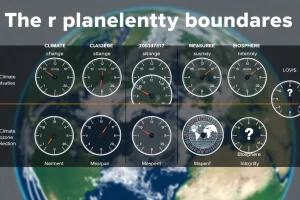
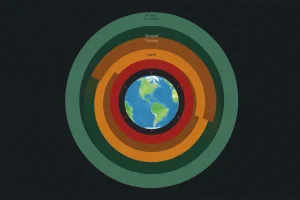
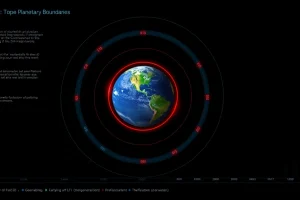
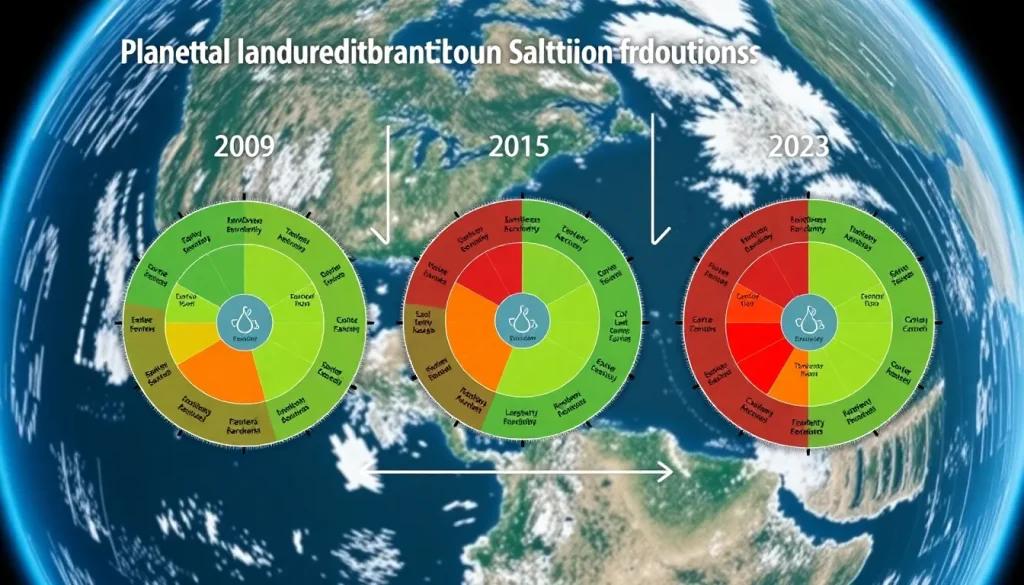
The planetary boundaries framework is not a static set of thresholds but a dynamic scientific construct that undergoes periodic revision. As of the most recent major update in 2023 (Richardson et al., 2023), the framework identifies nine boundaries, of which six are assessed as transgressed: climate change, biosphere integrity, land-system change, freshwater change, biogeochemical flows, and novel entities. This marks an increase from four transgressed boundaries in the 2015 update and three in the original 2009 formulation. The revision process is ongoing, with scientists continuously evaluating new evidence and refining the indicators to better capture the state of the Earth system.
Control variable
In the planetary boundaries framework, each boundary is associated with one or more control variables—quantifiable metrics that serve as proxies for the integrity of a critical Earth-system process. The choice of control variable is itself a subject of scientific deliberation and revision. For example, the climate change boundary originally used atmospheric CO2 concentration and radiative forcing; later updates added Earth’s energy imbalance. The biosphere integrity boundary has evolved from a single metric (extinction rate) to two complementary measures: genetic diversity (via extinction rate) and functional integrity (via the Biosphere Integrity Index). The freshwater boundary shifted from a global consumptive use limit to regional environmental flow requirements. These changes reflect a growing recognition that no single indicator can fully capture the complexity of Earth-system responses, and that the most policy-relevant and scientifically robust variables must be selected.
Proposed boundary or threshold
The safe boundary values are proposed based on the best available scientific evidence, often derived from paleoclimatic records, Earth-system modeling, and expert elicitation. These values are not fixed; they are revised when new data or improved understanding suggests a different threshold for triggering non-linear, potentially irreversible changes. For instance, the climate change boundary has consistently been set at 350 ppm CO2 and a radiative forcing of +1 W/m2 relative to pre-industrial levels, based on evidence of ice-sheet stability and past climate states. However, the 2023 update introduced a more nuanced assessment of energy imbalance. The freshwater boundary was revised from a global limit of 4,000 km3 per year of consumptive use to a regional approach based on environmental flow requirements, with the global safe operating space now defined as the aggregate of sub-global boundaries. Such revisions ensure that the proposed thresholds remain aligned with the latest understanding of Earth-system resilience.
Current measured value
As of the 2023 assessment, the control variables for six boundaries have exceeded their proposed safe limits. Atmospheric CO2 concentration stands at approximately 420 ppm, well above the 350 ppm boundary. The rate of species extinction is estimated to be tens to hundreds of times higher than the background rate, placing the genetic diversity component of biosphere integrity deep in the high-risk zone. Human appropriation of net primary production and land-use change have pushed the land-system boundary beyond its safe limit. Regional freshwater withdrawals exceed environmental flow requirements in many basins. Nitrogen and phosphorus cycles are massively disrupted, with global fertilizer use far exceeding safe levels. The novel entities boundary is transgressed due to the release of hundreds of thousands of synthetic chemicals and other anthropogenic substances into the environment. These measured values are updated with each assessment cycle, and the revision process often reveals that previously estimated values were too conservative or that new monitoring techniques allow more accurate quantification.
How the boundary is calculated
The process of setting and revising planetary boundary indicators involves a multi-step scientific synthesis. For each Earth-system process, researchers first identify a control variable that is both measurable and mechanistically linked to the risk of destabilization. The safe boundary is then determined by analyzing the range of natural variability during the Holocene—the relatively stable interglacial period of the past 11,700 years—and identifying the point at which human perturbations risk pushing the system into a new state. This analysis draws on paleoclimate data, contemporary observations, and Earth-system models. For example, the 350 ppm CO2 boundary was derived from evidence that during past interglacials, CO2 levels did not exceed 300 ppm, and that ice-sheet disintegration occurred when levels were sustained above 350–400 ppm. Revisions occur when new data (e.g., from ice cores, satellite monitoring, or process-based models) provide a clearer picture of thresholds, or when the scientific community reaches consensus on a more appropriate control variable. Expert elicitation and formal uncertainty analysis are often used to address gaps in knowledge. The entire framework is periodically reviewed and updated through collaborative efforts such as those led by the Stockholm Resilience Centre and the Potsdam Institute for Climate Impact Research.
Historical trend
The planetary boundaries framework has undergone three major iterations since its inception, each reflecting advances in Earth-system science and changes in human pressures. The original 2009 publication (Rockström et al.) identified nine boundaries and quantified seven, finding that three were already transgressed: climate change, biodiversity loss, and the nitrogen cycle. The 2015 update (Steffen et al.) refined several control variables, introduced regional boundaries for freshwater and land-system change, and concluded that four boundaries were transgressed: climate change, biosphere integrity, land-system change, and biogeochemical flows (nitrogen and phosphorus). The 2023 update (Richardson et al.) further revised control variables, added the novel entities boundary as fully assessed, and found six boundaries transgressed, including freshwater change and novel entities. This trend illustrates not only the increasing human footprint on the planet but also the improving ability of science to detect and quantify these impacts. Revisions have also led to the downgrading of some boundaries from transgressed to safe when new evidence suggested a higher threshold, though such cases are rare.
What is driving the change
Several factors drive the periodic revision of planetary boundary indicators. First, the rapid expansion of Earth observation systems—satellites, ground-based monitoring networks, and ocean sensors—provides a wealth of new data that can refine control variables and boundary values. Second, advances in Earth-system modeling, including the incorporation of tipping-point dynamics and feedback loops, allow for more accurate identification of thresholds. Third, the scientific community’s understanding of regional heterogeneity has grown, leading to a shift from purely global boundaries to sub-global assessments for processes like freshwater use and land-system change. Fourth, the recognition of novel anthropogenic threats, such as plastic pollution and synthetic chemicals, has prompted the addition of new boundaries. Finally, the framework is increasingly used to inform policy, creating a demand for the most up-to-date and policy-relevant indicators. These drivers ensure that the planetary boundaries framework remains a cutting-edge synthesis of Earth-system science.
What crossing the boundary means
When a revised assessment finds that a boundary has been crossed, it signals that the Earth system may be departing from the stable Holocene-like conditions that have allowed human civilizations to flourish. Transgression implies an increased risk of triggering non-linear, abrupt, or irreversible changes, such as the collapse of ice sheets, dieback of tropical forests, or disruption of ocean circulation. Revisions can also reveal that a boundary previously thought to be safe is now at risk, or that a transgressed boundary is even further beyond the safe zone than earlier estimates suggested. This has profound implications for global sustainability, as it indicates that humanity is operating outside the safe operating space and may be approaching planetary tipping points. The revision process itself can thus alter the perceived urgency of action.
Regional variations
A key evolution in the planetary boundaries framework has been the move from purely global boundaries to the incorporation of regional-scale assessments. Several boundaries—including freshwater change, land-system change, and biogeochemical flows—are now evaluated at sub-global levels because their impacts and thresholds vary geographically. For example, the freshwater boundary is based on environmental flow requirements in individual river basins; a global transgression is declared when a sufficient percentage of basins exceed their local limits. Similarly, land-system change is assessed by biome, with tropical and boreal forests having different thresholds for forest cover retention. This regionalization acknowledges that Earth-system processes are not uniformly distributed and that local transgressions can aggregate to global-scale effects. Revisions often refine these regional boundaries as more granular data become available.
Interaction with other boundaries
Revisions of planetary boundary indicators frequently reveal stronger and more complex interactions between boundaries. For instance, land-system change affects climate through carbon emissions and albedo changes, influences freshwater availability through evapotranspiration, and drives biodiversity loss through habitat destruction. The 2023 update explicitly considered such interactions, showing that transgressing one boundary can amplify pressures on others, creating cascading risks. The framework’s evolution has thus moved from treating boundaries as independent to recognizing them as a tightly coupled network. This systemic perspective is a major driver of revisions, as it necessitates updating control variables and thresholds to account for feedback loops and synergistic effects.
Impacts on people and ecosystems
Updated planetary boundary indicators provide a clearer picture of the risks that Earth-system changes pose to human well-being and ecosystems. For example, the transgression of the freshwater boundary highlights growing water scarcity, which threatens food production, human health, and aquatic biodiversity. The novel entities boundary underscores the pervasive contamination of the environment with plastics, pesticides, and industrial chemicals, with largely unknown long-term effects on human and ecosystem health. The biosphere integrity boundary’s decline signals the unraveling of ecosystem services such as pollination, pest control, and nutrient cycling. By refining these indicators, revisions help to quantify and communicate the concrete consequences of exceeding planetary boundaries, thereby informing risk assessments and adaptation strategies.
Possible pathways back toward the safe zone
Revisions of planetary boundary indicators are not merely diagnostic; they also inform pathways for returning to the safe operating space. Updated boundaries provide science-based targets for global and regional policy, such as the Paris Agreement’s temperature goals, the Kunming-Montreal Global Biodiversity Framework, and the Sustainable Development Goals. For example, the revised freshwater boundary supports the implementation of environmental flow standards in water management. The biogeochemical flows boundary points to the need for more efficient fertilizer use and circular nutrient economies. The novel entities boundary calls for a circular economy approach to chemicals and plastics, including design for recycling and safe substitution. By identifying the most critical leverage points, the revision process helps to prioritize actions that can reduce multiple pressures simultaneously, such as protecting intact forests, which benefits climate, biodiversity, freshwater, and land-system boundaries.
Scientific uncertainty
Uncertainty is inherent in the planetary boundaries framework, and revisions aim to reduce it while often revealing new complexities. Key uncertainties include the precise location of thresholds for non-linear change, the interactions between boundaries, and the representativeness of control variables. For example, the biosphere integrity boundary remains highly uncertain because of the difficulty in quantifying functional integrity and the lack of a clear global threshold for genetic diversity loss. The novel entities boundary is still not fully quantified due to the vast number of chemicals and their unknown synergistic effects. The framework addresses uncertainty by applying the precautionary principle, setting boundaries at the lower end of the uncertainty range to minimize the risk of crossing dangerous thresholds. Revisions incorporate new data and models to narrow these uncertainties, but they also acknowledge that some level of uncertainty will persist, necessitating adaptive management.
Criticism and alternative frameworks
The planetary boundaries framework has faced criticism, some of which is directly related to the revision process. Critics argue that frequent changes to control variables and boundary values can undermine the framework’s credibility and create confusion for policymakers. Some scientists contend that the concept of a single global boundary oversimplifies complex, spatially heterogeneous processes. Others propose alternative or complementary frameworks, such as the “doughnut economics” model, which combines planetary boundaries with social foundations, or the “safe and just” boundaries that incorporate equity considerations. There are also calls for a more dynamic, process-based approach rather than fixed thresholds. Proponents of the planetary boundaries framework acknowledge these critiques and emphasize that revisions are a strength, reflecting the self-correcting nature of science. They argue that the framework is intended to be a heuristic tool for guiding global sustainability, not a rigid prescription, and that periodic updates are essential to maintain its scientific integrity and policy relevance.
FAQ
Why do scientists revise planetary boundary indicators?
Scientists revise planetary boundary indicators to incorporate new data, improved models, and a better understanding of Earth-system processes. Revisions ensure that the framework remains scientifically robust and policy-relevant, reflecting the latest knowledge about thresholds, feedbacks, and regional variations. This is a normal part of the scientific process, similar to how the Intergovernmental Panel on Climate Change (IPCC) periodically updates its assessments.
How often are the planetary boundaries updated?
There is no fixed schedule for updates. Major revisions have occurred roughly every 6–8 years: the original framework was published in 2009, a significant update in 2015, and the most recent in 2023. However, individual boundaries may be reassessed more frequently as new studies emerge, and the scientific community continuously refines the underlying data and methods.
Does revising the boundaries undermine their credibility?
While some critics argue that frequent changes can create confusion, the scientific consensus is that revisions enhance credibility by demonstrating a commitment to evidence-based updates. The framework is intended as a dynamic tool, and its ability to evolve with new knowledge is seen as a strength rather than a weakness. Transparent communication about the reasons for revisions helps maintain trust among policymakers and the public.
References
- Rockström, J., et al. (2009). A safe operating space for humanity. Nature, 461, 472–475.
- Steffen, W., et al. (2015). Planetary boundaries: Guiding human development on a changing planet. Science, 347(6223), 1259855.
- Richardson, K., et al. (2023). Earth beyond six of nine planetary boundaries. Science Advances, 9(37), eadh2458.
- Lenton, T. M., et al. (2019). Climate tipping points — too risky to bet against. Nature, 575, 592–595.
- Stockholm Resilience Centre. Planetary boundaries research. https://www.stockholmresilience.org/research/planetary-boundaries.html