In brief
At a glance
Quick Facts
- Status
- Transgressed for most boundaries
- Control variable
- Multiple variables (temperature, ecosystem area, water flows, nutrient surplus, PM2.5)
- Proposed boundary
- Stricter limits than original planetary boundaries, e.g., 1.0°C warming, 50-60% ecosystem intactness
- Current value
- 1.2°C warming, ~45-50% ecosystem intactness, 34% land area with altered flows, 119 Tg N surplus, 10 Tg P surplus
- Pre-industrial baseline
- Holocene-like conditions (~0°C warming, near-100% ecosystem extent, minimal nutrient surplus)
Current status
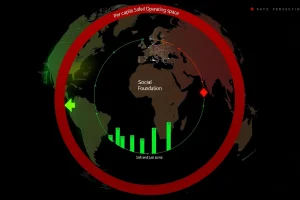
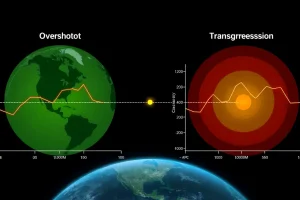
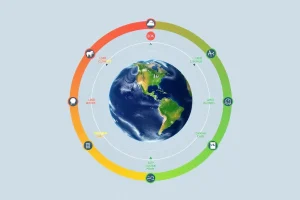
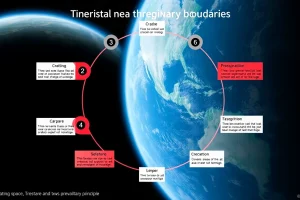
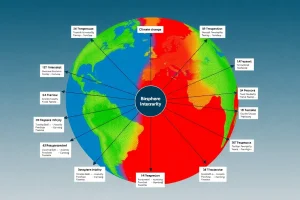
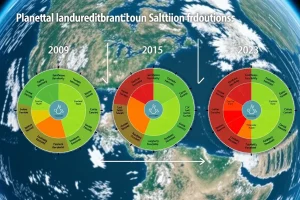
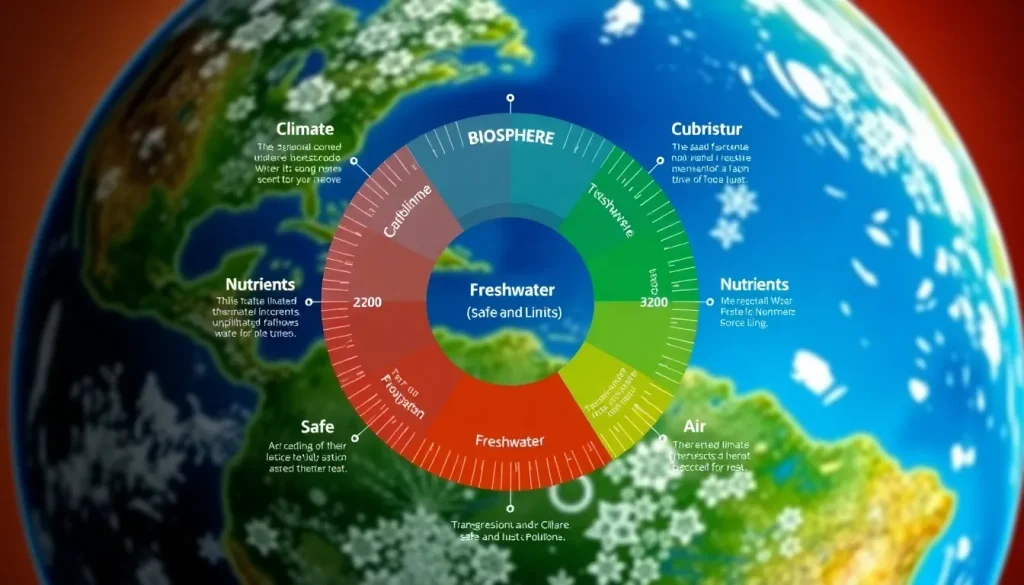
The safe and just Earth-system boundaries framework, published in 2023, reveals that humanity has already crossed multiple critical thresholds. Of the five domains assessed—climate, biosphere, freshwater, nutrients, and air pollution—the safe and just boundaries are transgressed for all except the global aerosol (air pollution) boundary, which is only transgressed in certain regions. This means that the Earth system is not only outside the safe operating space for many processes but also that billions of people are already experiencing significant harm due to environmental degradation. The most severe transgressions are seen in the biosphere (ecosystem integrity) and nutrient cycles, where the safe and just boundaries have been exceeded by large margins, indicating a high risk of irreversible changes and widespread human suffering.
Control variable
The safe and just Earth-system boundaries framework does not rely on a single control variable but rather a set of control variables for each of the five assessed Earth-system processes. These variables are chosen to capture both the stability of the Earth system (safe) and the protection of human populations from significant harm (just). The control variables are:
- Climate: Global mean surface temperature rise relative to pre-industrial levels, complemented by the degree of climate extremes (e.g., heat, drought) that cause significant human harm.
- Biosphere: The area of natural ecosystems remaining globally and within each biome, measured as a percentage of pre-industrial extent, to maintain biosphere function and ecosystem services.
- Freshwater: Surface water flow alterations and groundwater extraction volumes, assessed at sub-basin scales to avoid critical ecological and social thresholds.
- Nutrients: Surplus nitrogen and phosphorus from fertilizers applied to land, measured as the excess beyond crop uptake that leads to water pollution and ecosystem damage.
- Air pollution: Atmospheric concentration of fine particulate matter (PM2.5), which directly impacts human health and also affects regional climate and ecosystems.
Proposed boundary or threshold
The safe and just boundaries are defined as stricter limits than the original planetary boundaries, incorporating both Earth-system resilience and human well-being. The proposed boundaries are:
| Earth-system process | Safe boundary (Earth-system resilience) | Just boundary (human impact) | Integrated safe and just boundary |
|---|---|---|---|
| Climate | ≤1.5°C global warming | ≤1.0°C warming; or ≤1.5°C with adaptation limits | ≤1.0°C (already exceeded) |
| Biosphere (natural ecosystem area) | ≥50–60% of land and freshwater ecosystems intact | ≥50–60% of each biome intact to maintain ecosystem services | ≥50–60% intact; currently ~45–50% intact globally |
| Freshwater (surface water) | ≤20% alteration of monthly flow regimes | ≤20% alteration to avoid harm to aquatic life and human water security | ≤20% alteration; currently ~34% of global land area exceeds this |
| Freshwater (groundwater) | Extraction ≤ recharge rate | Extraction ≤ recharge rate to ensure access for communities | Extraction ≤ recharge; currently ~47% of sub-basins exceed this |
| Nutrients (nitrogen) | ≤62 Tg N/year surplus globally | ≤57 Tg N/year surplus to prevent eutrophication and drinking water pollution | ≤57 Tg N/year; current surplus ~119 Tg N/year |
| Nutrients (phosphorus) | ≤4.5–9 Tg P/year surplus globally | ≤4.5–9 Tg P/year surplus to avoid freshwater eutrophication | ≤4.5–9 Tg P/year; current surplus ~10 Tg P/year |
| Air pollution (PM2.5) | Annual mean ≤15 μg/m³ | Annual mean ≤15 μg/m³ (WHO guideline); or ≤10 μg/m³ for no-harm level | ≤15 μg/m³; currently exceeded in many urban areas globally |
Current measured value
As of 2023, the Earth system has transgressed the safe and just boundaries for multiple processes:
- Climate: Global warming has reached approximately 1.2°C above pre-industrial levels, exceeding the just boundary of 1.0°C and approaching the safe boundary of 1.5°C. Climate extremes already cause significant harm to human health, food security, and infrastructure.
- Biosphere: The global area of natural ecosystems has been reduced to about 45–50% of pre-industrial extent, below the safe and just boundary of 50–60%. Many biomes are far below this threshold, with tropical forests and grasslands particularly degraded.
- Freshwater (surface water): Approximately 34% of global land area experiences streamflow alterations exceeding the 20% boundary, affecting aquatic ecosystems and water availability for human use.
- Freshwater (groundwater): Around 47% of sub-basins globally are experiencing unsustainable groundwater extraction, leading to declining water tables and reduced baseflow to rivers.
- Nutrients (nitrogen): Global nitrogen surplus is estimated at 119 Tg N/year, more than double the safe and just boundary of 57 Tg N/year, causing widespread eutrophication and nitrate pollution of drinking water.
- Nutrients (phosphorus): Global phosphorus surplus is approximately 10 Tg P/year, exceeding the upper limit of the safe and just boundary (4.5–9 Tg P/year), leading to freshwater eutrophication and harmful algal blooms.
- Air pollution: While global average PM2.5 concentrations are near the safe boundary of 15 μg/m³, many regions—especially in Asia and Africa—experience levels far exceeding this, causing millions of premature deaths annually.
How the boundary is calculated
The safe and just boundaries are derived from a combination of Earth-system modeling, observational data, and assessments of human vulnerability. The methodology involves:
- Earth-system modeling: Global climate models, dynamic vegetation models, hydrological models, and nutrient cycling models are used to simulate the response of Earth-system processes to human pressures and to identify thresholds beyond which critical feedbacks (e.g., forest dieback, ice sheet collapse) may be triggered.
- Observational data: Satellite remote sensing, ground-based monitoring networks, and global databases provide current values for control variables such as temperature, ecosystem extent, river discharge, groundwater levels, nutrient loads, and aerosol concentrations.
- Human impact assessment: The just boundary is determined by evaluating the level of environmental change at which significant harm occurs to human health, livelihoods, food and water security, and exposure to extreme events. This involves integrating epidemiological studies, water scarcity indices, and assessments of ecosystem service degradation.
- Intersection of safe and just: The final boundary is set at the stricter of the safe (Earth-system) and just (human impact) limits. For example, the climate just boundary of 1.0°C is stricter than the safe boundary of 1.5°C, so the integrated boundary is 1.0°C.
- Downscaling: For processes like freshwater and air pollution, global boundaries are downscaled to regional or sub-basin scales to account for spatial heterogeneity in both Earth-system dynamics and human exposure.
Historical trend
Since the Industrial Revolution, human activities have progressively pushed Earth-system processes away from Holocene-like conditions. The historical trajectory shows:
- Climate: Global mean temperature has risen by about 1.2°C since 1850–1900, with most warming occurring after 1970. The rate of warming has accelerated in recent decades, and the 1.0°C just boundary was crossed around 2015.
- Biosphere: The extent of natural ecosystems has declined steadily over the past 300 years, with acceleration in the 20th century due to agricultural expansion, urbanization, and deforestation. The global intactness of ecosystems has fallen from near 100% in pre-industrial times to below 50% today.
- Freshwater: River flow alterations and groundwater extraction have increased dramatically since the mid-20th century, driven by dam construction, irrigation, and industrial use. The number of sub-basins exceeding the 20% alteration threshold has grown from negligible to over one-third of the global land area.
- Nutrients: The global surplus of nitrogen and phosphorus began to rise sharply in the 1950s with the widespread use of synthetic fertilizers. Nitrogen surplus has more than doubled since 1970, and phosphorus surplus has increased by about 50%.
- Air pollution: PM2.5 concentrations rose rapidly during industrialization in Europe and North America, peaked in the mid-20th century, and then declined due to air quality regulations. However, concentrations have risen steeply in Asia and Africa since the 1990s, offsetting global improvements.
What is driving the change
The primary drivers of transgression across all safe and just boundaries are human activities linked to population growth, economic development, and consumption patterns:
- Climate: Greenhouse gas emissions from fossil fuel combustion, deforestation, and agriculture are the dominant driver of global warming.
- Biosphere: Land-use change—particularly conversion of forests, grasslands, and wetlands to cropland, pasture, and urban areas—is the main cause of ecosystem loss and fragmentation.
- Freshwater: Water withdrawals for irrigation (accounting for ~70% of global freshwater use), industrial processes, and municipal supply, combined with dam construction and river channelization, alter flow regimes and deplete aquifers.
- Nutrients: The application of synthetic nitrogen and phosphorus fertilizers to croplands, along with manure from livestock, leads to large nutrient surpluses that run off into waterways or volatilize into the atmosphere.
- Air pollution: Emissions from fossil fuel combustion, industrial processes, residential heating and cooking, and agricultural burning are the main sources of PM2.5.
What crossing the boundary means
Transgressing a safe and just boundary implies that the Earth system is moving into a state of increased risk, where critical feedbacks and tipping points may be activated, and where human populations are already suffering significant harm. Consequences include:
- Climate: Beyond 1.0°C, extreme heat events, droughts, and floods become more frequent and intense, leading to mortality, crop failures, and displacement. Approaching 1.5°C increases the risk of triggering irreversible tipping points such as the collapse of the Greenland ice sheet or Amazon rainforest dieback.
- Biosphere: Loss of natural ecosystems reduces carbon sequestration, disrupts water cycles, and diminishes pollination and pest control services. It also accelerates biodiversity loss, undermining the resilience of the biosphere to future shocks.
- Freshwater: Altered river flows and groundwater depletion threaten water security for billions, reduce agricultural productivity, and degrade aquatic habitats, leading to loss of fisheries and increased conflict over water resources.
- Nutrients: Excess nutrients cause eutrophication of lakes, rivers, and coastal zones, creating dead zones, harmful algal blooms, and contamination of drinking water with nitrates, which is linked to cancer and other health issues.
- Air pollution: High PM2.5 levels are associated with respiratory and cardiovascular diseases, causing millions of premature deaths annually, and also affect regional climate by altering cloud formation and radiation balance.
Regional variations
The transgression of safe and just boundaries is highly uneven across the globe, with some regions far exceeding limits while others remain within them:
- Climate: Warming is amplified in the Arctic, where temperatures have risen more than twice the global average, and in many continental interiors. Small island developing states and low-lying coastal areas face existential threats from sea-level rise even at 1.2°C.
- Biosphere: Ecosystem loss is most severe in biodiversity hotspots such as Southeast Asia, the Amazon, and Central Africa, where deforestation rates are high. In contrast, some boreal and temperate regions have seen forest regrowth.
- Freshwater: Groundwater depletion is acute in major agricultural regions like the Indo-Gangetic Plain, the North China Plain, and the US High Plains. Surface water alterations are concentrated in heavily dammed river basins such as the Colorado, Yangtze, and Nile.
- Nutrients: Nutrient surpluses are highest in regions with intensive agriculture, including Western Europe, East Asia, and parts of North America, while sub-Saharan Africa often has nutrient deficits, leading to soil degradation.
- Air pollution: PM2.5 concentrations are highest in South Asia, East Asia, and parts of Africa, where industrial emissions, residential solid fuel use, and agricultural burning are prevalent. Many high-income countries have achieved concentrations below the safe boundary.
Interaction with other boundaries
The safe and just boundaries are deeply interconnected, and transgression of one can amplify pressures on others:
- Climate and biosphere: Deforestation and ecosystem loss reduce carbon sinks, accelerating climate change, while climate change increases the risk of forest fires and ecosystem degradation.
- Freshwater and climate: Groundwater depletion can reduce streamflow and wetland extent, affecting local climate regulation, while climate change alters precipitation patterns, exacerbating water scarcity.
- Nutrients and freshwater: Excess nutrients from agriculture run off into water bodies, causing eutrophication and degrading freshwater ecosystems, which in turn reduces their capacity to filter pollutants.
- Air pollution and climate: Some aerosols (e.g., black carbon) contribute to warming, while others (e.g., sulfates) have a cooling effect, but both harm human health. Reducing air pollution can unmask additional warming, highlighting trade-offs.
- Biosphere and freshwater: Loss of forests and wetlands disrupts the water cycle, reducing rainfall recycling and increasing flood risks, while water scarcity stresses ecosystems.
Impacts on people and ecosystems
The transgression of safe and just boundaries has direct and severe consequences for human well-being and the natural world:
- Human health: Heatwaves, air pollution, and waterborne diseases cause millions of premature deaths each year. Malnutrition and food insecurity rise due to crop failures and fishery collapses.
- Livelihoods and economies: Water scarcity, land degradation, and extreme weather events disrupt agriculture, industry, and infrastructure, leading to economic losses and displacement. The costs of adaptation and disaster recovery are escalating.
- Ecosystem services: The degradation of ecosystems reduces their ability to provide clean water, pollination, carbon storage, and flood regulation, undermining the natural capital upon which societies depend.
- Biodiversity: Habitat loss, pollution, and climate change are driving species extinctions at rates far above background levels, eroding the genetic diversity and functional integrity of ecosystems.
- Social equity: The impacts disproportionately affect vulnerable populations, including low-income communities, Indigenous peoples, and future generations, exacerbating global inequalities.
Possible pathways back toward the safe zone
Returning to within the safe and just boundaries requires transformative changes across multiple sectors:
- Climate: Rapidly phasing out fossil fuels, transitioning to renewable energy, enhancing energy efficiency, and scaling up carbon dioxide removal. Protecting and restoring forests and other carbon sinks is also critical.
- Biosphere: Halting deforestation and conversion of natural ecosystems, restoring degraded lands, and expanding protected areas. Implementing nature-based solutions and sustainable land management practices.
- Freshwater: Improving water-use efficiency in agriculture, reducing leakage in urban water systems, protecting and restoring wetlands and floodplains, and implementing groundwater management policies that limit extraction to sustainable levels.
- Nutrients: Increasing nitrogen and phosphorus use efficiency in agriculture through precision farming, reducing food waste, shifting diets toward less resource-intensive foods, and improving wastewater treatment to recover nutrients.
- Air pollution: Adopting stricter emission standards for industry and vehicles, promoting clean cooking and heating technologies, and reducing agricultural burning. Integrating air quality and climate policies to maximize co-benefits.
- Cross-cutting: Strengthening governance at all levels, incorporating safe and just boundaries into international agreements and national policies, and ensuring that transitions are equitable and just for all communities.
Scientific uncertainty
The safe and just boundaries framework involves several layers of uncertainty:
- Threshold identification: The precise level at which Earth-system tipping points are triggered or significant human harm occurs is not always known with high confidence. For example, the exact warming level that destabilizes the Greenland ice sheet is estimated between 0.8°C and 3.0°C.
- Model limitations: Earth-system models have incomplete representations of complex feedbacks, such as permafrost carbon release or cloud-aerosol interactions, leading to uncertainty in boundary values.
- Data gaps: Monitoring of some control variables (e.g., groundwater extraction, ecosystem intactness) is sparse in many regions, making global assessments uncertain.
- Human impact assessment: Quantifying the level of environmental change that causes “significant harm” involves value judgments and varies across contexts, making the just boundary inherently more subjective than the safe boundary.
- Interactions: The coupled nature of boundaries means that transgressing one may alter the safe level of another, but these interactions are not fully quantified.
Criticism and alternative frameworks
The safe and just boundaries concept has generated scientific debate and alternative perspectives:
- Criticism of the planetary boundaries framework: Some researchers argue that the global, top-down approach oversimplifies regional heterogeneity and may not be actionable at local scales. Others question the existence of clear global thresholds for processes like biodiversity loss or land-use change.
- Just boundary subjectivity: The integration of justice criteria has been criticized for introducing normative judgments into what was originally a biophysical framework. Defining “significant harm” is inherently political and context-dependent.
- Alternative frameworks: The “doughnut economics” model (Raworth, 2017) combines planetary boundaries with social foundations, creating a safe and just space for humanity. The “Earth system justice” approach emphasizes procedural and distributive justice in boundary setting. The “planetary health” concept focuses on the human health impacts of environmental change without prescribing global limits.
- Operationalization challenges: Translating global boundaries into national or corporate targets remains difficult, and some argue for a focus on resource footprints or consumption-based accounting rather than global aggregate limits.
FAQ
What is the difference between a safe boundary and a just boundary?
A safe boundary is the level of human pressure that maintains Earth-system stability and avoids triggering irreversible tipping points. A just boundary is the level that prevents significant harm to human populations, such as health impacts, loss of livelihoods, or displacement. The integrated safe and just boundary is the stricter of the two, ensuring both a stable planet and protection for people.
How many safe and just boundaries have been crossed?
As of 2023, the safe and just boundaries for climate, biosphere, freshwater, and nutrients have been transgressed globally. The air pollution boundary is transgressed in many regions but not globally. This means that billions of people are already experiencing harm from environmental changes.
Why is the just boundary for climate set at 1.0°C instead of 1.5°C?
The just boundary of 1.0°C is based on evidence that significant human harm—such as increased mortality from heatwaves, reduced crop yields, and water stress—is already occurring at current warming levels (~1.2°C). The 1.5°C limit is a safe boundary for Earth-system stability, but the just boundary is stricter to protect vulnerable populations.
References
- Rockström, J., et al. (2023). Safe and just Earth system boundaries. Nature, 619, 102–111.
- Steffen, W., et al. (2015). Planetary boundaries: Guiding human development on a changing planet. Science, 347(6223), 1259855.
- Richardson, K., et al. (2023). Earth beyond six of nine planetary boundaries. Science Advances, 9(37), eadh2458.
- Raworth, K. (2017). Doughnut Economics: Seven Ways to Think Like a 21st-Century Economist. Random House.
- IPCC (2021). Climate Change 2021: The Physical Science Basis. Contribution of Working Group I to the Sixth Assessment Report.