In brief
At a glance
Quick Facts
- Status
- Not applicable; compensation is not a boundary but a concept within the framework
- Control variable
- Multiple boundaries, each with its own control variable (e.g., CO₂ concentration, extinction rate, forest area)
- Proposed boundary
- No single boundary; all nine must be respected simultaneously
- Current value
- Six of nine boundaries transgressed as of 2023 assessment
- Pre-industrial baseline
- Holocene-like conditions for all boundaries (e.g., 280 ppm CO₂, pre-industrial extinction rates)
Current status
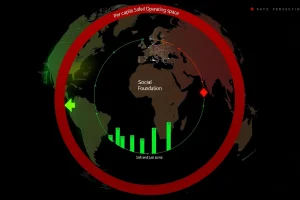
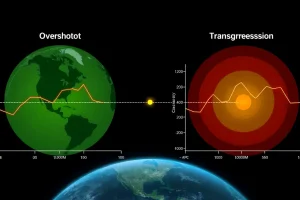
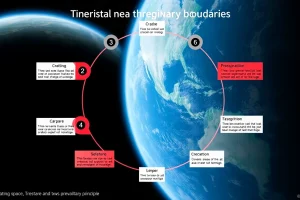
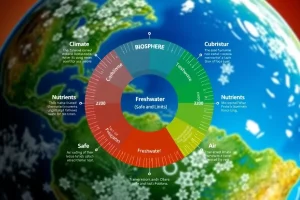
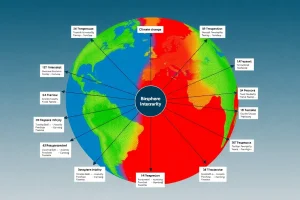
The planetary boundaries framework defines a safe operating space for humanity based on nine critical Earth-system processes. The question of whether staying within one boundary can compensate for transgressing another is fundamentally at odds with the framework’s design. Each boundary is independent and non-fungible; exceeding one cannot be offset by improvements in another. As of the most recent assessment (Richardson et al., 2023), six of the nine boundaries are already transgressed, indicating that humanity is moving further away from a safe state, not compensating across boundaries.
Control variable
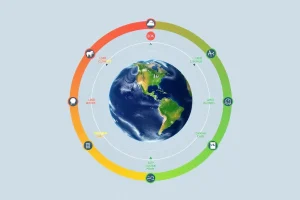
The planetary boundaries framework does not have a single control variable. Instead, it identifies nine separate boundaries, each with its own control variable(s) that measure the state of a critical Earth-system process. These include: climate change (atmospheric CO₂ concentration and radiative forcing), biosphere integrity (genetic diversity and functional integrity), land-system change (area of forested land), freshwater change (blue and green water consumption), biogeochemical flows (global nitrogen and phosphorus cycles), ocean acidification (surface aragonite saturation state), atmospheric aerosol loading (aerosol optical depth), stratospheric ozone depletion (ozone concentration), and novel entities (no single control variable yet). The concept of compensation would require a common metric across these diverse processes, which does not exist.
Proposed boundary or threshold
The planetary boundaries framework proposes a safe operating space defined by all nine boundaries simultaneously. There is no aggregate boundary or threshold that allows for trade-offs between them. Each boundary has its own proposed limit (e.g., climate change boundary at 350 ppm CO₂ and +1.0 W/m² radiative forcing; biosphere integrity at <10 extinctions per million species-years). The framework explicitly rejects the idea that transgressing one boundary can be compensated by staying well within another, because each boundary represents a unique, non-substitutable Earth-system function.
Current measured value
As of the 2023 update, six boundaries are assessed as transgressed: climate change (CO₂ ~417 ppm, radiative forcing ~2.91 W/m²), biosphere integrity (genetic diversity: extinction rate >100 extinctions per million species-years; functional integrity: declining), land-system change (global forest area below boundary), freshwater change (both blue and green water boundaries transgressed), biogeochemical flows (nitrogen and phosphorus cycles severely disrupted), and novel entities (boundary transgressed). The remaining three boundaries (ocean acidification, atmospheric aerosol loading, stratospheric ozone depletion) are currently within safe limits, but this does not compensate for the transgressed boundaries.
How the boundary is calculated
The planetary boundaries framework is not a single calculable boundary but a set of nine Earth-system processes, each with its own methodology. For each process, scientists identify a control variable, a proposed safe boundary value (often based on Holocene variability or known thresholds), and a zone of increasing risk. The overall safe operating space is defined as the intersection of all nine safe zones. There is no formula for compensation because the boundaries are incommensurable—they measure fundamentally different aspects of the Earth system, such as chemical pollution, biodiversity loss, and climate forcing. The framework uses Earth-system models, paleo-data, and contemporary observations to define each boundary independently.
Historical trend
Since the planetary boundaries framework was first published in 2009, the number of transgressed boundaries has increased from three to six. In 2009, climate change, biosphere integrity, and nitrogen cycle were identified as transgressed. By 2015, land-system change was added. The 2023 update found that freshwater change and novel entities had also been crossed. This trend shows that humanity is not compensating for transgressions in one area by improving another; instead, pressures on multiple boundaries are increasing simultaneously due to interconnected drivers like population growth, consumption, and technological changes.
What is driving the change
The idea that one boundary could compensate for another often arises from policy or economic thinking that treats environmental impacts as fungible. However, Earth-system science shows that the drivers of boundary transgression—such as greenhouse gas emissions, land-use change, and nutrient pollution—are often coupled. For example, agricultural expansion simultaneously drives climate change (via deforestation), biosphere integrity loss (habitat destruction), freshwater use, and nitrogen/phosphorus loading. Attempts to mitigate one pressure (e.g., bioenergy crops to reduce CO₂) can exacerbate others (land-use change, water use, fertilizer pollution), demonstrating that simple compensation is not feasible.
What crossing the boundary means
Crossing a planetary boundary increases the risk of triggering non-linear, abrupt, or irreversible changes in the Earth system. Because boundaries interact, transgressing one can push others closer to their thresholds. For instance, climate change amplifies biosphere integrity loss through habitat shifts and ocean acidification. The framework warns that crossing multiple boundaries could destabilize the entire Earth system, potentially leading to a state less hospitable to human societies. Compensation is not possible because the system is interconnected; a safe climate cannot offset a collapsed biosphere.
Regional variations
Several planetary boundaries operate at sub-global scales, meaning that transgressions can occur regionally even if the global average is within the safe limit. For example, freshwater use and land-system change are assessed at both global and regional (e.g., river basin) scales. A regional transgression cannot be compensated by a surplus elsewhere, because the impacts are localized and can trigger regional tipping points (e.g., Amazon dieback, monsoon disruption). The framework emphasizes that all regional boundaries must be respected to maintain Earth-system resilience.
Interaction with other boundaries
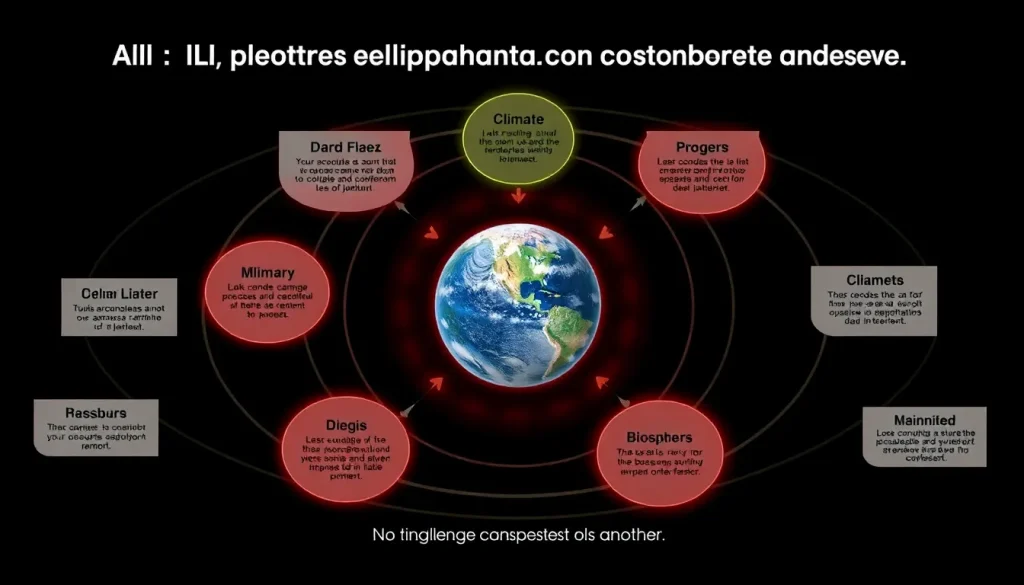
Planetary boundaries are highly interconnected, and transgressing one often amplifies the pressure on others. For example, climate change exacerbates ocean acidification, biosphere integrity loss, and freshwater change. Land-system change contributes to climate change, biodiversity loss, and disruption of biogeochemical flows. These interactions mean that staying within one boundary while transgressing another is not a stable state; the transgressed boundary can push others across their thresholds. The framework highlights that respecting all boundaries is necessary to avoid cascading effects.
Impacts on people and ecosystems
The non-compensability of planetary boundaries has direct consequences for human well-being. Transgressing multiple boundaries increases the risk of food and water insecurity, extreme weather events, disease emergence, and economic disruption. Ecosystems lose their capacity to provide services such as pollination, carbon sequestration, and water purification. Because these services are not interchangeable, a loss in one cannot be offset by gains in another. The most vulnerable populations, often in low-income regions, bear the brunt of these compounded impacts.
Possible pathways back toward the safe zone
Returning to a safe operating space requires simultaneous reductions in pressures across all transgressed boundaries. This involves systemic transformations in energy, food, and economic systems. Strategies include decarbonization, sustainable agriculture, circular economies, and conservation of biodiversity. The framework does not support trading off one boundary for another; instead, it calls for integrated approaches that address multiple boundaries at once, such as agroecology, which can reduce nitrogen pollution, enhance biodiversity, and sequester carbon.
Scientific uncertainty
There are significant uncertainties in the precise position of each boundary, the interactions between them, and the thresholds for irreversible change. The framework is a heuristic tool, not a precise predictive model. The concept of compensation is further complicated by unknown feedbacks and tipping cascades. Some scientists argue that the boundaries are too simplistic or that the safe limits may be more flexible than proposed. However, the precautionary principle underpins the framework: given the risk of catastrophic outcomes, compensation is not a prudent strategy.
Criticism and alternative frameworks
Critics of the planetary boundaries framework have argued that it is overly rigid and does not account for regional heterogeneity or technological innovation. Some propose alternative concepts like “planetary opportunities” or “doughnut economics,” which integrate social and environmental boundaries. However, even these alternatives do not suggest that environmental boundaries are fungible. The scientific consensus remains that Earth-system processes have distinct thresholds, and respecting all of them is essential for long-term stability. The idea of compensation is more common in economic or political discourse than in Earth-system science.
FAQ
Can we offset climate change by improving biodiversity?
No. Climate change and biodiversity loss are separate planetary boundaries with distinct control variables and thresholds. While there are interactions (e.g., forests sequester carbon), improving biodiversity cannot compensate for exceeding the climate boundary because the Earth system does not treat these processes as interchangeable. Both must be kept within safe limits to avoid destabilizing feedbacks.
Does the planetary boundaries framework allow for trade-offs between boundaries?
The framework does not support trading off one boundary for another. It emphasizes that all boundaries must be respected to maintain a safe operating space. However, it acknowledges that human activities often create trade-offs; for example, bioenergy production can reduce CO₂ emissions but increase land-use change and water consumption. The framework calls for managing these trade-offs to stay within all boundaries simultaneously, not compensating one transgression with another.
What happens if multiple planetary boundaries are crossed?
Crossing multiple boundaries increases the risk of triggering tipping points and cascading effects that could destabilize the Earth system. For instance, climate change can accelerate biodiversity loss, which in turn reduces the biosphere's capacity to regulate climate. This can lead to a less predictable and less hospitable planet, with severe consequences for human societies, including food and water insecurity, extreme weather, and economic disruption.
References
- Rockström, J., et al. (2009). A safe operating space for humanity. Nature, 461, 472-475.
- Steffen, W., et al. (2015). Planetary boundaries: Guiding human development on a changing planet. Science, 347(6223), 1259855.
- Richardson, K., et al. (2023). Earth beyond six of nine planetary boundaries. Science Advances, 9(37), eadh2458.
- Lade, S. J., et al. (2020). Human impacts on planetary boundaries amplified by Earth system interactions. Nature Sustainability, 3, 119-128.
- Rockström, J., et al. (2023). Safe and just Earth system boundaries. Nature, 619, 102-111.